
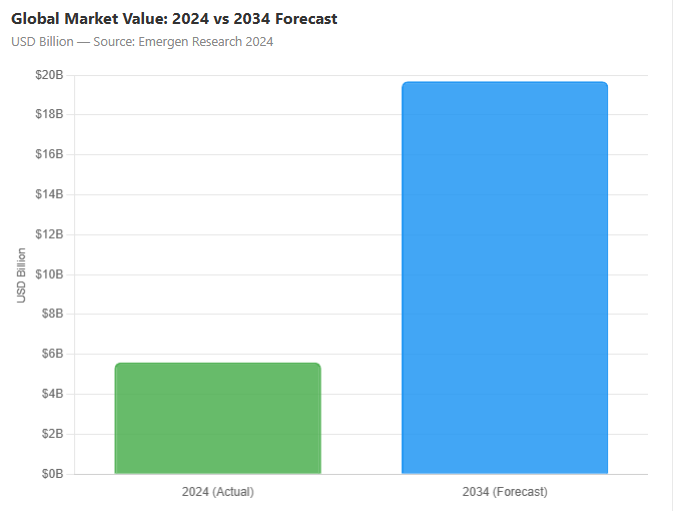
Across Latin America, an estimated 60 million people still live without reliable access to public lighting -and in peri-urban fringes from the Amazon basin to the Mexican highlands, grid-connected street lights are either technically unfeasible or economically out of reach. This single infrastructure gap costs communities in lost safety, stunted local commerce, and preventable road accidents every year. In response, solar street lighting in Latin America is no longer a niche pilot technology: it now commands approximately 8% of the global solar LED street lighting market -a market valued at USD 5.60 billion in 2024 and forecast to reach nearly USD 19.70 billion by 2034 at a compound annual growth rate (CAGR) of 13.4%.
For city planners, EPC (engineering, procurement and construction) contractors, procurement officers, and facility managers operating across Brazil, Mexico, Colombia, Chile, and beyond, 2026 is a pivotal year. Multilateral funding is accelerating, technology benchmarks are rising, and the total cost of ownership (TCO) case for solar lighting over grid-connected alternatives has never been stronger. This blog unpacks the key market trends, country-level project insights, technology requirements specific to the region’s climate, and the procurement intelligence every decision-maker needs.
The Latin American Solar Advantage: Why This Region Is Built for Solar Street Lighting
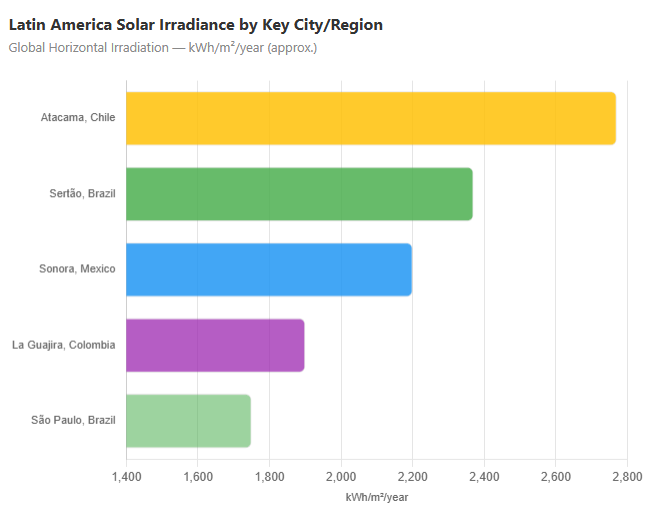
Latin America possesses one of the most compelling natural advantages for solar energy deployment anywhere on earth: exceptional solar irradiance. Brazil’s northeast interior -the Sertão region spanning Bahia, Piauí and Ceará -records global horizontal irradiation (GHI) values of 5.0 to 6.5 kWh/m² per day, placing it on par with Australia’s outback. Chile’s Atacama Desert records peak GHI values of up to 2,770 kWh/m² annually -the highest solar irradiation measured anywhere on the planet. Mexico’s Chihuahua, Sonora Desert, and Central Plateau regions regularly yield above 2,200 kWh/kWp annually, making solar the cheapest power source in the country at below USD 0.049 per kWh for utility-scale installations.
For solar street lighting specifically, high irradiance directly translates into reliable daily battery charging cycles, shorter system sizing requirements, and reduced backup day capacity needs. A well-designed solar street light in São Paulo or Bogotá, for instance, requires only 3 to 5 days of battery backup capacity -far less than equivalent systems deployed in Central Europe. This means leaner system sizing, lower capital cost per unit, and faster return on investment.
The region also benefits from relatively stable seasonal daylight hours across tropical latitudes, reducing the worst-case scenario for battery depletion that engineers must design around in northern markets. When combined with the region’s rapidly expanding renewable policy environment -Latin American governments collectively aim to meet 70% of total energy consumption from renewables by 2030 -the structural tailwinds for solar street lighting investment are unmistakable. Understanding how to capture these advantages through technically sound specifications is where projects succeed or fail.
Country-Level Trends: Where Projects Are Happening in 2026
Brazil is the dominant force in the Latin American solar LED street lighting market and among the top six countries globally by installed solar capacity, reaching over 50 GW in 2024. Brazil’s Nationally Determined Contribution (NDC) targets a 37% reduction in greenhouse gas emissions by 2025 and net-zero by 2060, with the public lighting sector playing a key role. The New Development Bank’s Brasília Capital of Solar Lighting Project directly targets a 50% reduction in public lighting energy consumption in the Federal District through LED replacement, while Law No. 6891/2021 mandates that 50% of Federal District public building energy consumption must come from renewables by end-2026. BNDES, Brazil’s national development bank, announced a BRL 20 billion green credit programme in 2024 specifically targeting solar and wind generation, and the IFC committed USD 150 million in January 2025 to expand solar energy financing through BV bank.
Colombia installed 1.6 GW of solar in 2024, bringing cumulative capacity to 1.87 GW -a jump from just 1.5% of the energy matrix in 2022 to approximately 9% in 2024. In October 2025, Colombia approved COP 8.35 trillion (approximately USD 2.1 billion) for the Colombia Solar programme, targeting 1.3 million low-income households with photovoltaic self-generation systems between 2026 and 2030. Urban street lighting beneficiaries include Bogotá, Cali, and Soacha, where the Techo Colombia initiative has already deployed solar streetlights in informal settlements. Colombia’s accelerated environmental licensing process, introduced in 2025, cuts approval timelines by up to 70% for solar projects between 10 MW and 100 MW.
Mexico is targeting between 6.4 GW and 9.5 GW of new renewable capacity under its Prosener 2025–2030 plan, with 96% of new additions projected from solar and wind. Distributed solar capacity rose by 1.09 GW in 2024 alone, reaching 4.42 GW cumulatively. Municipal solar street lighting tenders have been active in city parks, industrial corridors, and highway perimeters, though policy uncertainty around CFE’s (Comisión Federal de Electricidad’s) grid priority rules continues to create risk for larger private-sector projects.
Chile has solar accounting for 22% of total power generation in the first eight months of 2025, the second-highest share in Latin America. The government’s Ley de Descarbonización Acelerada, announced in June 2025, aims to close remaining coal-fired plants by 2035. Off-grid and standalone solar street lighting projects are accelerating, particularly in the northern Atacama corridor and in peri-urban communities that sit at the end of long, congested distribution lines.
Climate Considerations: Specifying Solar Street Lights for Latin American Conditions
Specifying solar street lighting systems for Latin America demands a fundamentally different engineering lens from temperate markets. The region spans tropical rainforest, coastal humidity, semi-arid desert, high-altitude Andean plateau, and subtropical savanna -each presenting distinct challenges for panel efficiency, battery performance, housing integrity, and LED thermal management.
Solar panel efficiency under heat stress is a critical concern. Generic polycrystalline panels rated at 15–17% efficiency under standard test conditions (STC, measured at 25°C cell temperature) can lose 0.3% to 0.5% output per degree Celsius above 25°C. In Brazil’s northeast or Mexico’s desert states, ambient temperatures routinely exceed 40°C, meaning panel temperatures can reach 70–80°C and efficiency losses of 22–27% are common with standard products. German-engineered monocrystalline panels rated at 21–23% efficiency under STC, combined with superior heat dissipation from die-cast aluminium housings, sustain performance advantages that compound over a 10-year asset life.
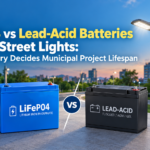
Battery chemistry is the most consequential specification decision in tropical deployments. Lead-acid batteries, still common in low-cost procurement, degrade rapidly under daily deep-discharge cycling in ambient temperatures above 30°C and typically last only 300–500 cycles or 2–4 years in the field. By contrast, LiFePO4 (lithium iron phosphate) batteries -the standard in German-engineered systems -deliver 2,000 to 3,000 charge-discharge cycles and a calendar life of 8 to 12 years. In hot climates, LiFePO4’s strong iron-phosphate lattice chemistry provides inherent thermal stability and resistance to thermal runaway, and fully sealed IP67-rated housings prevent the corrosive moisture ingress that rapidly destroys exposed battery terminals in coastal and high-humidity environments.
LED thermal management is the third major variable. At 50°C ambient temperature -routinely seen across lowland Latin America from June to August -generic solar street lights using plastic or thin-metal housings allow LED junction temperatures to exceed 100°C, dramatically shortening LED life from a rated 50,000 hours to as little as 20,000–30,000 hours in practice. German-engineered aluminium die-cast housings, designed to dissipate heat efficiently, maintain LED junction temperatures at or below 85°C even in 50°C ambient conditions -preserving the full 50,000-hour rated lifespan and 160–180 lm/W LED efficacy.
The MPPT charge controller (Maximum Power Point Tracking) is another specification that significantly impacts performance in variable-cloud-cover environments common to tropical Latin America. An MPPT controller extracts 25–30% more energy from the solar panel than a PWM (Pulse Width Modulation) controller under partial shading or variable irradiance conditions -the difference between a system that maintains reliable performance through rainy season and one that undercharges its battery and fails prematurely.
For regions with seasonal rain and cloud cover -including Colombia’s Pacific coast, Brazil’s Amazon basin, and parts of Central America -specifying a minimum of 3 to 5 consecutive days of battery backup capacity is essential. For monsoon-adjacent environments, 5 to 7 days is the German-engineering recommendation.
Procurement and Financing Frameworks: Accessing Multilateral Funding in 2026
One of the most significant shifts driving solar street lighting adoption across Latin America in 2024–2026 is the expansion of multilateral financing mechanisms and public-private partnership (PPP) frameworks that reduce the upfront capital barrier. Understanding these frameworks is essential for EPC contractors and municipal procurement officers.
The Inter-American Development Bank (IDB) and IDB Invest have committed portfolio-wide alignment with sustainable infrastructure across all 26 Latin American and Caribbean member countries, with the IDB Group’s country strategy for Brazil for 2024–2027 explicitly prioritising climate change, clean energy infrastructure, and poverty reduction. The International Finance Corporation (IFC) committed USD 150 million to Brazil in January 2025 specifically for solar financing expansion. The New Development Bank’s Brasília Solar Lighting Project demonstrates how multilateral capital can be directly channelled into public street lighting infrastructure.
For EPC contractors pursuing projects with multilateral development bank (MDB) financing -particularly under IDB, World Bank, or ADB procurement frameworks -understanding certification and quality requirements is essential. Procurement specifications increasingly require IEC 62133 battery certification, TÜV or equivalent third-party panel testing, IP67 ingress protection verified by an accredited laboratory (not self-declared), and IK08 or above impact ratings for pole-mounted fixtures. As detailed in our guide to ADB and World Bank solar street light procurement in 2026, MDB-funded tenders have moved substantially toward merit-point criteria (MPC) frameworks that reward technical quality alongside price.
The FIDIC EPC contract requirements for solar street light projects have become particularly relevant in Latin America, where Brazil, Chile, and Colombia regularly use FIDIC Silver Book contracts for infrastructure tenders. Contractors who understand the specific performance guarantee structures applicable to solar lighting assets -particularly around battery state-of-health and luminaire efficacy degradation -are significantly better positioned to win and execute bankable projects. For contractors navigating local content requirements, our analysis of local content requirements in solar street light tenders provides a practical framework applicable to Brazilian and Colombian public procurement law.
Green bond financing is also opening new channels. Brazil’s sustainable bond market exceeded BRL 60 billion in 2024, with the energy sector accounting for 47% of total issuance. Municipal issuers in São Paulo, Fortaleza, and Curitiba have begun using green bond structures to fund energy efficiency upgrades including street lighting conversions.
Total Cost of Ownership: The 10-Year Case for Premium-Specification Systems
For procurement officers and city finance departments evaluating solar street lighting investments in Latin America, the purchase price comparison between a German-engineered system and a generic low-cost alternative is misleading without a full 10-year TCO analysis.
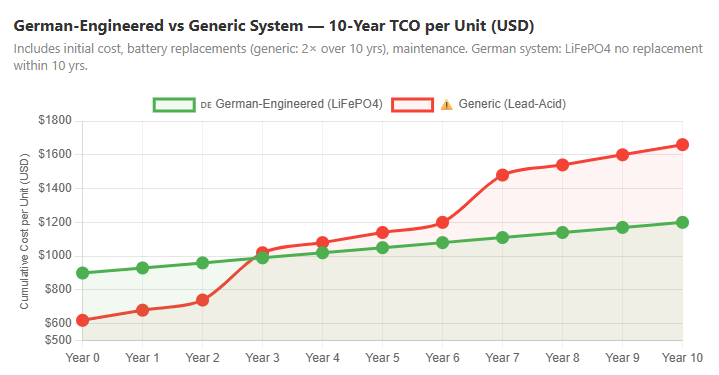
Consider a typical 60W solar street light installation at a Latin American municipality. A generic system using lead-acid batteries, a PWM charge controller, and a polycrystalline 15–17% efficiency panel might carry an ex-works price 30–40% below a German-engineered equivalent. However, the lead-acid battery will require replacement every 2–4 years under tropical cycling conditions -generating 2 to 3 replacement events over a 10-year period, each requiring procurement, logistics, labour, and disposal. Over 10 years, the total ownership cost of the generic system is typically 2 to 3 times higher than the premium system.
The LiFePO4 battery in a German-engineered system, rated for 2,000–3,000 cycles and 8–12 years calendar life, eliminates those replacement cycles entirely within a standard 10-year asset evaluation window. The MPPT charge controller adds a further 25–30% energy yield improvement over PWM alternatives, directly reducing battery stress and extending system life in variable-irradiance conditions. With LED efficacy of 160–180 lm/W versus 100–120 lm/W in generic systems, fewer watts are required to achieve the same lux level on the road surface -enabling smaller battery sizing, smaller panel sizing, and lower initial capital cost for equivalent photometric performance.
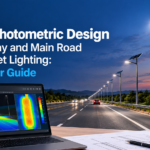
For projects designed to IEC and DIN street lighting standards, the ability to accurately calculate pole spacing and achieve target lux levels -commonly 10–15 lux average for residential roads and 20–30 lux for arterial roads -depends entirely on reliable luminaire performance data. Generic products often cannot provide independently verified IES photometric files, making DIALux simulation impossible and leaving contractors exposed to post-installation performance disputes.
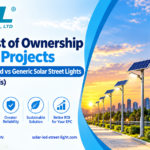
Our detailed analysis of total cost of ownership for EPC projects provides a full 10-year TCO model with worked examples that procurement teams can adapt directly for Latin American project conditions. For any project valued above USD 500,000, the financial case for German-engineered specification is overwhelming.
Smart Technology Integration: The Next Wave of Solar Street Light Deployments
The 2026 frontier for solar street lighting in Latin America is not simply replacing grid-connected fixtures with solar units -it is integrating intelligent control systems that enable municipalities to manage entire lighting networks remotely and reduce energy consumption further through adaptive dimming.
Smart solar street lights equipped with 4G/LTE or NB-IoT (Narrowband IoT) communication modules allow city operations centres to monitor battery state of health, luminaire lumen output, fault conditions, and energy consumption in real time -for every fixture across a network of thousands of units. This capability is particularly valuable in Latin America, where municipal maintenance budgets are constrained and the cost of rolling field crews to remote peri-urban or rural installations is significant. Predictive maintenance -triggering a service visit only when battery capacity drops below 80% or LED lumen depreciation exceeds 20% -dramatically reduces operational expenditure compared to time-based maintenance schedules.
Adaptive dimming using motion sensors or pre-programmed dimming profiles is already standard in German-engineered systems. A typical profile dims the luminaire to 30–40% output between midnight and 5 AM -hours of minimal pedestrian or vehicle movement -extending battery backup capacity by effectively adding 1.5 to 2 full nights of additional reserve. In practical terms, this converts a 3-day backup system into the equivalent of a 4.5-day backup system with no hardware change, solely through intelligent energy management.
The 7 benefits of all-in-one solar street light technology are particularly relevant in Latin American deployments: the integrated design eliminates exposed cable runs and external battery boxes that are prime targets for theft -a persistent project risk in informal settlements and remote corridors across Brazil, Colombia, and Mexico. All-in-one units with anti-tamper pole mounting and IP67 sealed enclosures represent best practice for these conditions. The 9 benefits of solar light remote control technology further details how remote monitoring capabilities directly reduce total lifecycle maintenance cost.
For large-scale EPC deployments -particularly those financed by multilateral lenders with performance bond requirements -the ability to demonstrate real-time luminaire health data through a monitoring dashboard is increasingly a contractual requirement under output-based aid (OBA) and results-based financing (RBF) frameworks. Selecting a solar street lighting system with integrated telemetry from the outset eliminates costly retrofit requirements later.
Capturing the Latin American Opportunity with the Right Specification
Latin America’s solar street lighting market is at an inflection point. The combination of exceptional solar resources, accelerating multilateral financing, ambitious national renewable energy policies across Brazil, Colombia, Mexico, and Chile, and a growing body of procurement expertise creates conditions for large-scale, sustained deployment. The global solar LED street lighting market’s trajectory -from USD 5.60 billion in 2024 to a projected USD 19.70 billion by 2034 -will be shaped in large part by how effectively Latin America converts its natural advantages into well-executed infrastructure projects.
Three takeaways stand above all others for decision-makers. First, climate-appropriate specification is not optional: tropical heat, humidity, and seasonal rain create failure modes for generic systems that destroy project economics within 2–4 years. LiFePO4 batteries, MPPT controllers, IP67-rated housings, and monocrystalline panels are minimum requirements for bankable Latin American projects, not premium add-ons. Second, TCO thinking must replace unit-price comparison in procurement evaluation -the 10-year cost difference between a premium and generic system can reach 2 to 3 times the initial price differential. Third, multilateral financing is available and growing, but accessing it requires systems that meet international certification standards verified by accredited third parties.
For expert consultation on solar LED street lighting solutions engineered to perform across Latin American climates and designed to meet international procurement standards, visit solar-led-street-light.com or contact our team for a customised project quote and technical specification review.
Frequently Asked Questions
1. What solar panel efficiency should I specify for projects in tropical Latin America?
For projects in Brazil, Colombia, coastal Mexico, or Central America, specify a minimum 21% efficient monocrystalline panel -ideally 21–23% as found in German-engineered systems. Standard polycrystalline panels rated at 15–17% efficiency lose a further 22–27% output in ambient temperatures above 40°C, meaning real-world energy yield will be severely below the design assumption. Monocrystalline panels with better temperature coefficients maintain closer to rated output under heat stress, directly affecting battery charge reliability.
2. How many backup days of battery capacity should I specify in Latin American projects?
For most tropical and subtropical regions in Latin America -including Colombia, coastal Brazil, and southern Mexico -specify a minimum of 3 to 5 consecutive cloudy-day backup capacity. For high-humidity Amazon basin locations or areas with monsoon-adjacent rainy seasons, specifying 5 to 7 days of backup capacity is recommended. German-engineering practice also includes adaptive dimming profiles that effectively extend backup duration by reducing nighttime energy demand during off-peak hours.
3. Why is LiFePO4 battery chemistry so important for Latin American solar street lighting projects?
Lead-acid batteries -still common in low-cost procurement -typically last only 300–500 cycles or 2–4 years under tropical conditions involving daily deep discharge and ambient temperatures above 30°C. LiFePO4 batteries deliver 2,000–3,000 cycles and an 8–12 year calendar life under the same conditions. For a 10-year project evaluation period, this eliminates 2–3 battery replacement events that would otherwise double or triple total ownership costs.
4. What certifications should I require from solar street light suppliers for MDB-funded Latin American tenders?
At minimum, require IEC 62133 certification for batteries, IEC 62471 or IEC 60598 for luminaires, TÜV or equivalent third-party solar panel testing documentation, IP67 ingress protection verified by an accredited laboratory, and IK08 or above impact resistance. For World Bank or IDB-funded projects, also request ISO 9001 manufacturing quality certification and a forced labour / supply chain compliance declaration. Self-declared ratings without independent test reports should not be accepted in formal tenders.
5. How does smart dimming improve solar street light performance in Latin American municipalities?
Smart dimming typically operates on a pre-programmed schedule or motion sensor trigger, reducing output to 30–40% during late-night hours of minimal activity. This reduces energy draw by 60–70% during the dimming period, extending effective battery backup by an equivalent of 1.5 to 2 additional nights per cycle. Over a 10-year asset life, this reduces battery depth-of-discharge stress, meaningfully extending LiFePO4 battery life beyond the rated cycle count. Municipalities also benefit through reduced carbon output and near-zero operational electricity costs.
6. Can German-engineered solar street lights withstand the corrosive coastal humidity found in Brazilian and Colombian port cities?
Yes -provided the specification includes IP67-rated fully sealed housings (not IP65, which permits limited water ingress) verified by an accredited laboratory, die-cast aluminium corrosion-resistant enclosures, and nickel-plated copper battery interconnects. Generic products frequently feature self-declared IP65 ratings using plastic housings that degrade under sustained UV and salt-air exposure within 2–3 years. German-engineered systems with IK08 impact ratings and IP67 sealed enclosures are specifically designed to withstand coastal tropical environments for the full 8–12 year battery life.
7. What is the typical payback period for solar street lighting investments in Latin American municipalities?
Payback periods vary by country, electricity tariff, and system quality, but for well-specified German-engineered systems in Brazil, Colombia, or Mexico, typical payback periods range from 4 to 7 years based on displaced grid electricity costs and eliminated maintenance expenditure. After payback, the operational cost is near-zero for the remaining 3–6 years of the evaluation window, generating a highly favourable net present value (NPV). Generic low-cost systems with frequent battery replacements frequently fail to achieve payback within their actual operational life.
8. How should EPC contractors approach local content requirements in Brazilian solar street lighting tenders?
Brazil’s public procurement law (Lei 14.133/2021) and sector-specific regulations increasingly incorporate local content scoring, particularly in federally funded infrastructure tenders. EPC contractors should evaluate whether local assembly of luminaire components, battery packing, or pole fabrication is required or scored. Our detailed analysis of local content requirements in solar street light procurement provides a practical framework. In practice, the most defensible approach is to partner with a supplier whose components carry internationally recognised quality certifications -since local content requirements rarely override minimum quality thresholds in MDB-funded tenders.