
Solar lighting infrastructure is often sold on the promise of ‘set it and forget it’ efficiency. However, seasoned facility managers and government planners know that even the most advanced systems have a vulnerability: the point of detection.
Even though reports indicate that solar street lights can decrease maintenance expenses by about 50-60%, that ROI evaporates the moment your sensors stop making sense of the environment. It’s a headache no project manager wants, yet it’s more common than you’d think.
In this blog, we will explain the common causes for solar motion sensor light repair and how to fix solar light sensors.

Common Causes of Motion Sensor Light Failure
In the context of solar street lights, the issue rarely stems from a single catastrophic failure. Instead, it is often a combination of environmental factors and component fatigue. Here are the most common culprits:
- Environmental Degradation
Accumulation is the silent killer of sensor responsiveness for street lights on busy roads or in industrial areas. The PIR (Passive Infrared) lens can be completely blocked by a layer of dust, industrial smog, or even bird droppings.
The problem is that the sensor can’t pick up on the changes in the heat signature that would turn on the light.
- Power Starvation
Unlike hardwired grid lights, a solar unit relies entirely on its ecosystem. If the battery storage is bad or the panel is in the shade, the system may prioritize core functions and cut power to the sensor first.
There won’t be enough solar energy stored to carry out the ON command, even though the sensor might be working perfectly.
- Sensitivity Misconfiguration
It’s normal to make changes after installation, but if the sensitivity settings (Lux or Range) aren’t set right for the site conditions, the light will look like it’s not working.
If the light is set too low, it won’t detect people walking by. If the setting is too high, it will either trigger by mistake (wasting energy) or go into an “always-off” safety mode because it cycles too quickly.
- Moisture Ingress and Corrosion
Even though outdoor infrastructure has high IP (Ingress Protection) ratings, it still gets damaged. As time goes on, seals can break down because of thermal expansion and contraction, which lets moisture get into the sensor housing.
This usually means that you need to replace the whole component instead of simple solar light repair mechanisms.
- Thermal Interference
Most solar street lights use PIR technology in their motion sensors. This technology detects changes in heat. In very hot weather, which is common in many places where solar energy works, the temperature outside can be the same as the temperature inside a person’s body.
So, the sensor can’t view a person or car against the hot background, which means it misses triggers.
Tools Needed for Solar Motion Sensor Light Repair
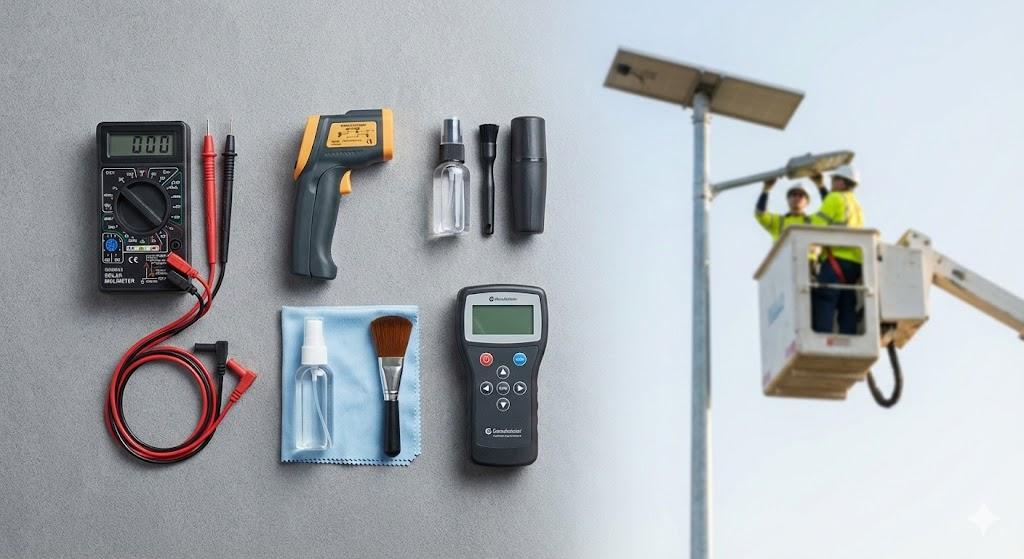
Have a look at the standardized toolkit for motion sensor light repair for solar street lights:
- Digital Multimeter
A high-quality digital multimeter is required to check voltage and continuity at important points. It helps them check whether:
- The battery is delivering power
- The panel is generating power
- The sensor is getting power but not sending the ON signal
- Hydraulic Bucket Truck
This is a basic safety infrastructure required for every solar motion sensor light repair project. Technicians need a safe place to open housing units, clean panels, and change the angles of sensor responsiveness without the risk of falling.
- Non-Contact Infrared Thermometer
An infrared thermometer is required to make sure that the parts in the control box or battery case aren’t getting too hot. This quick scan can stop more damage from happening during solar motion sensor light repair.
- Specialized Lens Cleaning Kit
A dirty lens blocks the infrared signal that turns on the light. A technician should first check to see if the lens is clean before ripping apart the wiring. This easy step often brings back full efficiency.
- Manufacturer Programmer
The hardware might be fine, but the software logic might be messed up. A programmer lets the technician change the sensor’s settings or force a ‘test mode’ to check Sensor Responsiveness right away during the day, which saves a trip back at night.
Step-by-Step: How To Fix Solar Light Sensor Anomalies
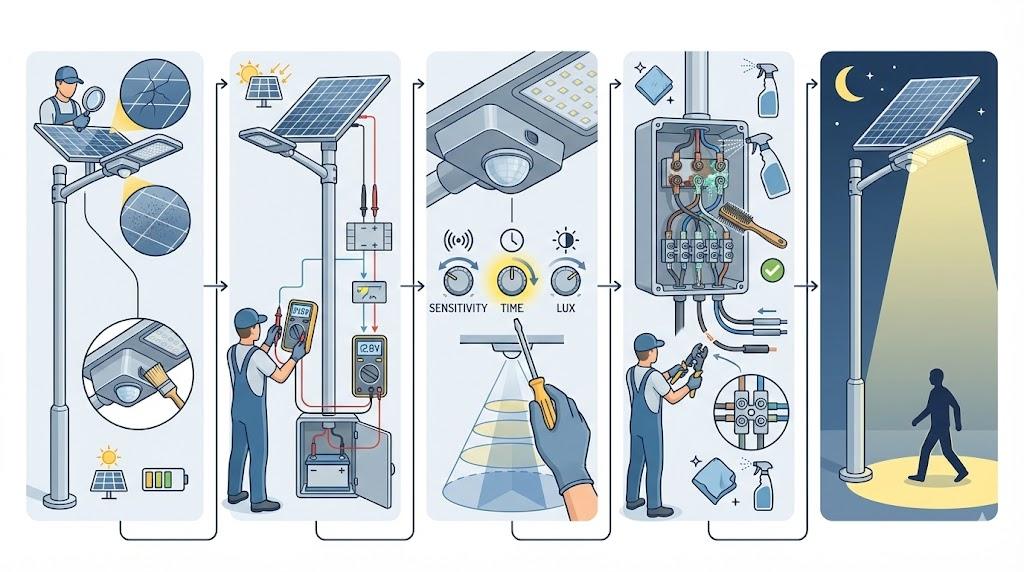
Follow this 6-step protocol to diagnose and resolve solar motion sensor light repair issues:
- Do a Visual Inspection and Environmental Assessment
Document the failure mode before you touch any equipment. Does your solar light not turn on at all, or does it only respond to sensors in strange ways?
Here are the list of things to check:
- Check the surface of the solar panels for dirt, bird droppings, or shade from tree growth.
- Look for cracks, water damage, or damage from vandalism to make sure the housing is sound.
- Check the stability of the mount. Over time, vibration can loosen connections.
- Take into account things in the environment around you, like new buildings that cast shadows and changes in plants.
- Test Solar Panel Output
This step in the diagnostic process finds out if the problem is with generating or storing energy. Here’s the testing protocol:
| Component | Tool | Acceptable Range | Action if Failed |
| Solar Panel | Multimeter | 17-22V DC | Clean/replace panel |
| Battery (full charge) | Multimeter | 12.6-13.2V DC | Replace battery |
| Battery (under load) | Multimeter | Above 11.5V DC | Test connections |
Set your multimeter to DC voltage. Take the battery out, measure the solar panel’s output in direct sunlight, and then test the battery’s voltage on its own. If the battery voltage drops below 11.5V while the system is in use, battery degradation is making it hard for the sensors to work properly.
- Verify Motion Sensor Calibration
Thermal cycling and exposure to the environment can cause PIR (Passive Infrared) sensors to lose their calibration. This step addresses the detection mechanism itself.
Have a look at the calibration check process:
- Access the sensor adjustment dials (usually called SENS for sensitivity and TIME for duration)
- For testing, set the sensitivity to the highest level and the duration to the lowest level
- Walk through the detection zone at different distances (most sensors work from 5 to 12 meters)
- Check to see if activation is consistent
- Inspect and Remediate Electrical Connections
Connection corrosion accounts for majority of solar motion sensor light repair calls in coastal and high-humidity installations. Here are some tips to maintain your connections:
- Look for green and white corrosion deposits on all terminal connections
- Use fine-grit sandpaper or contact cleaner to clean corroded terminals
- Apply dielectric grease to all connections before reassembly
- Check the integrity of the wires by looking for cracks in the insulation or brittleness
Make sure to pay close attention to how the photocell (dusk-to-dawn sensor) and control circuit are connected. A broken photocell connection can cause the annoying situation where motion detection works perfectly but the light never comes on because the system thinks it’s still daytime.
- Test Integrated System Function and Document Results
After the solar motion sensor light repair, make sure the whole system works properly in real nighttime conditions. Check out some final verification steps:
- Cover the solar panel completely to make it look like it’s dark (this turns on the photocell).
- Turn on the motion sensor by going through the detection zone.
- Check that the light turns on at the right brightness levels.
- Set the duration cycle to the right time and check that it matches the programmed settings.
- For maintenance records, write down what you did to fix things and the results of the tests.
Factors Affecting The Cost of Solar Motion Sensor Light Repair
Have a look at some things you need to keep in mind while budgeting for solar motion sensor light repair:
- System Age and Component Availability
Older street light models often need special parts that are hard to find, which makes them much more expensive. Systems that are 5 to 7 years old often reach a point where the cost of repairs is more than the cost of replacing them.
- Failure Complexity
It costs $50 to $100 in labor to fix simple problems with solar light sensors, like cleaning the panels or changing the sensitivity. But if your solar light doesn’t turn on and you have to do a lot of testing to figure out why, it could take 2 to 3 hours at $75 to $150 per hour.
Problems with battery storage and sensor responsiveness cause compound failures that make repairs more difficult and expensive in direct proportion to their severity.
- Geographic Challenges
The cost of labor goes up a lot depending on where the street lights are. Installing solar motion sensor lights at ground level makes it easy to fix them quickly. But lights that are 20 to 30 feet off the ground need bucket trucks (which cost $200 to $400 per deployment) and extra safety measures. Remote or busy areas make lane closures, traffic management, and longer travel times more expensive.
- Volume Considerations
Municipal contracts that cover more than one fixture usually get hefty discounts on parts, compared to repairs on a single unit. Similarly, buying a lot of replacement sensors and battery storage units at once for preventive maintenance programs saves a lot of money on each unit.
- Environmental Exposure Severity
In cities with a lot of pollution, cleaning schedules need to be more strict to keep solar energy working well. Similarly, corrosion happens faster on coastal installations. So, they need to be repaired and weatherproofed more often. These environmental factors can make annual maintenance costs much higher than they would be for installations in moderate climates.
When To Replace Your Solar Energy Street Light
At some point, the maintenance cost outweighs the asset value. But where is that line? These are some important red flags that signal that it’s time to retire the solar motion light rather than repair it:
- If the cost of labor and parts to fix the Solar Light is more than 50% of the cost of a new one, you should replace it right away. New models come with new warranties and better efficiency, which means your agency or business will get a better return on investment over time.
- PIR sensors need clear optics, so irreversible lens cataracts are a problem. If the sensor lens has turned yellow, cloudy, or brittle (crazing) after years of UV exposure, no amount of cleaning will make it more responsive.
- If you open the housing of a solar light sensor and see white or green powdery residue on the circuit board, it means that moisture has gotten past the seal. You could clean it today, but the copper traces are already damaged. Replace the unit to avoid repeated failures.
- Are you fixing a system that is 10 years old? Outdated detection technology Older sensors can be set off by things like wind and leaves. Replacing them with modern Microwave or Dual-Tech sensors stops false alarms and saves solar energy for when it is really needed.
Frequently Asked Questions (FAQs)
- Why is my solar motion sensor lights not working?
The most common culprits are depleted battery storage due to dirty panels, or a sensor lens blocked by dust and debris. In older street light units, moisture ingress causing internal corrosion often triggers the need for solar motion sensor light repair.
- How to fix solar light sensor?
Start by cleaning the lens to restore sensor responsiveness, then adjust the sensitivity and Lux dials to match the location’s lighting conditions. If the issue persists, perform a hard reset by disconnecting the power source.
- How do you clean a solar light sensor?
Gently wipe the PIR sensor lens with a clean microfiber cloth and a small amount of isopropyl alcohol to remove grime without scratching the plastic.
Conclusion
Motion sensor light repair doesn’t have to be a recurring headache that drains municipal budgets and compromises public safety. All you need to do is treat the solar motion sensor systems as critical infrastructure.
And of course, the most effective maintenance strategy is to start with hardware built for the long haul. That is the philosophy behind DEL Illumination. We design our commercial solar street lights with high-grade, weather-resistant components and intelligent sensors that resist drift and degradation. Contact us now for more information!