
Road construction projects and municipal infrastructure upgrades demand cost-effective lighting solutions that last for decades. That’s exactly where the relevance of solar powered light motion sensors comes in.
They turn on automatically when they detect movement. And guess what? Project managers don’t need to factor in ongoing electricity costs as these systems run freely on solar energy.
It’s no wonder that the solar motion sensor light market is flourishing. According to Verified Market Reports, the market size of solar sensor light was valued at $1.2 billion in 2024, and it is expected to reach $2 billion.8 Billion by 2033.
The huge growth has given more options in the market. But it’s also important to remember that a lot of junk products are trying to cash in on the trend. So, how do you spot the ones that actually last?
Let’s break down exactly what to look for to buy the best outdoor solar motion sensor light for your development projects.
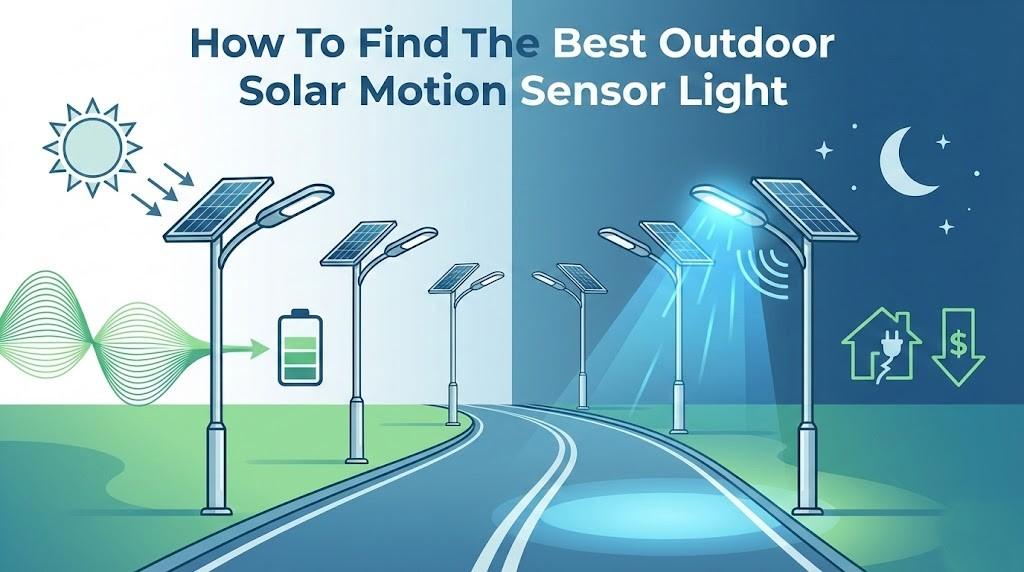
What is Solar Powered Light Motion Sensor?
A solar powered light motion sensor is an outdoor light that runs on sunlight and turns on only when it detects movement. It stores energy in a built-in battery during the day and uses it at night to efficiently illuminate roads, highways, parking areas, and public infrastructure without grid dependence.
Benefits of Solar Powered Light Motion Sensors
Check out some reasons why a solar powered light motion sensor is essential for your infrastructure upgrade projects:
1. Better Security
Motion detection provides instant illumination when vehicles or pedestrians approach. This improves visibility to prevent unauthorized activity in public spaces at night.
2. Zero Operating Costs
Solar motion sensor lights harvest solar energy during the day and operate autonomously at night. If you’re a contractor managing hundreds of light poles, eliminating monthly utility bills becomes a significant long-term savings.
3. Easy to Install
EPC contractors can install complete solar street light systems in hours rather than days. Pre-integrated AIO (All-in-One) and AIT (All-in-Two) designs eliminate complex wiring to speed up the project timelines and reduce labor costs.
4. Place Them Anywhere
Solar outdoor motion sensor lights can be deployed in remote locations or areas where grid extension would be prohibitively expensive. It’s a major advantage for rural road projects and developing regions.
How to Choose the Best Solar Motion Sensor Light for Your Needs
If you want real security and reliable outdoor lighting that lasts more than one season, you need to look at the real features. Here’s a breakdown of what to look for to pick the best outdoor solar motion sensor light:
1. Brightness
Brightness is obviously the first decisive factor for choosing outdoor lights. It’s measured by a unit called lumens. Here’s a basic idea of how many lumens are needed for each area:
- Secondary Roads & Pathways: 2,000–4,000 lumens per pole for 5–6 meter pole heights with 20–25 meter spacing
- Primary Roads & Highways: 6,000–12,000 lumens per pole for 8–10 meter pole heights with 30–35 meter spacing
- Parking Lots & Industrial Areas: 8,000–15,000 lumens per pole depending on coverage area and mounting height
Don’t believe the saying “more lumens is better.” You must work with your lighting designer to calculate illuminance levels (measured in lux) and uniformity ratios that meet local standards such as EN 13201 or IESNA RP-8 guidelines for roadway lighting.
2. Motion Detection Technology
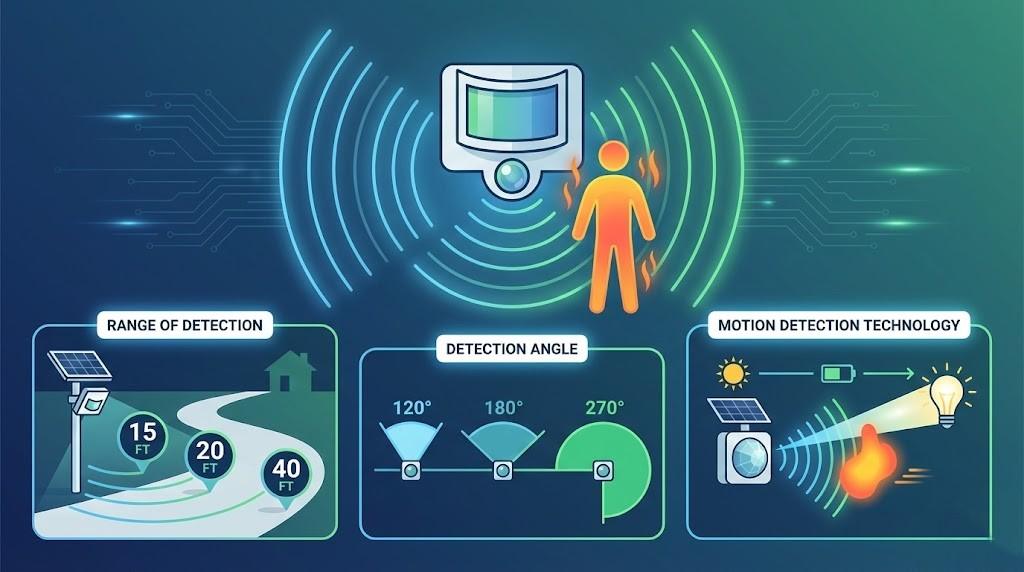
Most motion sensor lights use a PIR (Passive Infrared) sensor. These sensors pick up on heat signatures and turn on when something warm, like an animal or a person, moves through the detection zone.
But not all are the same. In order to pick the best outdoor solar motion sensor light, you must look for the:
- Range of Detection
This tells you how far away the sensor can detect things moving. Most good lights can see movement up to 40 feet away.
- Detection Angle
The sensor can see in a range of 120° to 270°. A wider angle means fewer places where you can’t see:
- 120–140°: Good for corners or areas that need to be focused on
- 180°: Most uses have standard coverage at this angle.
- 240–270°: Almost full coverage, great for places where people might come from more than one direction.
3. Solar Panel Type and Efficiency
Have a look at the three main types of solar panels and their main features:
| Panel Type | Efficiency | Best For | Avoid If |
|---|---|---|---|
| Monocrystalline | 15-20% | Year-round use | Budget is extremely tight |
| Polycrystalline | 13-16% | Sunny locations | You need winter performance |
| Amorphous | <10% | Decorative purposes only | You want functional lighting |
4. Battery Capacity And Material
The amount of milliamp-hours (mAh) in a battery tells you how long your light will stay on after sunset. Check out how many mAh of outdoor solar lights you need:
- 1,200 to 1,500 mAh: The least amount of power needed for basic pathway lights (4 to 6 hours of use).
- 2,000–2,400 mAh: This is the standard for most security applications and lasts 8 to 10 hours.
- 3,000+ mAh: The best choice for running all night (10–12+ hours of use).
Try to use lithium-based batteries. They:
- Last longer (up to 1,000 charge cycles)
- Works better in extreme temperatures
- Hold their charge better than older nickel-metal hydride (NiMH) batteries
5. Light Modes
Make sure that the motion sensor outdoor light has efficient modes to fit your specific use cases:
| Mode | How It Works | Best For |
|---|---|---|
| Security Mode | Light stays off until motion is detected, then blasts 100% brightness for 20-30 seconds. | Parking lots and industrial perimeters |
| Always On | Light stays on at medium brightness for 4-6 hours, regardless of motion. | Critical highways |
| Dim-to-Bright | Light stays in an energy-saving Dim mode all night. When motion is detected, it jumps to 100% brightness. | Urban streets |
6. Weather Resistance
Every solar motion sensor light is required to have an IP (Ingress Protection) rating to let you know its ability to handle the weather. Here’s what the numbers mean:
- IP44: Safe from splashes of water. It’s good for bus shelters that are covered, but not for direct rain.
- IP65: Resists dust and water jets. It can adapt to most climates.
- IP66-IP67: Even better protection from water. If the project is in an area that receives a lot of rain or snow, it’s worth it.
- IP68: Can go underwater and is completely waterproof. Yes, it’s too much for lights, but nice to have for frequent flood-prone areas.
Always go for outdoor solar motion sensor lights with aluminium or tempered-glass outer casing, as they are more durable. Plastic panels become brittle from UV exposure over time.
7. Installation Flexibility
There are mainly two types of solar lighting:
- All-in-One Lights: As the name suggests, it’s pre-installed and comes with a cleaner look. But if the light needs to be in a shaded area, the panel might not get the best sun exposure.
- Separate Panel With Cable: You can place the panel in the sunniest spot, and the light will reach where you need it. But it requires more work. And it comes with a cable, which you need to hide.
8. Advanced Features
Nowadays, some of the best outdoor solar motion sensor lights offer extra features like:
- A remote control to change controls.
- Timer functions so that you can set specific hours of operation for energy-saving.
- Dual sensors for larger area coverage.
- Mounting brackets that let you aim both the panel and the light head.
Where to Buy Solar Powered Motion Sensor Light?
It’s always better to source solar motion sensor lights directly from the manufacturers. We, at DEL Illumination, provide:
- Customizable Solutions: Tailored to your project’s specific lux requirements, autonomy needs, and pole specifications.
- Technical Documentation: Complete IES photometric files, datasheets, and installation guides for project submissions.
- Reliability & Warranty: Professional-grade components backed by substantial warranties.
How to Install Solar Powered Motion Sensor Light?
Here are some quick tips to help you get the solar light installation right the first time:
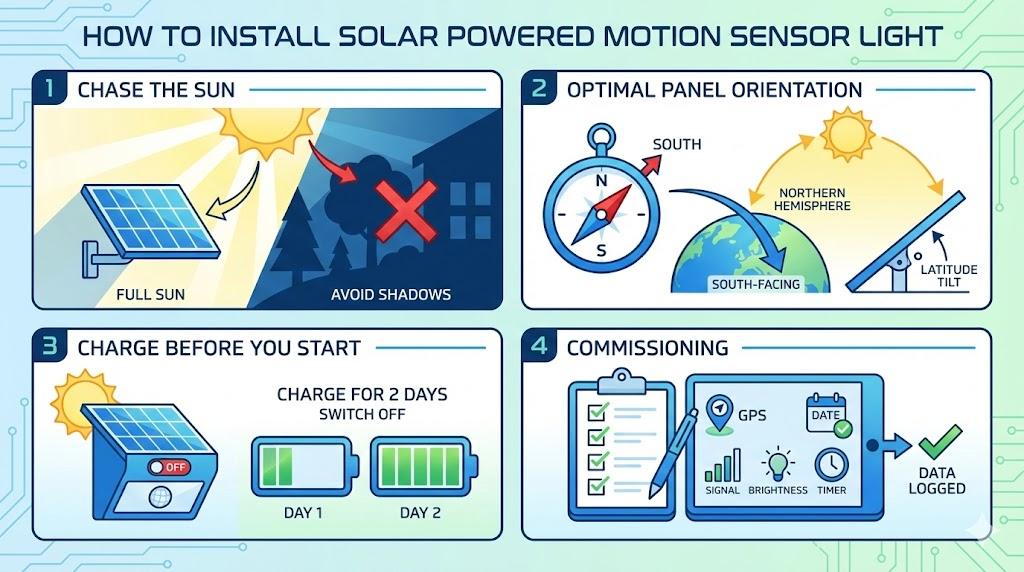
1. Chase The Sun
The sun is the only thing that makes your light work. So, place the solar panel where it gets direct sunlight for at least 6 to 8 hours a day. If you put it under the roof eaves or tree branches that cast shadows, your battery will be dead by midnight. For more details, check out our blog on: Can solar lights charge without sunlight?
2. Optimal Panel Orientation
In the Northern Hemisphere, panels should generally face south; in the Southern Hemisphere, face north. Tilt angle should approximate local latitude for year-round optimization.
3. Charge Before You Start
Before you mount it, turn the switch to “OFF” and leave it in the sun for two full days. This gives the battery a full, deep charge at the beginning of its life, which helps it last longer in the long run.
4. Commissioning
Document GPS coordinates, installation dates, and initial performance metrics for each pole. This data is critical for warranty claims and maintenance planning.
Frequently Asked Questions (FAQs)
- What is the cost of a solar motion sensor light?
Engineering-grade solar street lights range from $300–$800 per pole for standard AIO systems (30W–60W) to $800–$1,500 for high-power AIT systems (80W–150W).
- How does a solar powered light motion sensor work?
The solar panel charges an internal battery during the day in a simple three-step cycle. A dusk-to-dawn sensor turns on the system when the sun goes down. Lastly, a PIR (Passive Infrared) sensor picks up heat waves from moving things and turns on the LED light right away.
- Are solar motion sensor lights worth it for highway projects?
Yes, when properly specified. High-power AIT systems (100W+) with extended detection range and 5-7 nights autonomy can meet highway lighting standards.
- How long do solar powered motion lights last?
The LED bulbs can last more than 10 years (50,000 hours), but the batteries need replacement every 2 to 4 years. If you buy a model with a high-quality glass solar panel, it can easily last outside for more than five years.
Conclusion
Look, you’ve got the knowledge now. But despite this inside scoop, many project managers make the same old mistake of buying the cheapest solar motion sensor lights.
Stop doing that.
Start with your actual needs. What are your illumination standards? What’s your expected system lifespan? What autonomy do you need for local climate conditions?
Once you know your needs, you just need to match them to the specs we covered.
At DEL Illumination, we’ve been manufacturing high-performance solar motion sensor lights for global projects for years. Our AIO and AIT product lines are built to meet the rigorous demands of road construction, municipal works, and EPC contracts. Contact us now to know more!