
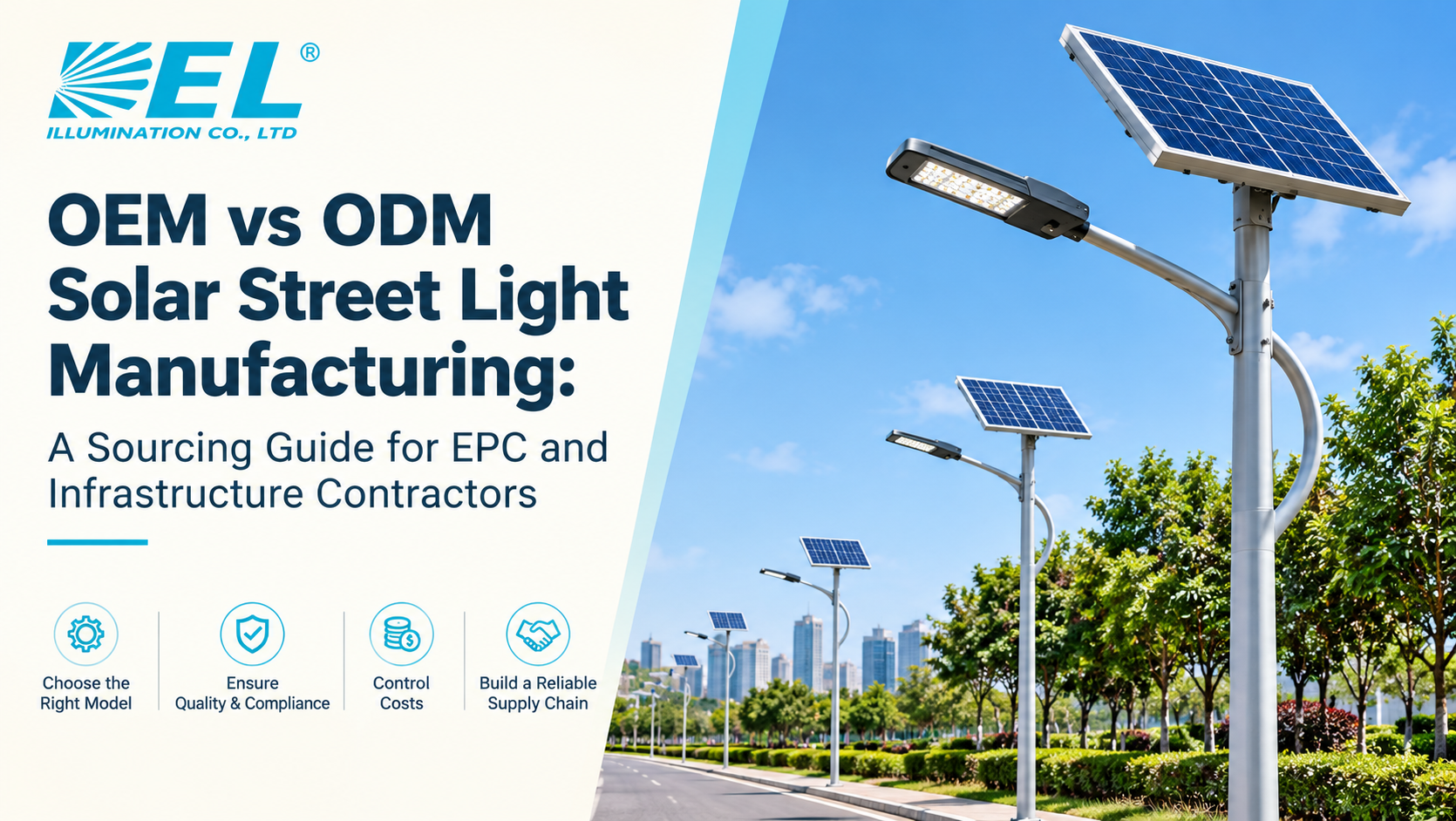
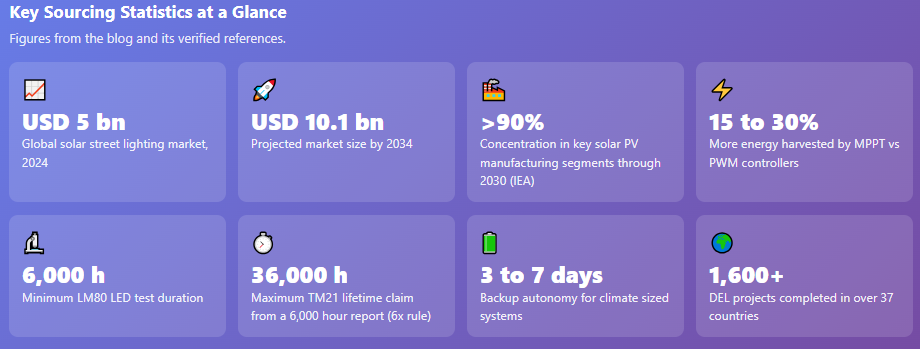
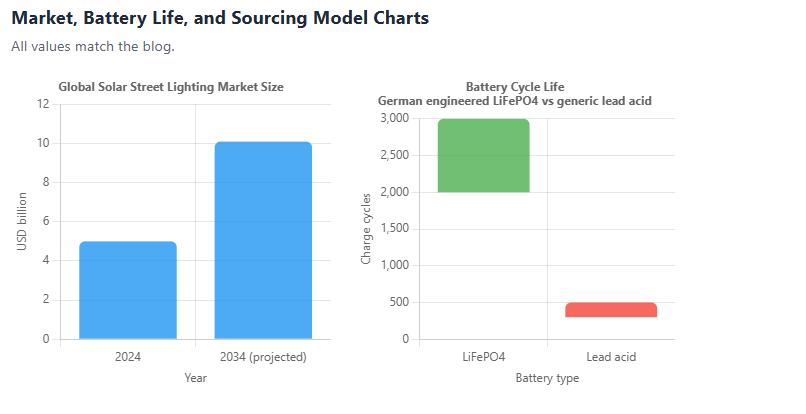
The global solar street lighting market was valued at around USD 5 billion in 2024 and is projected to reach USD 10.1 billion by 2034, according to Global Market Insights. Growth on that scale attracts thousands of factories, and most of them call themselves an OEM solar street light manufacturer. For an EPC contractor, the real risk is not finding a supplier. It is signing with the wrong kind of supplier, then finding in year three that the battery design, warranty terms, and spare parts belong to someone else.
Choosing between an OEM solar street light manufacturer and an ODM solar street light manufacturer decides who owns the design, who carries the engineering risk, and how much control you keep over specifications during a 10 year project life. This guide explains both contract manufacturing models, compares cost, lead time, and control, shows where ODM customization fits infrastructure work, and sets out a practical checklist for choosing an OEM lighting partner.
What OEM and ODM Mean in Solar Street Light Manufacturing
In lighting procurement, the two terms describe who creates the product design.
An OEM solar street light manufacturer (original equipment manufacturer) builds lights to a specification that you, the buyer, define. You set the battery capacity, LED wattage, optics, housing material, controller logic, and branding, and the factory produces to that brief. In most agreements with an OEM solar street light manufacturer, the buyer owns or controls the specification and tooling, which is why larger EPC firms and distributors prefer this route for long programmes.
An ODM solar street light manufacturer (original design manufacturer) sells products it has already designed and tested. The buyer selects from existing platforms and can usually adjust wattage, pole brackets, colour temperature, dimming profiles, and labels. The design and its intellectual property normally stay with the factory. Private label lighting production is a common form of ODM, where the factory’s proven model is sold under your brand.
There is also a middle path. Many manufacturers offer semi knocked down (SKD) supply, where core modules are built and tested at the factory and final assembly happens in the destination country. SKD can help contractors meet local content requirements on development bank projects without redesigning the product.
Neither model is better by default. Whether you need an OEM solar street light manufacturer or an ODM platform depends on project volume, the level of engineering control your client demands, and how much design risk your team is equipped to carry.
OEM vs ODM: Cost, Control, and Lead Time Compared
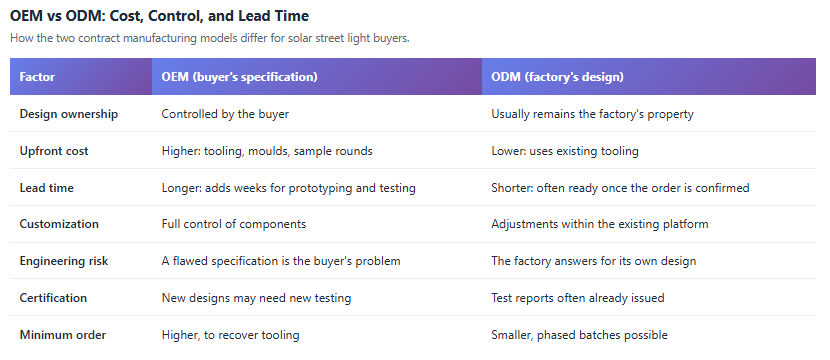
For OEM vs ODM sourcing for EPC contractors, the practical differences show up in money, time, and accountability. Industry guidance describes OEM work as needing higher upfront investment and longer development, while ODM offers faster market entry with customization limited to predefined options.
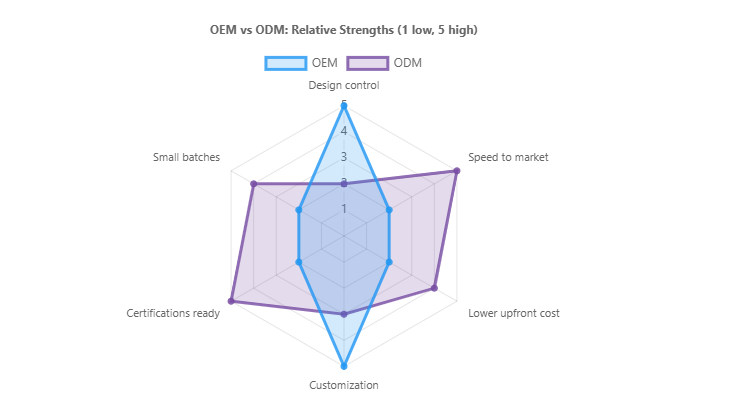
In solar street lighting, the comparison looks like this:
- Design ownership: OEM specifications are controlled by the buyer. ODM designs usually remain the factory’s property.
- Upfront cost: An OEM solar street light manufacturer may require tooling, moulds, and sample rounds. ODM uses existing tooling, so costs are lower.
- Lead time: OEM development adds weeks for prototyping and testing. ODM products are often ready once the order is confirmed.
- Customization: OEM allows full control of components. ODM allows adjustment within the existing platform.
- Engineering risk: Under OEM, a flawed specification is the buyer’s problem. Under ODM, the factory answers for its own design.
- Certification: ODM platforms often arrive with test reports already issued. OEM designs may need new testing.
A new design from an OEM solar street light manufacturer might need fresh IEC luminaire safety tests, IP and IK verification, and battery safety reports before it can enter a financed project. If your tender deadline is fixed, a certified ODM platform may be the lower risk path even when an OEM design looks cheaper on paper.
Bulk procurement terms also differ. An OEM solar street light manufacturer usually sets higher minimum quantities because tooling must be recovered, while ODM platforms can be ordered in smaller, phased batches.
Where ODM Customization Fits Infrastructure Projects
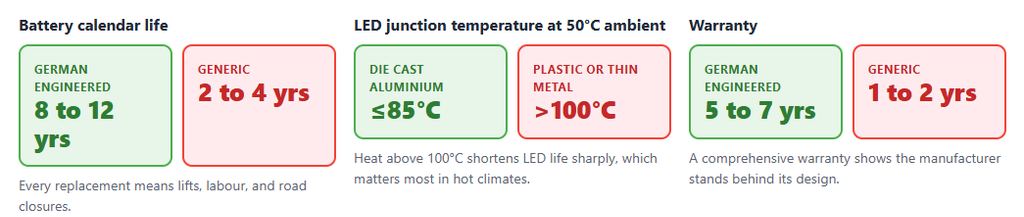
For most infrastructure programmes, ODM customization for infrastructure delivers the best balance. A mature platform has already been through field failures and design corrections, and custom design engineering can then be applied where the project genuinely needs it.
Typical ODM adjustments for public works include:
- Solar panel and battery sizing for local sun hours and three to seven days of backup autonomy
- Lumen output and optics matched to the road class, verified with photometric simulation
- Dimming schedules and motion sensing to stretch stored energy through long winter nights
- Pole height, bracket angle, and wind load design for the site
- Housing coatings for coastal, desert, or high humidity conditions
A turnkey manufacturing partner goes further, supplying lighting design, poles, foundations drawings, and commissioning support as one package. For highway projects, this matters because lighting uniformity is judged against road standards, not against a brochure. Photometric work such as DIALux luminaire spacing optimization often decides how many poles you need, which moves the budget more than the unit price does.
A light sized for Southern Europe will fail early in the Gulf, where panel temperatures stay high for months. Systems built for Middle East climates need heat tolerant batteries, die cast aluminium housings that keep LED junction temperatures at or below 85 degrees Celsius at 50 degrees Celsius ambient, and higher IP ratings against dust. Generic housings made from plastic or thin metal can push junction temperatures above 100 degrees Celsius, which shortens LED life sharply.
How to Source Solar Street Lights: Vetting the Factory
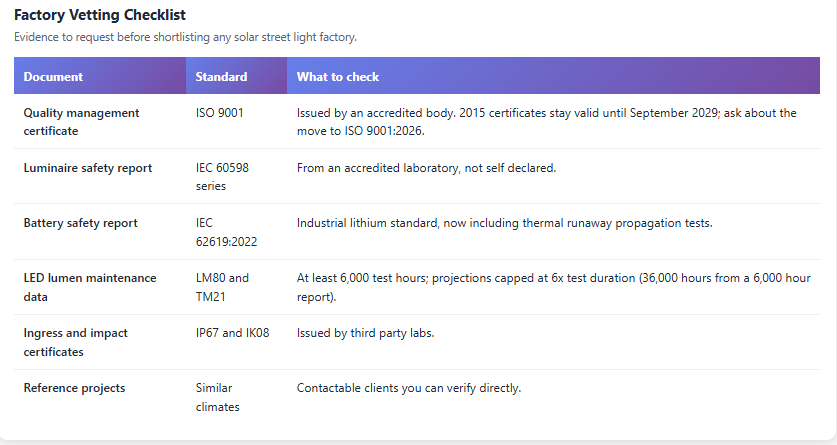
Knowing how to source solar street lights comes down to verifying claims before signing. Every solar street light supplier sends a catalogue. Far fewer can show the evidence behind it. Good EPC contractor manufacturer selection starts there: whether you are vetting an OEM solar street light manufacturer or an ODM platform, quality control auditing should cover both the factory and the product.
Before shortlisting any solar street light factory, request:
- ISO 9001 certificate from an accredited body; 2015 certificates stay valid until September 2029, but ask about the move to ISO 9001:2026
- Luminaire safety reports under the IEC 60598 series, from an accredited laboratory, not self declared
- Battery safety reports under IEC 62619:2022, the industrial lithium standard, which now includes thermal runaway propagation tests
- LM80 and TM21 LED data, where LM80 requires at least 6,000 hours of testing and TM21 limits projections to six times the test duration
- IP67 and IK08 test certificates from third party labs
- Reference projects in similar climates, with contactable clients
Because TM21 caps projections at six times the tested hours, a 6,000 hour LM80 report supports a lifetime claim of no more than 36,000 hours. A 100,000 hour claim from short test data goes beyond the method.
The IEA reports that concentration in key solar PV manufacturing segments is set to stay above 90 percent through 2030, so development bank buyers increasingly ask where cells and batteries originate. For financed tenders, align your supplier’s paperwork with bankable certification requirements before bid submission, not after award. A capable solar street light exporter also handles export documents, sea freight packing, and spare parts.
German Engineered vs Generic Specifications in the Contract
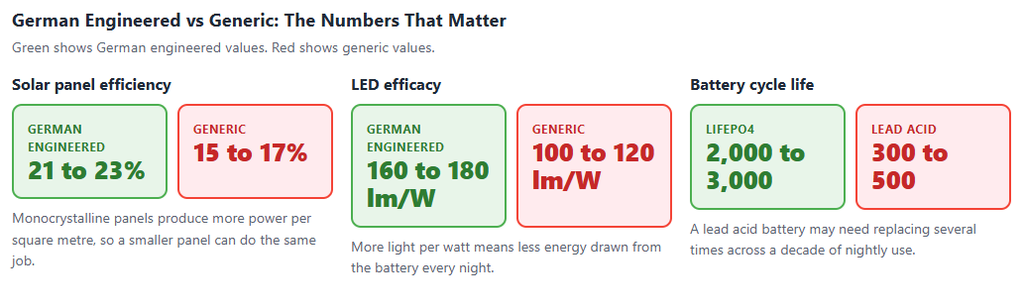
Whether you sign with an OEM solar street light manufacturer or an ODM supplier, the specification written into the purchase contract is what protects you. This is where German engineered systems and generic alternatives separate most clearly.
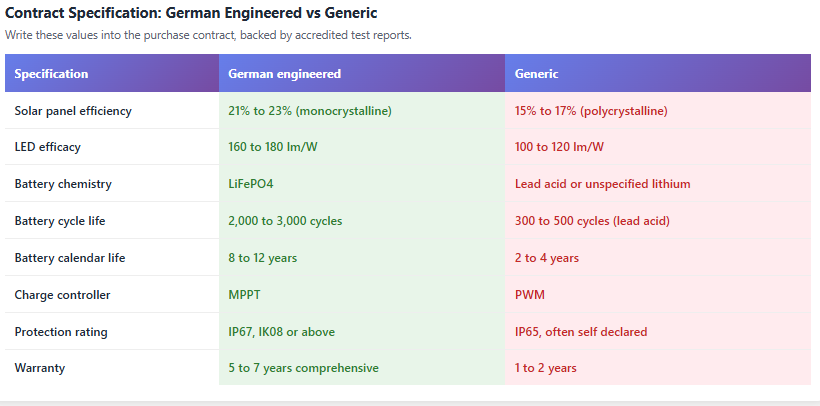
The controller alone changes the energy budget. A maximum power point tracking (MPPT) controller typically harvests 15 to 30 percent more energy than a pulse width modulation (PWM) controller, which can mean a smaller panel or an extra night of autonomy.
A battery rated for 300 to 500 cycles may need replacing several times across a decade of nightly use, and every replacement means lifts, labour, and road closures. That is why a 10 year total cost of ownership comparison, not unit price, should drive your choice of OEM solar street light manufacturer. Development lenders reinforce this: the World Bank’s Procurement Regulations allow rated criteria that assess quality, sustainability, and value for money rather than lowest price alone.
Conclusion
Three points matter most when sourcing. First, the choice between an OEM solar street light manufacturer and an ODM platform is really a choice about who owns the design and who carries the engineering risk. Second, a proven ODM platform with existing certifications is often the lower risk route for fixed deadline tenders, with custom design engineering applied only where the site demands it. Third, the contract specification, backed by accredited test reports, protects you far more than any sales promise.
DEL Illumination works as a solar street lighting engineering solution expert, offering OEM, ODM, and SKD models with German design roots, ISO 9001 certified production, and more than 1,600 completed projects in over 37 countries. For a sourcing consultation or project quote, visit solar-led-street-light.com and speak with our engineering team.
Frequently Asked Questions
1. Can I switch from ODM to OEM partway through a programme?
Yes, and many contractors do. A common approach is to start with a certified ODM platform for the first phase, then commission an OEM version once volumes justify tooling. Agree in writing who will own the new drawings and test reports before development begins.
2. Who owns the intellectual property in an OEM agreement?
It depends entirely on the contract. Ownership of drawings, firmware, moulds, and test reports should be stated explicitly. Without that clause, the factory may retain rights to reuse the design for other customers.
3. How many samples should I test before a bulk order?
Most contractors test a small batch of production samples, not hand built prototypes. Run them through a full charge and discharge cycle, check light output against the datasheet, and have at least one unit verified by an independent laboratory if the project is financed.
4. What payment terms are typical with Chinese and Asian factories?
A deposit on order with the balance paid against shipping documents is common. For large public projects, letters of credit and performance bonds give both sides more security and are often required by lenders.
5. Does private label production affect warranty claims?
It can. If the product carries your brand, end clients will contact you first. Make sure the factory warranty passes through to you on identical terms, including response times and replacement shipping costs.
6. How do I verify a factory before visiting?
Check certificate numbers directly with the issuing body, ask for a live video walkthrough of production and testing areas, and request contact details for past clients. Independent inspection agencies can also carry out a pre shipment audit on your behalf.
7. Is the lowest bid usually the riskiest?
Not always, but a much lower price usually reflects a cheaper battery, a smaller panel, or a PWM controller. Compare bids line by line on component specifications and warranty terms before comparing totals.
References
Global Market Insights. (2024). Solar Street Lighting Market Size, Growth Analysis 2025 to 2034. https://www.gminsights.com/industry-analysis/solar-street-lighting-market
Allied Market Research via GlobeNewswire. (2024). Solar Street Lighting Market to Reach $11.1 Billion, Globally, by 2033 at 10.5% CAGR. https://www.globenewswire.com/news-release/2024/09/24/2952304/0/en/Solar-Street-Lighting-Market-to-Reach-11-1-Billion-Globally-by-2033-at-10-5-CAGR-Allied-Market-Research.html
International Energy Agency. (2025). Renewables 2025: Executive Summary. https://www.iea.org/reports/renewables-2025/executive-summary
International Electrotechnical Commission. (2022). IEC 62619:2022, Safety requirements for secondary lithium cells and batteries for use in industrial applications. https://webstore.iec.ch/en/publication/64073
DQS. (2026). ISO 9001:2026: The Secure Transition. https://www.dqsglobal.com/en/explore/blog/iso-9001-2026-transition
World Bank. (2025). Procurement Regulations for IPF Borrowers. https://documents.worldbank.org/en/publication/documents-reports/documentdetail/099120102072534901
Decrolux. (2024). What is a TM21 Report. https://decrolux.com.au/learning-centre/2024/what-is-a-tm-21-report
SolaX Power. (2026). MPPT vs PWM: Best Solar Controller for You? https://www.solaxpower.com/blogs/mppt-vs-pwm-solar-charge-controller.html
SEACOMP. (2026). OEM vs ODM: What’s the Difference in Hardware Manufacturing? https://www.seacomp.com/resources/oem-vs-odm-manufacturing
Disclaimer
This article is for informational purposes only and does not constitute professional engineering, installation, or procurement advice. Performance specifications and costs may vary based on project requirements, location, and local regulations. Always consult qualified solar energy professionals and legal advisors before making procurement decisions. For expert consultation on solar LED street lighting solutions, visit solar-led-street-light.com or contact our team for a customised quote.