
Why Lighting Simulation Is Now Non-Negotiable in Solar Street Light Tenders
Picture this: an EPC contractor submits a solar street light bid backed by little more than a product brochure and a manufacturer’s claimed lumen output. The tender is awarded, but months after installation, a government audit reveals the road fails EN 13201 uniformity requirements. The contractor faces costly retrofits, damaged credibility, and potential contract penalties.
This scenario plays out across infrastructure projects every year. According to industry research, up to 40% of solar street lighting installations in emerging markets fail to meet design-intent illuminance levels, often because photometric simulation was skipped entirely during procurement. In the current landscape of ADB and World Bank solar street light procurement, simulation-backed compliance documentation is increasingly a mandatory threshold requirement, not a nice-to-have.
This guide explains how DIALux Solar Street Light Simulation professional lighting simulation, combined with verified IES photometric files, enables EPC contractors, city planners, procurement officers, and facility managers to submit fully compliant solar street light tenders. We cover the standards that matter (EN 13201 and CIE), what a compliant simulation report must contain, and how German-engineered solar street light systems are purpose-built to deliver real-world results that match simulation outputs.
Understanding the Standards Landscape: EN 13201, CIE, and Why Both Matter
Before running a single DIALux simulation, every project team needs to understand which performance standards govern their tender. Two frameworks dominate global road lighting procurement.
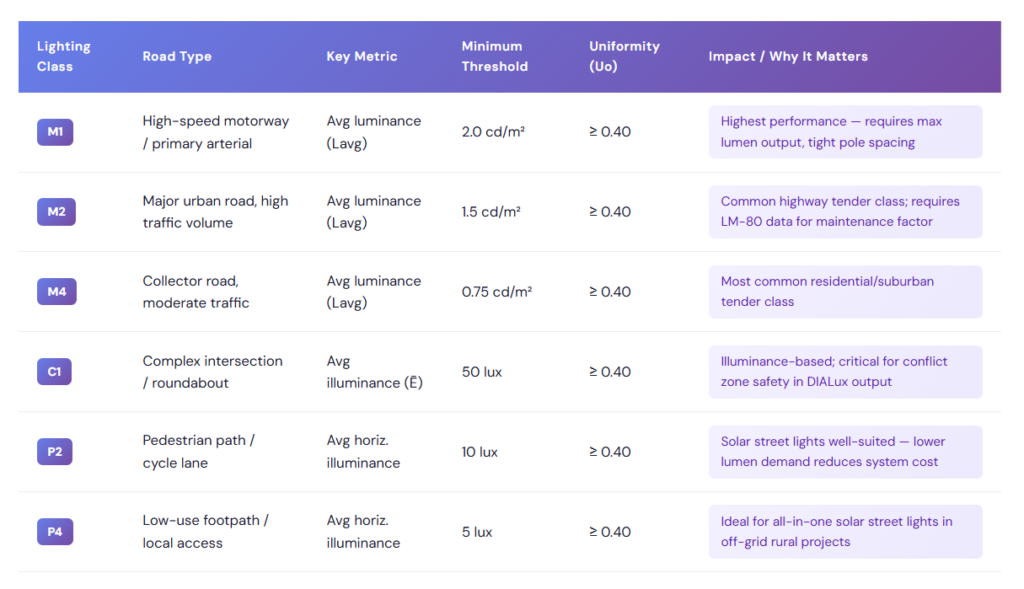
EN 13201 is a five-part European standard that defines how roads must be illuminated for safe use by motorists, cyclists, and pedestrians. Published by the European Committee for Standardization (CEN), it establishes three core lighting class categories, M (motorized traffic), C (conflict zones such as intersections and roundabouts), and P (pedestrian and cyclist paths). Each class carries specific quantitative thresholds. For example, M1-class roads require a maintained average road surface luminance of at least 2.0 cd/m², overall uniformity no lower than 0.4, and longitudinal uniformity no lower than 0.7. The standard also governs glare control through the Threshold Increment (TI) and environmental lighting through the Edge Illuminance Ratio (EIR). EN 13201-3 specifies the precise mathematical procedures for calculating these values, the same procedures that DIALux evo implements internally.
CIE 115 (International Commission on Illumination) is the international reference document from which EN 13201 was largely derived. Projects in Asia, Africa, Latin America, and the Middle East often reference CIE 115 directly when EN 13201 has not been formally adopted locally. For EPC contractors working across multiple countries, understanding CIE 115 ensures that a simulation produced for a European-aligned client can be adapted for global tenders without starting from scratch. DIALux evo’s declaration of conformity confirms it follows CIE 140 calculation methodology for road lighting, which underpins both frameworks.
A critical point often overlooked in tender preparation: the standard specifies maintained values, not initial values. Every EN 13201 calculation must incorporate a Maintenance Factor (MF) that accounts for LED lumen depreciation over time, luminaire soiling, and lamp survival rates. The formula is: MF = LLMF × LSF × LMF (Lamp Lumen Maintenance Factor × Lamp Survival Factor × Luminaire Maintenance Factor). A real-world MF for a well-maintained LED system typically falls between 0.75 and 0.85. Skipping this step, or assuming MF = 1.00, produces non-compliant simulations that will fail post-installation verification under EN 13201-4.
IES Files: The Foundation of Every Credible DIALux Simulation
A DIALux simulation is only as accurate as the photometric data fed into it. This is where IES files become critical.
An IES file (Illuminating Engineering Society format, extension .ies) is a standardized text file that encodes a luminaire’s complete light distribution pattern, how intensely it emits light at every measured vertical and horizontal angle. This data is captured using a goniophotometer under controlled laboratory conditions and formatted to the IES LM-63 standard. The European equivalent is the LDT format, common in German and EU projects. Both are accepted by DIALux evo.
For EPC solar street light tenders, the IES file is the document that transforms a supplier’s claimed lumen figure into a verified, three-dimensional representation of how that fixture will actually illuminate a road surface. Without it, pole spacing and power calculations are little better than educated guesses.
There is one critical procurement rule every EPC team must enforce: insist on model-specific IES files, not generic or “similar model” files. A file generated for a 60W luminaire cannot validly represent a 40W fixture with a different optic. Generic IES files are one of the most common sources of simulation-to-reality mismatches on solar street light projects. When reviewing supplier documentation, confirm that the IES file header metadata matches the exact product model, wattage, CCT (colour temperature), and drive current listed in the offer. This is a minimum standard for any certification-backed EPC contract.
German-engineered solar street lights are tested by accredited third-party laboratories, not self-certified, and IES files are generated from actual goniophotometer measurements. This is the difference between photometric data you can stake a project on, and marketing numbers dressed up as engineering.
Running a Compliant DIALux Simulation: Step-by-Step Workflow
A professional DIALux simulation for an EPC solar street light tender follows a structured process. Here is the workflow used on compliant projects.
Step 1, Define the Road Geometry. In DIALux evo’s Road Lighting module, input the exact road parameters: carriageway width, number of lanes, median width, footway width, and kerb offsets. These must match site survey data. Even a 0.5m error in road width can shift uniformity results enough to affect compliance.
Step 2, Select the Lighting Class. Using CEN/TR 13201-1 (the guidance companion to EN 13201-2), determine the appropriate M, C, or P class for the road type. A residential collector road with moderate traffic and no central divider typically falls in the M4 or M5 class range, requiring average luminance of 0.75–1.0 cd/m². A primary arterial with high-speed traffic may require M1 or M2.
Step 3, Set the Maintenance Factor and R-Table. Select the appropriate road surface reflectance table (R1 through R4). Newly laid asphalt typically follows R3 or R4; cement-treated surfaces may require R2. Apply the calculated MF based on the luminaire’s LM-80 test data and the project’s planned maintenance cycle. Never accept a simulation that uses MF = 1.00.
Step 4, Import Verified IES Files. Load the supplier-provided IES file for the exact solar LED luminaire specified in the bid. Confirm the luminaire’s output, beam angle (Type II or Type III for road applications is most common), and CCT.
Step 5, Configure Pole Layout. Enter mounting height (typically 6–12m depending on road class), pole spacing, lateral offset from kerb, and tilt angle. The spacing-to-height ratio (S/H) is a useful early guide, for M-class roads, an S/H ratio between 3.5 and 5.0 is a standard starting point. Arrangement options include single-sided, staggered bilateral, and median-mounted.
Step 6, Run the Simulation and Verify All Parameters. A compliant simulation must pass all of these checks simultaneously: average luminance (Lavg), overall uniformity (Uo), longitudinal uniformity (Ul), Threshold Increment (TI for glare), and Surround Ratio (SR) where applicable. For C and P classes, average illuminance (Ē in lux) and illuminance uniformity (Uo) replace luminance criteria.
Step 7, Generate the Compliance Report. DIALux evo produces a report package that includes isolux diagrams, false-colour luminance maps, calculation grids, fixture lists, and a summary results table. This is the document submitted with the tender.
What a Compliant Simulation Report Must Contain for EPC Tenders
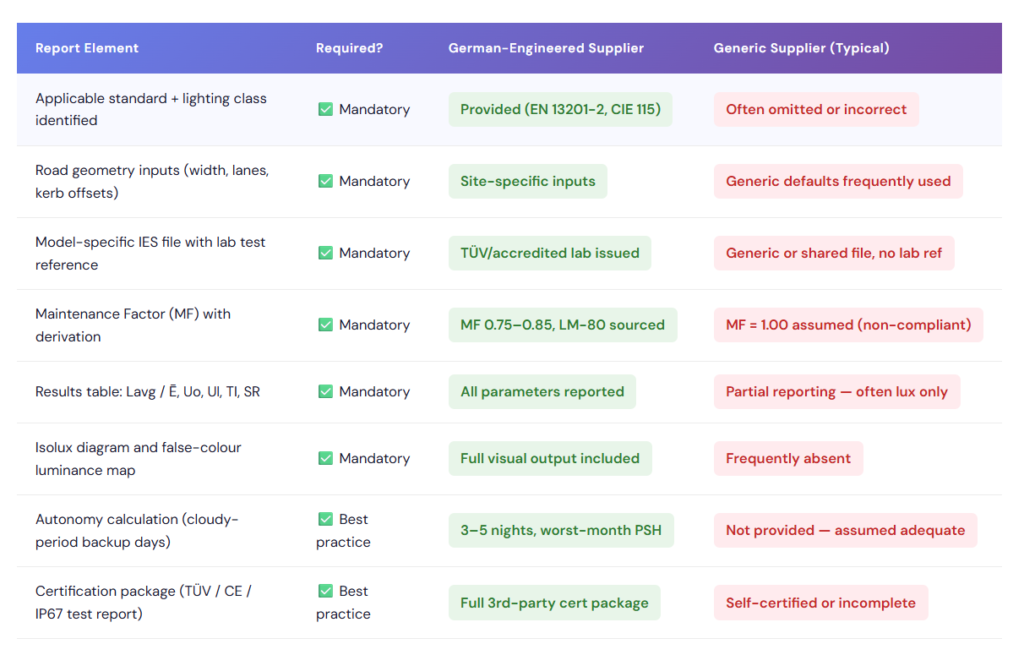
Procurement evaluators reviewing lighting simulation reports for EPC tenders, whether under World Bank, ADB, or bilateral government funding, typically require the following elements to be present for a bid to be considered technically complete.
The report must clearly identify the applicable standard (e.g., EN 13201-2:2015, lighting class M3), the specific luminaire model with wattage, lumens, and CCT, the IES file source and test laboratory, the road geometry inputs, the maintenance factor applied with its derivation, and a results summary table showing all calculated values against required thresholds. If a value fails, for example, TI (glare) exceeds the permitted 15% for the selected class, the simulation must be revised before submission.
From a total cost of ownership perspective, it is worth noting that getting the simulation right at tender stage avoids expensive post-installation remediation. Upgrading under-specified luminaires or reducing pole spacing after installation can increase project costs by 20–35%.
German-engineered solar street lights carry LED efficacies of 160–200 lm/W, with verified luminaire output backed by TÜV-certified test reports. This means that when the IES file is loaded into DIALux, the simulation results genuinely reflect what will be installed on site. Generic alternatives with self-reported efficacies of 100–130 lm/W and unverified IES data frequently produce field results that fall 25–40% below the simulated values, a gap that becomes a contractual liability.
The FIDIC EPC contract framework is unambiguous about contractor responsibility for delivered performance. A simulation submitted at tender stage forms part of the technical baseline against which installed performance is measured.
German-Engineered Systems and Simulation Accuracy: Closing the Gap Between Paper and Reality
The practical value of DIALux simulation in solar street light tenders depends entirely on one thing: whether the equipment installed on site performs as the simulation predicted. This is where the gap between German-engineered systems and generic alternatives becomes commercially significant.
German-engineered solar street lights use monocrystalline solar panels rated at 23%+ efficiency and MPPT controllers operating at 95–98% efficiency, compared to 15–18% polycrystalline panels and 70–75% PWM controllers found in generic alternatives. The implication for simulation accuracy is direct: a system that harvests and stores more energy per day is far less likely to enter power-saving dim modes that reduce lumen output below the simulated value. Generic systems sized at less than 2.5x load power, a common shortcut, regularly underperform during extended cloudy periods, delivering actual illuminance levels that fall below the EN 13201 threshold.
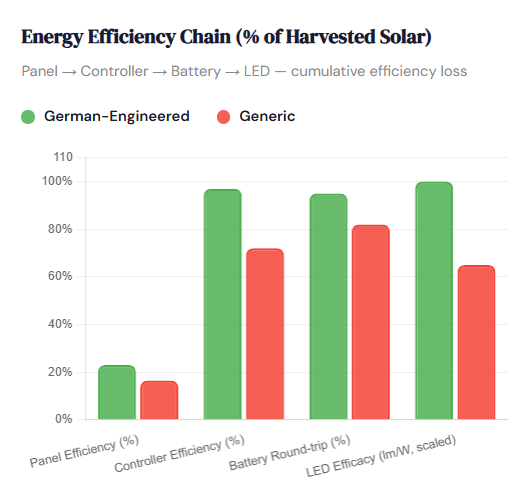
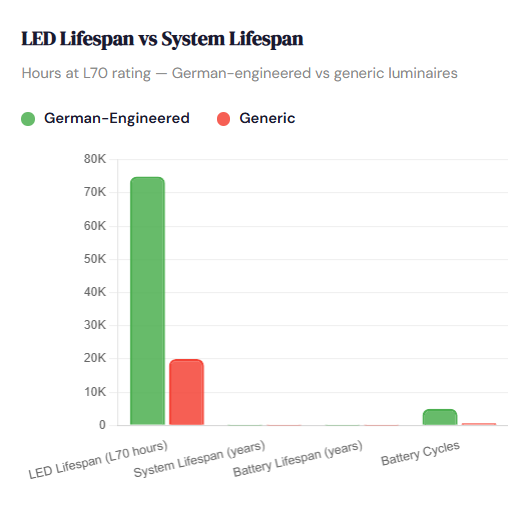
For LED performance, German-engineered luminaires are rated at 50,000–100,000 hours at L70 (the point at which lumen output falls to 70% of initial value). This is the figure used to calculate LLMF in the maintenance factor. Generic luminaires rated at under 20,000 hours reach L70 much earlier, meaning the MF in the simulation should realistically be lower, but this is rarely disclosed by low-cost suppliers.
Battery performance is equally relevant to simulation integrity. A system built with A-class LiFePO4 cells rated at 5,000+ cycles and 8–10 years of service life maintains consistent operating voltage across the battery’s life, ensuring stable LED driver performance. Generic recycled Li-ion cells with 500–800 cycle ratings degrade in capacity within 18–24 months, reducing effective operating hours and real-world lumen output, none of which shows up in a DIALux report.
The patent-protected design features in German-engineered solar street lights, including thermal management, optics housing, and waterproofing, also directly support sustained photometric performance. Third-party verified IP67 ratings, unlike self-claimed IP65-67 ratings on generic products, ensure the optical system maintains performance in rain, dust, and humidity.
Conclusion: Simulation Is a Risk Management Tool, Not a Formality
Three takeaways matter most for EPC teams preparing solar street light tenders.
First, DIALux simulation backed by verified IES files is the only defensible method for demonstrating EN 13201 or CIE compliance before installation. A wattage chart and a product photo do not constitute photometric evidence. In a tender environment where ADB merit-point criteria and World Bank procurement standards are raising the bar on technical evidence, a simulation-backed bid is a competitive differentiator.
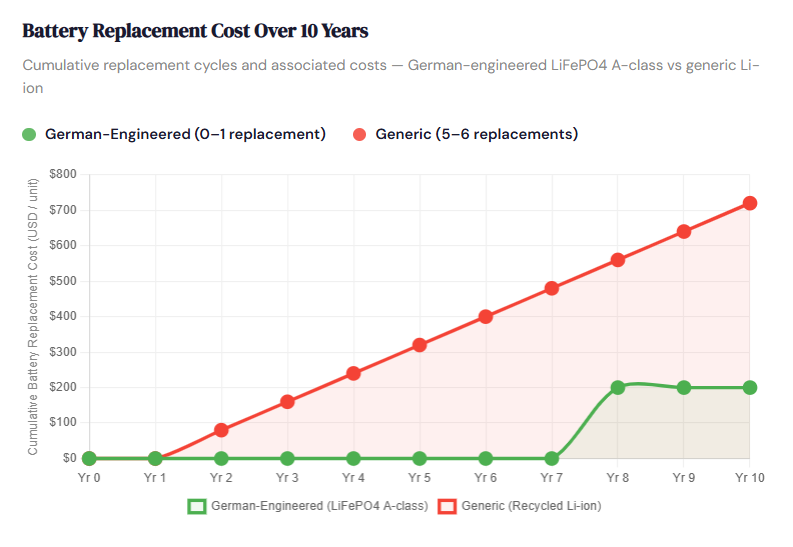
Second, the simulation is only as reliable as the product behind it. German-engineered solar street lights, with TÜV-certified LED performance, verified IES photometric data, A-class LiFePO4 batteries, and MPPT controllers, close the gap between simulated and real-world performance. Generic alternatives create a liability gap that shows up in post-installation inspections, not in the tender document.
Third, investing in professional lighting simulation at the design stage is the most cost-effective form of project risk management available. It eliminates disputes about delivered performance, satisfies FIDIC contract requirements, and gives procurement authorities the technical confidence to award contracts.
Visit solar-led-street-light.com to request a project-specific DIALux simulation report, verified IES files, and a full technical tender package from our German-engineering-standard team.
Frequently Asked Questions
Q1: What is DIALux and why is it used for solar street light tenders? DIALux is the world’s leading professional lighting simulation software, available free in 26 languages and used by lighting engineers on public infrastructure projects globally. For solar street light tenders, it generates photometric compliance reports that demonstrate a proposed lighting layout meets the quantitative requirements of EN 13201 or equivalent road lighting standards. Procurement authorities and international development banks increasingly require DIALux-generated reports as part of technical bid submissions.
Q2: What is the difference between an IES file and an LDT file? Both formats store photometric data, the measured light distribution pattern of a luminaire, but they follow different standards. IES files follow the Illuminating Engineering Society format (North American standard, .ies extension), while LDT files follow European formatting conventions (.ldt extension). DIALux evo accepts both. For international EPC solar street light projects, suppliers should ideally provide both formats to ensure compatibility with the evaluator’s preferred simulation platform.
Q3: Can a solar street light achieve EN 13201 M-class compliance? Yes, but only with the right engineering. EN 13201 M-class compliance requires specific luminance levels, uniformity ratios, and glare control targets. Solar street lights achieving this must have LED efficacy high enough to deliver the required lumens at the design pole spacing, battery systems that maintain consistent output throughout the night without dimming below compliance thresholds, and a solar panel and MPPT controller sized to keep the battery charged in worst-month solar irradiance conditions. German-engineered systems are specifically designed to meet these requirements.
Q4: What is the Maintenance Factor and why does it matter? The Maintenance Factor (MF) accounts for the gradual reduction in a lighting system’s output over its service life due to LED lumen depreciation, soiling of optical surfaces, and lamp failures. It is applied in DIALux to calculate the maintained (not initial) performance values that EN 13201 requires. A typical MF for a well-maintained LED system is 0.75–0.85. A simulation that uses MF = 1.00 is non-compliant and will fail post-installation verification, leaving the EPC contractor liable.
Q5: How many days of autonomy should a solar street light have for an EPC tender? Standard EPC tender specifications for solar street lights typically require 3–5 consecutive nights of autonomy without solar charging, to accommodate cloudy periods. In monsoon or high-latitude winter locations, 5–7 nights may be specified. German-engineered systems use panel sizing of 3–4× the daily load power to ensure adequate charging in worst-month conditions, compared to generic systems that use less than 2.5×, a design shortcut that leads to chronic underperformance.
Q6: What certifications should a solar street light supplier provide alongside IES files for an EPC tender? At minimum, a comprehensive tender package should include: TÜV or equivalent third-party certification for the LED luminaire, CE marking for European-aligned projects, ISO 9001 manufacturing quality certification, UN 38.3 and IEC 62619 for battery safety, and IP67 verification from an accredited test laboratory. Self-certified ratings should not be accepted for any bankable EPC contract.
Q7: How long does a DIALux simulation take to produce for a typical road lighting project? For a standard road section with a defined geometry and verified IES files already on hand, an experienced lighting engineer can produce a preliminary DIALux simulation within 24–48 hours. Final compliance reports with full documentation, including isolux diagrams, calculation grids, and results tables, typically require 48–72 hours. German-engineering-standard suppliers maintain libraries of pre-verified IES files that accelerate this process significantly.
Q8: Can I use DIALux results to compare different supplier proposals in an EPC tender? Yes, but only if all simulations use identical inputs: the same road geometry, the same lighting class, the same maintenance factor methodology, and each supplier’s own verified IES file (not a shared generic file). Bids that do not include model-specific IES files should be flagged as technically unverifiable before price comparison. Standardizing simulation inputs is essential for an apples-to-apples technical evaluation.
References
- European Committee for Standardization (CEN). (2015). EN 13201-2: Road Lighting, Part 2: Performance Requirements. https://www.en-standard.eu/csn-en-13201-1-4-road-lighting/
- European Committee for Standardization (CEN). (2015). EN 13201-3: Road Lighting, Part 3: Calculation of Performance. https://www.en-standard.eu/csn-en-13201-1-4-road-lighting/
- International Commission on Illumination (CIE). (2010). CIE 115: Lighting of Roads for Motor and Pedestrian Traffic, 2nd Edition. https://cie.co.at/
- International Commission on Illumination (CIE). (2000). CIE 140: Road Lighting Calculations, 2nd Edition. https://cie.co.at/publications/road-lighting-calculations-2nd-edition
- DIAL GmbH. (2024). DIALux evo, Professional Lighting Design Software. https://www.dialux.com/
- Illuminating Engineering Society (IES). (2023). IES LM-63: Standard File Format for Electronic Transfer of Photometric Data. https://www.ies.org/
- European Commission Joint Research Centre. (2017). Revision of the EU Green Public Procurement Criteria for Street Lighting and Traffic Signals. https://publications.jrc.ec.europa.eu/repository/bitstream/JRC106647/pr_final_25.08.2017_sci4_pol.pdf
- BEGA Lighting. (2024). Maintained Illuminance According to DIN EN 13201. https://www.bega.com/en/knowledge/lighting-theory/reference-values-for-illumination/maintained-illuminance-according-to-dinen13201/
- DEL Illumination. (2025). Road Lighting Standards 2026: EN 13201 and IESNA Guide. https://solar-led-street-light.com/road-lighting-standards-en-13201-iesna/
- Inlux Solar. (2026). IES & DIALux for Road Lighting: Inputs, Checklist & RFQ Clauses. https://www.inluxsolar.com/solar-street-light/resources/ies-dialux/
Disclaimer
This article is for informational purposes only and does not constitute professional engineering, installation, or procurement advice. Performance specifications and costs may vary based on project requirements, location, and local regulations. Always consult qualified solar energy professionals and legal advisors before making procurement decisions.
For expert consultation on solar LED street lighting solutions, visit solar-led-street-light.com or contact our team for a customized quote.