
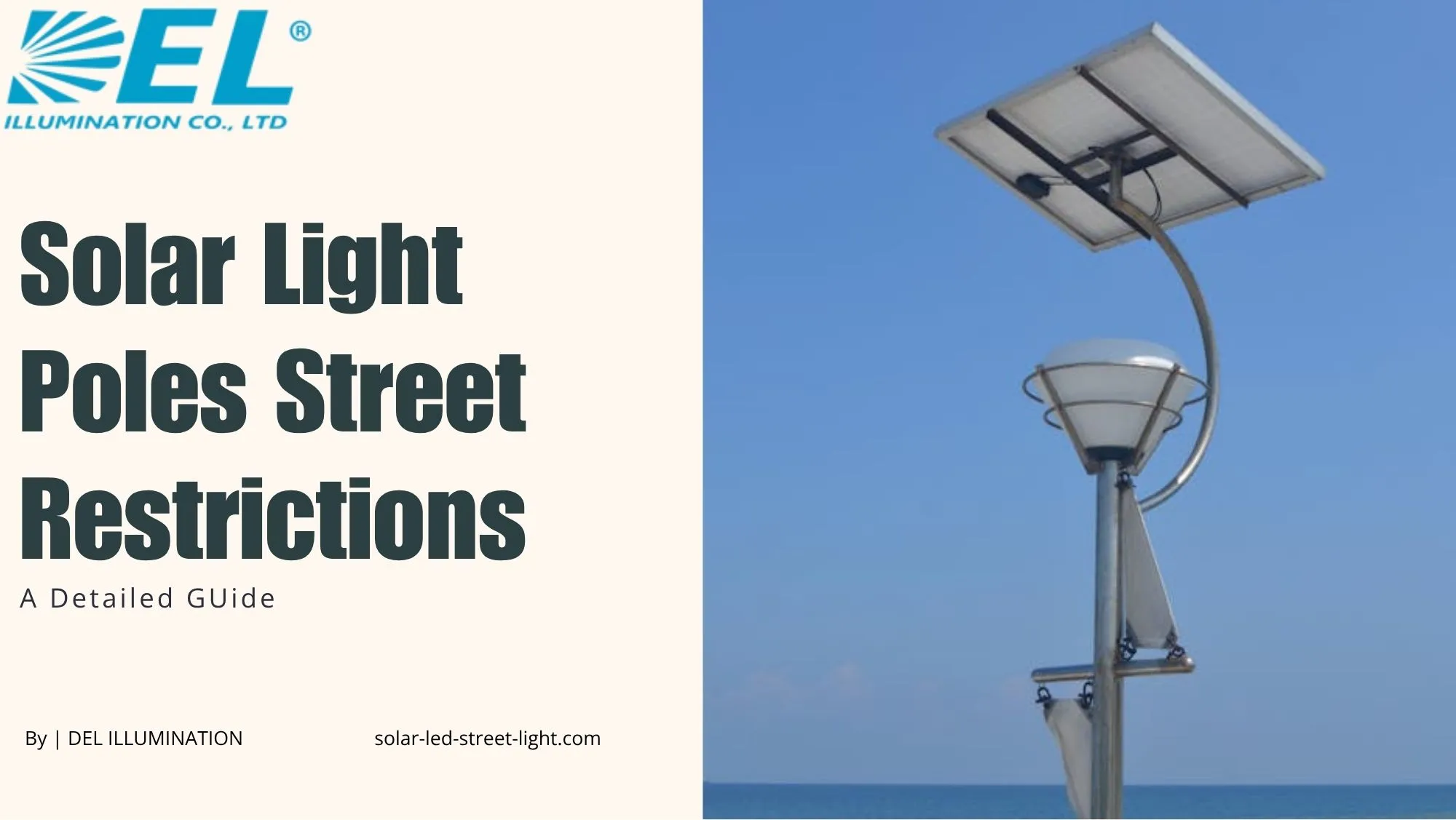
Solar light poles are essential components in the installation of street lighting systems. They provide support to the solar panel, light fixture, and other electronics that are included to improve the performance of the product. They provide the recommendable height to provide the required lighting density and sufficient light to prevent excessive glare and light pollution.
In the design and selection of this type a post for your system, you need to first identify and understand the solar light poles street restrictions in your area. There are a few regulations on where and how you should set up the columns.
Municipal bylaws or community homeowners associations set these restrictions. Most of these regulations are for road safety. This way, the poles will create unreasonable impacts on the property below it during a fall.
The solar light poles street restrictions govern the technology and method used in the installation of the system. The legal restrictions are developed jointly by the local government, state regulatory agencies, the construction industry, professional associations, solar street light companies, and electric utility providers.
Some countries have guidelines for the use of timber material as utility poles. These limitations come as a reaction to rapid deforestation. These measures have led to the use of aluminum material in most of the solar street light projects. The aspect of lightweight in aluminum poles has improved the ease of installation.

Pole Design Restrictions
The posts need to be manufactured and treated following the required standards for a specified project. Some of the restrictions come as a result of the number of solar panels you’re going to use, the type of mount, the design of the pole (solid or hollow) the material type, the weight of the components, and the budget.
In some regions, the allowable Solar energy systems pole may have a height limit of about ten feet.
Pole Mounting Restrictions
Mounting height restrictions come into consideration in areas that are prone to high wind loading rates. In designing your solar street light system, makes sure you abide by the available guidelines for the safety of others.
You can find a restriction of 20 feet for the installation of a solar panel at the top of the pole. In this situation, you’ll need to mount your lighting fixture a few feet below the modules, probably at the height of between 15 and 18 feet.
Pole Distribution Restrictions
When installing solar street lights, there are certain restrictions to do with the pole distribution, the distance between one pole to the other. The expected distance between every two consecutive poles will depend on the LED distribution types. There are six types (I, II, III, IV, V, and VS) of distributions you can choose for your project depending on the area you need to illuminate and the preferred lateral width angle (15, 25, 40, 60, and 360 degrees).
Apart from the luminary distribution types, the Space Height Ratio plays a major role in the calculation of the distance between each solar street light poles. This ratio will change depending on the application; for outdoor use, the ratio should be less than three.
The effort towards spacing the street light poles is to ensure that there are no areas of patches on the road. They need to be placed at consistent intervals to allow the uniform eyes functionality and thus prevent accidents that can result when they adjust to accommodate varying illumination.
Pole Material Restrictions
The environment can also dictate the type of street light pole for your project. A termite-infested area does not allow you to use timber as support. In the coastal region, you will need to use a material that is resistant to corrosion.
You can use any of the following materials in designing for your streetlights, and they include metal (such as steel and aluminum), and concrete. In some states, you will be required to conform to a specific class of concrete for the foundation or standard of steel for the pole.

Pole Installation Restrictions
Another factor that can influence the selection of street light installation is the natural conditions of the area, such as the angle of the terrain, the weather conditions (snow load and wind speeds), the shade covering, or the type of the soil (class).
You can choose to fix your pole into the ground or use an anchor base to accomplish stability. The foundation must cover the specified depth and width recommended by the governing body. They must be suitable for the environment.
In residential areas, installing the poles beyond their limit will violate the upscale development’s deed restrictions if the solar panels extend into someone’s property. For a road path, you may be required to select the poles as per the set-out guidelines and specifications.
Pole Quality Standards
The ISO standard stands out among the other guidelines concerning quality. You may find restrictions in terms of the color coating and material treatment you can use on your solar street light poles. The column should be so strong and have the support that will prevent undesired movement.

Solar Light Poles Street: Conclusion
Generally, the solar light poles street restrictions are confined to a defined area. They rely on the environment, population density, and the surrounding property. All of these types of restrictions will impact your selection of solar light poles for your project. You should count yourself lucky if your municipal law or local government does not require a permit for you to do a solar street light project.
For a successful erection and installation of your Solar Street Light, it is important to make sure to follow the instructions and safety guidelines about the poles. Due to very serious security concerns, you should consult an expert to help you do the installation of solar street lights well.
The nature of a solar street light pole is different from the conventional traditional grid lines posts. This solution requires a different approach, one that a DEL ILLUMINATION specialist can provide. You should get help in designing poles that will achieve the longest lifetime.
Frequently Asked Questions (FAQs)
Q1: What are solar light poles street restrictions, and why do they exist?
Solar light poles street restrictions are legal and regulatory guidelines that govern the design, height, spacing, material, and installation of solar-powered street light poles. They are established by local governments, municipal bodies, and homeowners associations primarily to ensure public safety, prevent property damage, and maintain structural integrity under environmental conditions such as high winds, heavy snow, and corrosive coastal air.
Q2: How tall can a solar street light pole be under typical restrictions?
Height limits vary by jurisdiction, but many residential areas cap solar energy system poles at around 10 feet. In roadway or commercial applications, poles can go higher – often up to 20 feet or more – but the mounting height for the solar panel is frequently capped at 20 feet, with the light fixture positioned 2 to 5 feet below it. Always verify with your local authority before finalizing pole height.
Q3: What materials are commonly allowed for solar street light poles?
The most widely accepted materials include aluminum, galvanized steel, and pre-stressed concrete. Timber is restricted or banned in many regions due to concerns about deforestation and termite vulnerability. In coastal environments, corrosion-resistant materials like marine-grade aluminum are typically required. Some states also mandate specific grades or classes of steel and concrete for the pole and foundation respectively.
Q4: How is the correct spacing between solar street light poles determined?
Pole spacing is determined by the type of LED light distribution (Types I through VS) and the Space-to-Height Ratio (SHR), which should generally be below 3 for outdoor roadway applications. The goal is to achieve uniform illumination across the road surface with no dark patches. Using the correct spacing formula based on luminaire distribution type and mounting height ensures both safety compliance and energy efficiency. See our LED solar area light distance calculator guide for details.
Q5: Do I need a permit to install solar street light poles?
In most jurisdictions, yes – a permit is required for installing solar street light poles, especially in public right-of-way areas or residential neighborhoods. Permit requirements typically involve submitting engineering drawings, specifying materials, and demonstrating compliance with local solar light poles street restrictions. Some rural or low-density areas may have simpler processes, but it is always advisable to consult your local municipal authority before beginning any installation.