
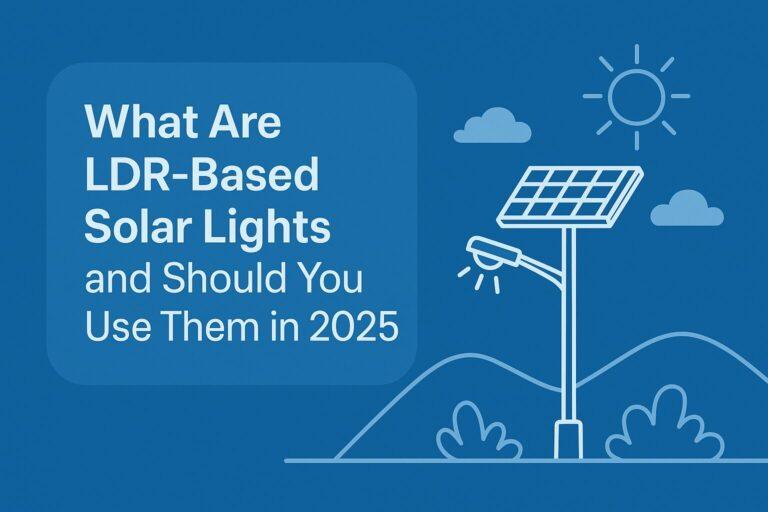
LDR-Based Solar Lights: What They Are and How They Work
If you’ve ever seen a light turn on by itself at dusk and switch off at sunrise, you’ve watched a photocell at work. Many of those “set-and-forget” fixtures rely on an LDR, a light-dependent resistor, to sense ambient brightness and trigger the light automatically. In 2025, LDR-based solar lights are still widely used, but they’re not the only option, and they’re not always the best one for every application.
In this guide, we’ll explain what LDRs do, where they shine (pun intended), where they fall short, and how they compare with other ambient light sensors. By the end, you’ll know exactly when to choose dusk-to-dawn solar lights driven by LDRs, and when a different control strategy makes more sense.
Quick Summary (for busy specifiers and facility managers)
- LDR-based solar lights use a photoresistor to detect ambient light and turn fixtures on at dusk/off at dawn. Simple, proven, low-cost.
- For public right-of-way and commercial sites, LDRs are still common for dusk-to-dawn control; however, photodiodes/phototransistors or integrated ambient light sensor ICs offer better linearity, faster response, and tighter thresholds—useful where standards and uniformity matter.
- PIR motion is not a replacement for an LDR; it detects movement (heat changes), not daylight. PIR is great for adaptive dim/boost, not day/night switching.
- In 2025, be mindful of materials compliance for CdS photoresistors under EU RoHS (cadmium restrictions with evolving exemptions). If you sell or deploy into the EU/UK, confirm supplier compliance.
- For the energy system, pair dusk-to-dawn solar lights control with LiFePO₄ batteries and MPPT charge controllers for longer life and better performance in low-irradiance or cold conditions.
What Is an LDR and How Does It Control a Solar Light?
An LDR (light-dependent resistor), also called a photoresistor, changes its resistance based on the amount of light hitting it: high resistance in the dark, low resistance in bright light. In a simple control circuit, the LDR forms part of a divider that feeds a controller input; once the measured voltage crosses a threshold, the controller turns the light on or off. It’s simple, strong, and inexpensive, which is why LDRs have been used for street lighting and automatic night lights for decades.
This “dusk-to-dawn” behavior (on at dusk, off at dawn) is exactly what most property owners want for safety, visibility, and convenience. Hence the frequent conflation of terms: LDR-based solar lights, photocell solar lights, and dusk-to-dawn solar lights are often referring to the same outcome—though the sensing element can differ.
LDR vs Photocell vs Ambient Light Sensor: What’s the Difference?
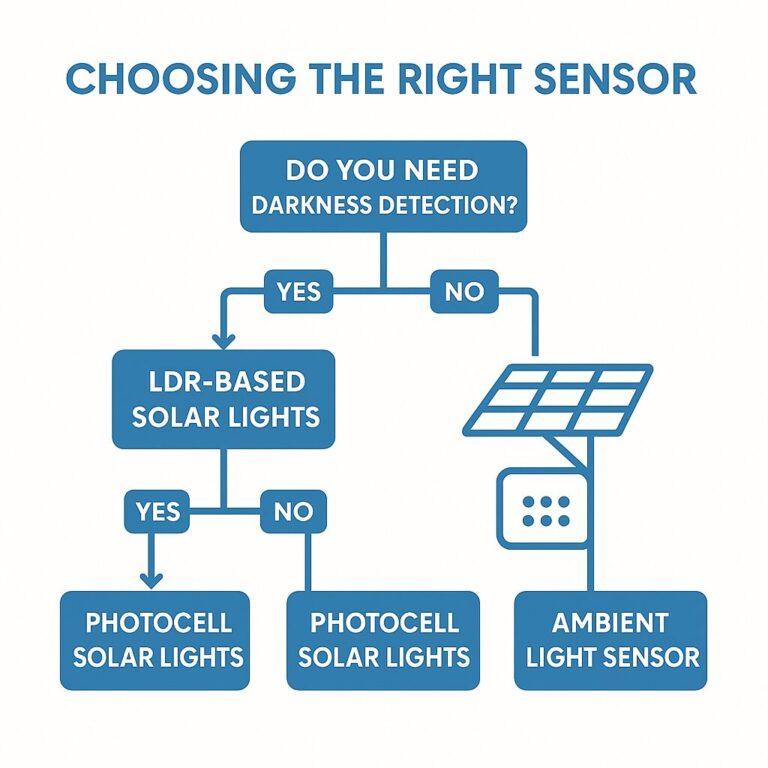
Here’s where terminology gets messy:
- Photocell (general): colloquial umbrella term for “light sensor” in lighting controls. It could be an LDR, a photodiode, or a phototransistor.
- LDR (photoresistor): passive component whose resistance changes with light. Pros: low cost, simple circuit. Cons: slower response, less linear, temperature-dependent, typically broad spectral response, and material/compliance considerations (CdS).
- Photodiode/Phototransistor: active semiconductor light sensors producing current in response to light. They offer faster response, better linearity/threshold accuracy, and tighter control, which can translate to more consistent switching at the target lux level.
- Ambient Light Sensor (ALS) IC: integrated device that often mimics human eye response (photopic), filters IR, and communicates digitally with the controller. Great for precise lux thresholds and immunity to IR contamination from sunsets or nearby sources.
Bottom line: LDR vs photocell vs ambient light sensor isn’t a simple either/or; “photocell” is the behavior, LDR is one way to achieve it, and ALS/photodiode-based designs are modern alternatives when you want tighter control, faster response, or cleaner compliance documentation.
How Dusk-to-Dawn Control Actually Works On a Solar Street Light
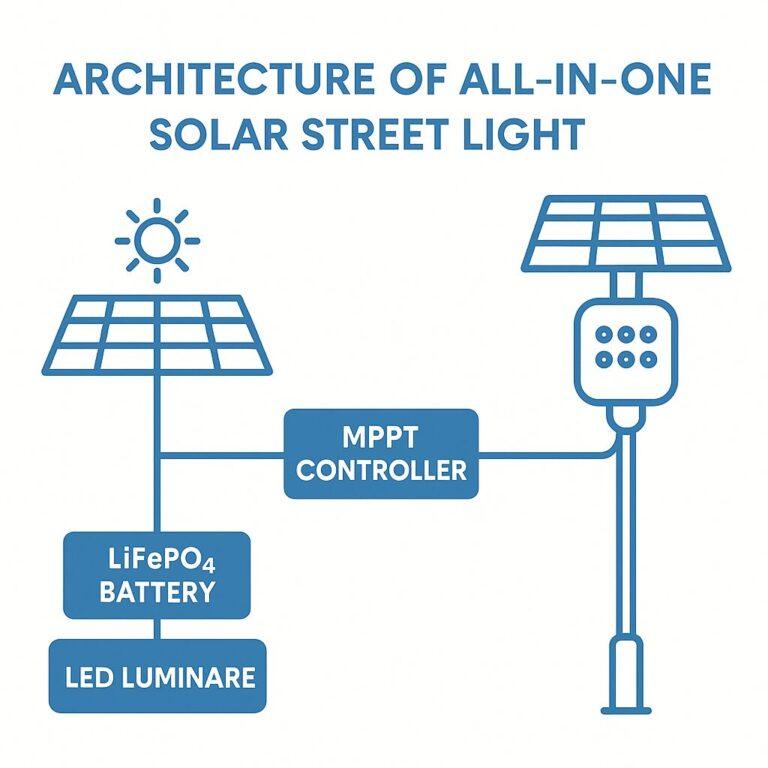
In a typical all-in-one solar street light, the control board monitors battery voltage, panel input, and a light sensor. When the sensed illuminance drops below a set threshold (e.g., civil twilight), the controller powers the LEDs. At sunrise—when light rises above the threshold—it turns them off. This automation improves safety and energy efficiency with no manual intervention.
Well-designed systems let you calibrate that threshold (e.g., 10–30 lux) to match local conditions, light pollution, and standards such as target lux levels on sidewalks, car parks, and pathways. (Professional guidance varies by application; consult regional standards or design guides.)
LDR- Based Solar Lights Pros and Cons
| Pros of LDR-based solar lights | Cons of LDR-based solar lights |
|---|---|
| Cost-effective: LDRs are inexpensive, so total system cost comes down. | Accuracy and drift: Temperature and aging can shift the switch point; thresholds can vary between units more than with photodiodes/ALS ICs. |
| Simplicity: Minimal circuitry, fewer failure points, fast to integrate. | Response time: LDRs generally react more slowly than photodiodes, which can cause lag near dawn/dusk or under fast-changing conditions (e.g., storms). |
| Proven behavior: Time-tested dusk-to-dawn solar lights operation for residential and light commercial sites. | Spectral sensitivity: Broad response can be influenced by non-visible components or nearby light sources, making calibration important in urban environments. |
| Compliance considerations: Many LDRs are cadmium sulfide (CdS). If you deploy/sell into EU/UK markets, RoHS restricts cadmium, with exemptions that have been updated in May 2024—you’ll want documentation from your supplier. |
Where LDR-Based Solar Lights Fit Best in 2025
Residential yards, gardens, pathways: Straightforward dusk-to-dawn behavior with occasional foot traffic. Add PIR “boost” if you want better nighttime autonomy. (Dusk-to-dawn covers wayfinding; PIR adds momentary security lighting.)
Low-risk parking lots, campus paths, HOA entries: If design targets are modest and the priority is cost, LDR-triggered fixtures with time-dimming (e.g., 100% at evening, 50% after midnight) work well. Smart controllers with MPPT help maximize charge on cloudy days.
Read our blog: Best Solar Streetlights for Highways, Parking Lots, Seaside, and Campuses
When the stakes are higher, arterials, compliance-sensitive areas, or light-pollution-sensitive zones, consider a system aligned to industry practices:
Photocontrol standards for roadway lighting (e.g., ANSI C136.10/.41 for locking-type photocontrols and dimming interfaces) exist to ensure interchangeability and control quality in municipal deployments. If you’re doing city or utility work, spec against these families of standards.
Light pollution/obtrusive light guidance (CIE 150:2017 and ILP GN01/21) sets expectations for limiting sky glow, trespass, and glare. Controllers and optics must work together: even perfect dusk/dawn control won’t fix poor optical distribution or uplight.
If your project requires tight lux thresholds, documented photopic response, or fast transient response (e.g., tunnels, pedestrian crossings with dynamic conditions), consider photodiode/ALS-based sensors tied to the controller instead.
Don’t Confuse PIR with Photocell: They Solve Different Problems
A lot of spec sheets mention PIR (passive infrared) and dusk-to-dawn in the same breath. They’re complementary:
- Photocell/LDR/ALS: detects ambient light for day/night switching.
- PIR: detects motion (changes in infrared) to brighten/boost or activate a security pattern. It’s ideal for adaptive lighting and energy savings in low-traffic periods but doesn’t know whether it’s day or night without a light sensor in the loop.
System-Level choices that Matter More Than the Sensor, Long-Term
Even perfect day/night switching won’t save a system with weak energy storage or inefficient charging.
- Battery chemistry: LiFePO₄ is the sweet spot for modern solar street lights—stable, long cycle life, better performance in cold and heat than many lead chemistries. It still needs temperature-aware charging and proper sizing.
- Charge controller: MPPT (Maximum Power Point Tracking) extracts more energy from the panel—especially in low-irradiance or cold conditions—than PWM, helping the light make it through long winter nights. Costs more up front but often pays back in reliability and autonomy.
- Optics and IP rating: Optics ensure even light on the ground (hit your lux targets), and IP66-class enclosures keep dust and water out for multi-year reliability. (Always confirm the full fixture spec, not just the sensor.)
Should you choose LDR-based solar lights in 2025?
Choose LDR-based if you need:
- Reliable dusk-to-dawn solar lights at the best cost.
- Simple integration with existing fixtures or controllers.
- Residential/light-commercial deployments where ±a few lux in switching threshold isn’t critical.
Consider photodiode/ALS-based photocell solar lights if you need:
- Precise thresholds that align with a lighting design (Dialux/AGi32) or municipal standards.
- Faster response near twilight, or immunity to tricky spectral conditions (snow glare, nearby decorative lighting).
- Compliance documentation for EU/UK markets—ask for RoHS declarations and sensor BOM details.
Either way, pair your control with LiFePO₄ batteries and MPPT charging for the best “it just works” experience through seasonal changes.
2025 Regulations and Component Availability for LDR-Based Solar Lights
Because many LDRs use cadmium compounds, they fall under EU RoHS restrictions (cadmium content limits with specific exemptions). The European Commission updated cadmium exemptions in May 2024; the current framework maintains exemptions for certain uses while refining timelines.
If you manufacture or import to the EU, verify supplier compliance and the exact exemption that applies to your component selection.
For end users/buyers, this mostly means reputable vendors will keep shipping RoHS-compliant products, but it’s smart to ask for RoHS declarations when sourcing at scale.
Practical Tips to Get LDR-Based Dusk-to-Dawn Solar Lights Right
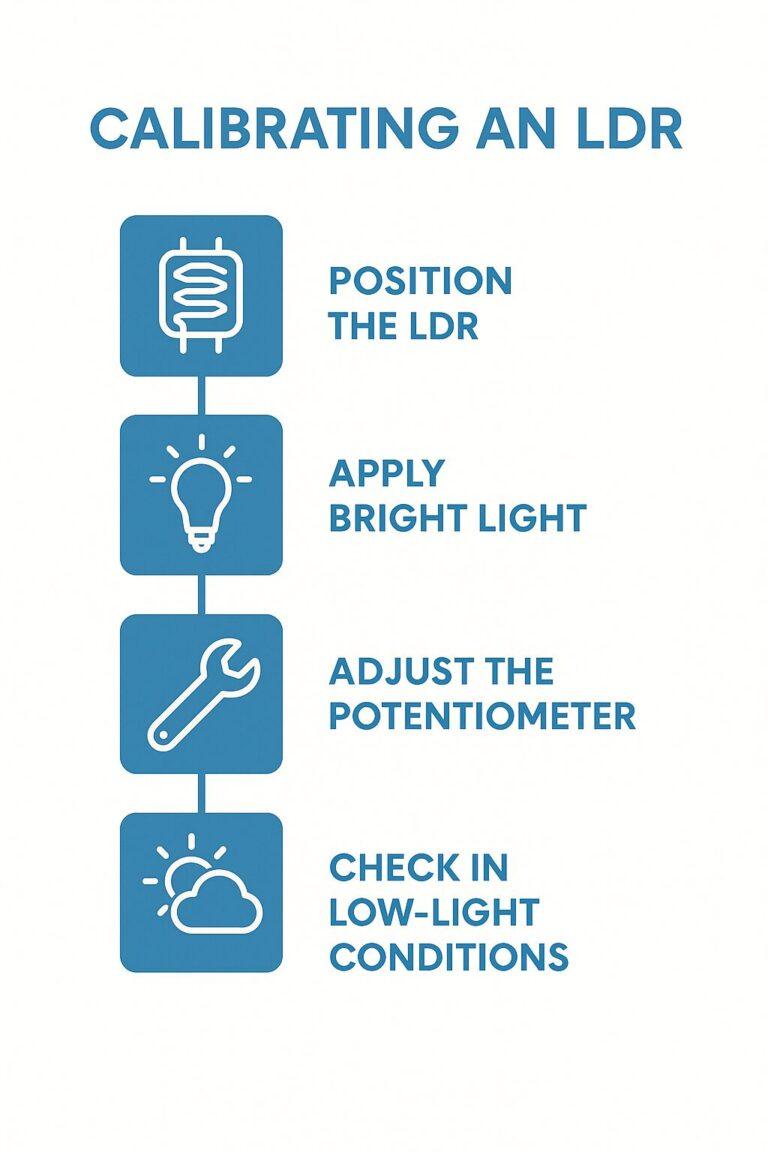
- Mount the sensor correctly. Keep the LDR or photocell with a clear view of the sky—away from the beam of the luminaire and not shaded by eaves or signage. (Avoid “self-illumination” that keeps the light off.)
- Calibrate the threshold. Start conservative (e.g., around 20 lux) and fine-tune to local conditions after a week of observation. Match your lighting design’s target illuminance.
- Use time delays (hysteresis). Prevent on/off flutter around twilight or during fast-moving clouds by using a controller with delay and hysteresis. (Many modern controllers include this.)
- Plan for environment. Near coastal fog, snow, or urban glare, expect to tweak thresholds or consider an ALS.
- Verify compliance. If the sensor is CdS-based and your install is in the EU/UK, capture RoHS docs from the supplier; exemptions were updated in May 2024.
Real-world Use Cases
- Neighborhood street retrofit (budget-led): LDR photocell solar lights deliver dusk-to-dawn coverage with minimal commissioning. Pair with LiFePO₄ + MPPT to ensure winter autonomy.
- University car parks (light pollution nearby): Start with LDR but expect a bit of trial on thresholds; consider stepping up to an ALS if neighboring signage causes premature shutoff.
- Municipal pedestrian corridor (specified lux): Use photodiode/ALS-based photocell solar lights for tighter switch points; add PIR for late-night dim-to-bright events.
2025 Buyer’s Checklist (Use This to Vet Vendors)
- Control mode
Dusk-to-dawn via LDR or via ambient light sensor IC?
Is there time-dimming and PIR boost capability?
- Charge controller
MPPT preferred for better harvest in low-irradiance or cold conditions; confirm LVD setpoints are configurable and aligned with your battery chemistry (e.g., LiFePO₄ vs lead-acid).
- Battery
For long life and deep cycling, LiFePO₄ is the 2025 benchmark in solar street/area lights. (Look for realistic autonomy claims—3–5 days is common in quality systems.)
- Solar Lighting Factory
Optics & compliance
Ask for photometric files and BUG rating; design to CIE/ILP guidance where applicable.
- Environmental robustness
IP65/66 housings, corrosion resistance, and cable glands matter more than the sensor choice in salty or dusty sites.
- Documentation
For EU projects: request RoHS declarations, including any cadmium exemptions applicable to LDR components.
When to Choose LDR-Based Solar Lights (and When Not To)
Choose LDR-based solar lights when you need reliable dusk-to-dawn behavior at the lowest cost and your site isn’t compliance-sensitive. Add PIR if you want to stretch autonomy without oversizing the system.
Choose ambient-sensor-driven (photodiode) or smart-controller systems when you need:
- Stricter lighting codes or environmental constraints (CIE/ILP).
- System-level telemetry, fine control of lux thresholds, or networked profiles.
- Municipal or utility interchangeability with ANSI C136 accessories.
FAQs (Use Cases & Buyer Questions)
1. Are LDR-based solar lights good for street/parking/yard?
Yes, especially when you want dusk-to-dawn solar lights that simply turn on at night and off in the morning, with minimal maintenance and low cost. For yards and residential streets, LDR-based systems are a solid default. For parking lots and public walkways, they work well if slight variations in switch points aren’t a problem; if you need tighter control tied to a lighting plan, consider photodiode/ALS-based sensors.
2. When not to use LDR-based solar lights?
Avoid LDR-only control when your project needs precise thresholds, rapid response, or strict compliance documentation (e.g., EU/UK RoHS paperwork around cadmium). In these cases, go with photodiode/ALS solutions or make sure your supplier provides clear compliance statements and stable thresholds.
3. How to fine-tune LDR for ambient light pollution?
Start with a conservative dusk threshold (around 15–25 lux) and verify ground-level illuminance with a meter after dark. Adjust in steps until you meet your target lux for the application (residential paths vs. car parks have different benchmarks). Use controllers that support delay/hysteresis to prevent flutter from nearby shopfronts or traffic. If you’re surrounded by bright signage or glass facades, consider an ALS with a photopic response curve for better consistency.
4. Why are my LDR solar light always on/off?
Always on (even in daylight): The sensor may be shaded, contaminated (paint/dust), or “seeing” only darkness due to placement. Clean the sensor window; remount with sky exposure; check wiring/polarity.
Always off (even at night): The sensor might be lit by the fixture’s own beam or nearby lighting; relocate or shield it. Verify threshold settings and ensure the controller’s time delay isn’t set excessively high.
Random flicker at dusk/dawn: Add or increase hysteresis and time delay; in high-glare areas, consider upgrading to a photodiode/ALS input.
The Bottom Line for 2025
LDR-based solar lights remain a dependable, cost-effective way to achieve photocell solar lights behavior—true dusk-to-dawn operation with minimal setup. They’re ideal for residential and many commercial contexts where you value simplicity and budget.
If your project demands tighter lux control, rapid response, or formal compliance documentation, step up to photodiode/ALS-based sensing. And regardless of sensor choice, your system’s real-world reliability will ride on battery chemistry (LiFePO₄) and MPPT charging, the two upgrades that keep lights on when nights are long and weather is uncooperative.
Ready to spec a system?
If you’re planning a parking lot, pathway, or neighborhood lighting project and want clear recommendations (sensor type, optics, battery pack, and controller sizing), we can help you design a package around your site conditions—no guesswork.
Talk to our team and we’ll propose a configuration that balances cost, performance, and compliance for your exact use case.