
The global solar street lighting market is experiencing unprecedented momentum. According to Fortune Business Insights, it is expected to grow from the current value of $12.23 billion to $33.26 billion by 2034.
Yet a significant percentage of installations underperform or fail prematurely. Why? The answer often lies beneath the panel: improper solar street lighting battery sizing.
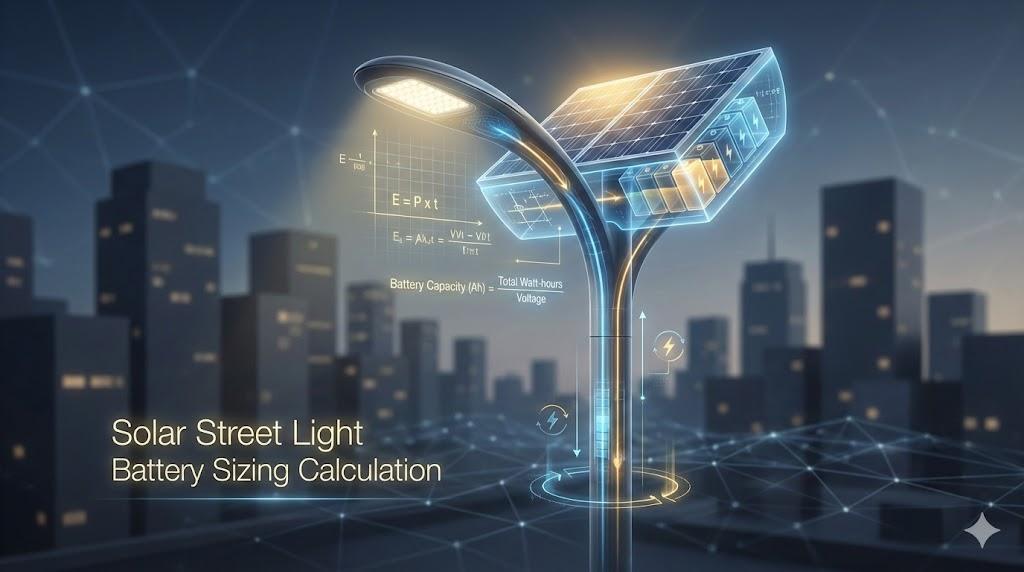
This technical mistake is really costly. Undersizing your storage leads to blackouts, whereas oversizing inflates the budget. In this blog, we will walk you through the precise solar street light battery sizing calculation to make sure that your installations are built to withstand real-world conditions.
Why Solar Street Light Battery Size Is Critical for Project Success
Even though the solar panel collects the energy, the battery is the heart of the system that keeps it going. Here is why getting the right solar street light battery size is so important for a long-lasting installation:
1. Reliability
Nature is hard to predict. A properly sized battery can handle autonomy days, which are days of continuous rain, fog, or heavy cloud cover. If your solar energy storage capacity is too small, just two days of cloudy weather can leave streets completely dark. This is pretty dangerous and could lead to lawsuits.
2. Battery Lifespan
Batteries can only go through a certain number of cycles. If a battery is too small, it has to drain a lot every night to keep the lights on. This high Depth of Discharge (DoD) cuts the battery’s life short by a lot, which means you have to replace units years earlier than you thought.
3. Balance of CapEx and OpEx
There is a fine line between efficiency and waste. Oversizing the battery bloats your upfront capital expenditure (CapEx) unnecessarily. Undersizing it skyrockets your operational expenditure (OpEx) due to frequent maintenance and replacements. Precise calculation is required for optimizing the solar street lighting budget.

Important Parameters Required for Solar Street Light Battery Sizing Calculation
Solar street light battery sizing should be determined based on specific parameters that define your system’s energy profile and operational requirements. Here are the main factors that decide the right battery capacity for solar street lights:
1. Daily Load Consumption (Watt-Hours)
Start with your nightly energy demand. To figure that out, you need to multiply fixture wattage by operating hours. For example, a 30W LED running 5 hours at full power and 7 hours at 50% brightness consumes approximately 255 Wh per night.
Don’t forget about extra loads like motion sensors, WiFi modules, or security cameras. These will increase the amount of energy your solar lighting system needs.
2. Days of Autonomy
Autonomy is the number of nights your system can run without solar charging when it’s cloudy or stormy. It’s usually 2-3 days for urban installations, and 4-5 days for remote locations.
Similarly, sites with extended winter cloud cover may have higher autonomy days and need more supplementary charging capacity to maintain solar street light battery performance year-round.
3. Depth of Discharge (DoD)
Different types of batteries can handle different levels of discharge. For instance:
- Lead-acid batteries usually use 0.7 DoD
- Lithium batteries allow 0.8 DoD.
That means you can safely use more of the lithium battery’s capacity without hurting the cells.
Designing beyond the recommended DoD speeds up degradation and cuts the battery life of solar street lights by a huge amount.
4. System Voltage (12V/24V)
The architecture of your system, whether it’s 12V or 24V, affects the current flow, the cable size, and the choice of components. According to industry experts, the fixtures that use more than 40W should use higher voltage (25.6V) systems to reduce cable losses and controller current. This choice affects how you calculate the final amp-hour and the overall efficiency of your off-grid solar system.
5. System Losses
Real-world conditions reduce theoretical capacity. Industry practice applies a 0.85 factor for battery losses due to many factors, such as:
- Account charge/discharge inefficiencies
- Temperature effects
- Controller consumption
Also, batteries lose 10 to 20 percent of their capacity when the temperature drops below freezing.
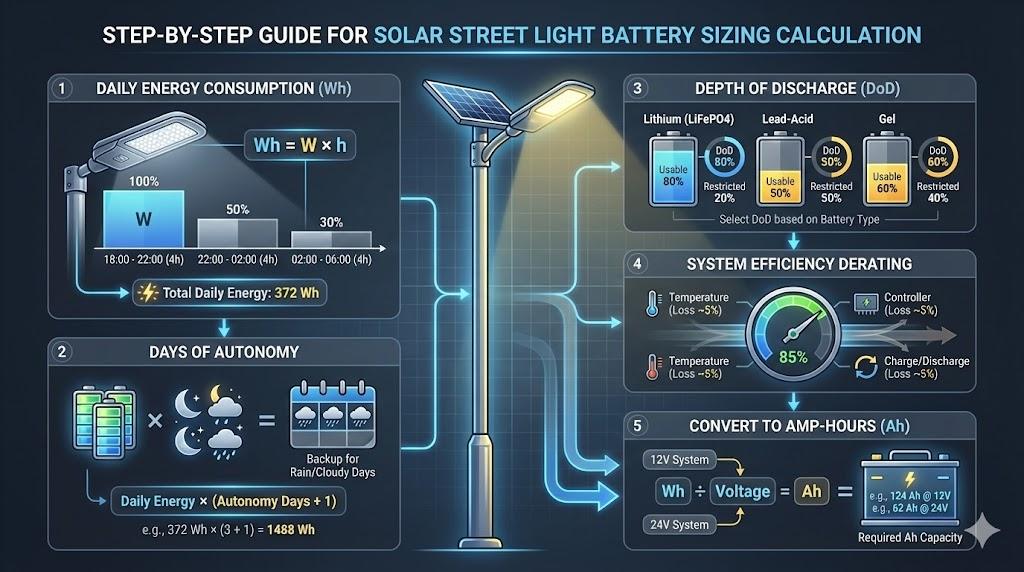
Step-by-Step Guide For Solar Street Light Battery Sizing Calculation
Now that we have our parameters, it is time to do the math. Here is the professional workflow to calculate the perfect solar street light battery size:
1. Calculate Daily Energy Consumption
First of all, calculate your night power requirements. This forms the foundation of your entire solar street light battery size calculation. The formula is:
Daily Energy (Wh) = LED Power (W) × Operating Hours (h)
Take the case of a 60W LED fixture with dimming capability:
- Hours 1-2: 100% brightness (60W × 2h = 120 Wh)
- Hours 3-8: 50% brightness (30W × 6h = 180 Wh)
- Hours 9-12: 30% brightness (18W × 4h = 72 Wh)
Here, the total daily consumption would be 372 Wh per night.
2. Apply the Days of Autonomy Multiplier
Next, we size the battery to survive bad weather. If your location experiences consecutive rainy days, your battery must store enough energy to cover them without any recharge. Here’s how we calculate it:
Total Energy Required = Daily Consumption × (Autonomy Days + 1)
The ‘+1’ accounts for the night before rainy days begin. So, 3 backup days means 4 total nights of storage.
3. Adjust for Depth of Discharge (DoD)
This is the step most amateurs miss. You cannot drain a battery to 0%. You must divide your total required energy by the safe Depth of Discharge (DoD) percentage of your battery chemistry to protect your solar street light battery lifespan.
Here’s the DoD values of the most common battery materials:
| Material | Depth of Discharge (DoD) |
| Lithium (LiFePO₄) | 80-90% DoD |
| Lead-Acid (AGM) | 50% DoD |
| Gel Batteries | 60-70% DoD |
The formula is:
Required Battery Capacity (Wh)= Total Required Energy Storage / DoD %
4. Apply System Efficiency Derating
Real-world conditions require dividing by 0.85 to account for battery charging and discharging losses, temperature effects, and controller consumption.
Adjusted Capacity = Required Capacity ÷ System Efficiency (usually 0.80-0.85)
5. Convert to Amp-Hours (Ah)
Most datasheets and tenders specify battery capacity in Ampere-hours (Ah), not Watt-hours. To get this number, you divide your final energy requirement by the system voltage (usually 12V or 24V).
Battery Rating (Ah)= Required Battery Capacity (Wh) / System Voltage (V)
How to Verify Battery Performance Post-Installation
So, the poles are up, the lights are on, and the contractor says the job is done. But as a project manager, how do you know the solar street light battery size installed is actually what was promised?
Here is how you audit and verify battery performance before you sign the final handover document:
1. The Voltage Drop Load Test (Field Test)
This is the quickest way to spot a weak or undersized battery without specialized lab equipment. Here’s how to do it:
- Measure the battery voltage when the light is OFF (Open Circuit Voltage). It should be stable (e.g., ~13.4V for a full 12V LiFePO4 battery).
- Cover the solar panel to trick the system into ‘Night Mode’ and force the light to turn on.
- While the light is ON (Under Load), measure the voltage again.
A properly sized battery will show a very slight drop (e.g., 0.1V – 0.5V). If the voltage drops quickly and a lot (for example, from 13V to 11V), the battery has a lot of internal resistance or is too small for that load.
2. 72-Hour Autonomy Simulation
This is the best way to check the days of autonomy. It takes some time, but it gives you proof that is hard to deny.
You just need to disconnect the solar panel (or cover it completely with a thick tarp) to prevent any charging. Let the street light run purely on battery power for the number of autonomy days specified in your tender (usually 2-3 nights).
If the light dims significantly or cuts out completely before the end of the test period, the solar energy storage capacity is insufficient, or the DoD limit was miscalculated.
3. Remote Monitoring Systems (RMS) Data
It’s not possible to test by hand for big government projects with more than 50 lights. This is where IoT-based Remote Management becomes your best auditor.
Luckily, there are many new MPPT controllers with IoT/GPRS that let you log in to a dashboard and see data in real time.
Check the Voltage Curve right before dawn. If the battery voltage is dangerously close to the Low Voltage Disconnect (LVD) point every morning, your battery is undersized and will fail prematurely.
4. Visual And Physical Integrity Check
Don’t ignore the hardware.
You must look for rust or white powder on the terminals. This makes them less efficient and wastes power.
Similarly, verify the manufacturing date on the battery casing. Installing new batteries that have sat in a hot warehouse for 2 years means they have already lost cycle life.
Frequently Asked Questions (FAQs)
- How do you calculate the size of the battery in a solar street light?
To calculate the correct size, you must first determine the total daily energy consumption (Watt-hours) of your LED fixture, including any dimming profiles. Multiply this daily load by your required Days of Autonomy (backup days), then divide the result by the system voltage and the battery’s safe Depth of Discharge (DoD) limit to get the required Ampere-hours (Ah).
- What is the formula for battery size calculation?
The industry-standard formula for solar street light battery sizing is: Battery Capacity (Ah) = (Daily Watt-hours × Days of Autonomy) ÷ (System Voltage × Depth of Discharge).
- What is the ideal Depth of Discharge (DoD) for solar batteries?
For Lithium Iron Phosphate (LiFePO4) batteries, the ideal DoD is 80%, which balances capacity with a long cycle life. For older Lead-Acid or Gel batteries, you should never exceed 50% DoD. That means you need a battery twice the size of your actual energy requirement to avoid damaging the cells.
- How many days of autonomy are required for solar street lights?
For standard commercial or municipal projects, 2 to 3 days of autonomy is the recommended baseline to withstand typical overcast weather. However, for critical infrastructure or regions with heavy monsoon seasons, we recommend sizing for 4 to 5 days to guarantee zero blackouts.
Conclusion
It is often tempting to look at a tender and shave off a few Amp-hours to meet a tight budget. But in infrastructure, reliability is the only currency that really matters. The solar street lighting battery sizing calculation you do today determines whether your phone rings with complaints six months from now or if your project stands as a successful testament to green energy for years to come.
At DEL Illumination, we believe that true sustainability is all about building systems that endure. That’s why we rigorously test and size every component to ensure that when the storm clouds roll in, your lights stay on.
Want to build a solar project that stands the test of time? Contact us now for more information!