
Overview: Performance of Solar Lights in Rainy and Cloudy Weather
Solar street lighting has revolutionized outdoor illumination for cities and infrastructure projects, especially across emerging regions in Southeast Asia, Africa, and South America. Yet a common concern remains: Can solar lights withstand rain, fog, and overcast days?
Decision-makers in municipalities and road construction firms need confident answers backed by engineering expertise. The short answer is yes, modern solar street lights are purpose-built to perform reliably in inclement weather. These systems combine weatherproof solar lights hardware and smart energy management to ensure streets stay lit even under gloomy skies.
In this blog, we delve into how solar lights in rainy and cloudy weather maintain performance, the technology and design features that make them resilient, and what specifications (like IP ratings and battery autonomy) to look for when planning projects in challenging climates.
Understanding Weather Challenges for Solar Street Lights
Deploying solar street lights in tropical and subtropical climates means contending with heavy rains, frequent cloud cover, and occasional fog. Unlike traditional grid-powered lights, solar units harvest energy from sunlight – so anything that reduces solar irradiance (like clouds or fog) or physically impacts the hardware (like rain or humidity) could affect performance.
It’s important to understand that solar panels do not require direct sun to generate power; they can produce electricity from diffuse or indirect light, though at lower efficiency. Overcast days typically reduce a panel’s energy output compared to clear days, but they don’t zero it out.
In fact, depending on cloud density and panel quality, solar panels might generate around 10–30% of their normal energy output on very cloudy days, meaning a 70–90% drop in efficiency is possible under thick cloud cover. On lighter cloudy days the drop is much smaller (perhaps only 10–25%). Foggy conditions have a similar effect – one source notes that typical coastal fog can cut solar output roughly in half.
Rainy conditions present two aspects: reduced sunlight due to clouds, and the physical effect of rain on equipment. The lack of sun during storms or extended rainy periods means less solar panel output, which could drain the battery if the situation persists for many days. However, quality solar street lights mitigate this by storing surplus energy on sunny days and by using intelligent controllers to ration power when needed.
Let’s explore exactly how modern solar street lights tackle cloudy skies, heavy rain, and foggy mornings.
Solar Lights in Rainy and Cloudy Weather
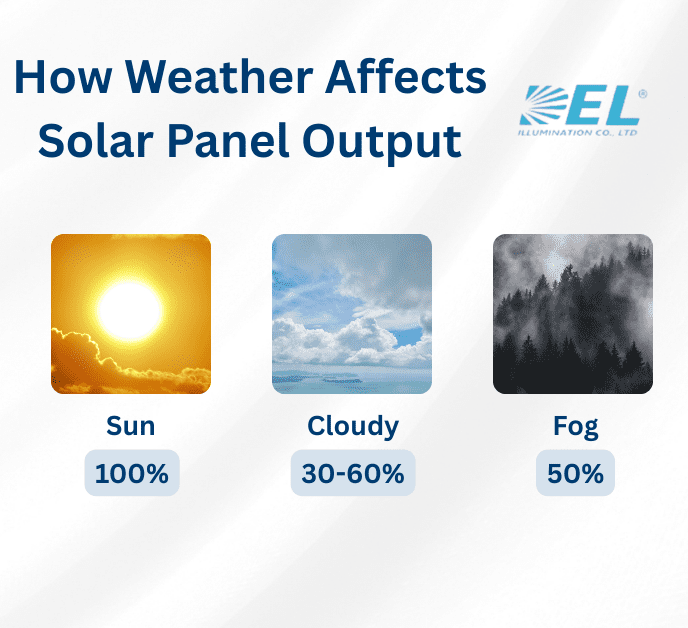
This is how weather affects solar panel output. Street lighting systems have evolved to maintain dependable performance by implementing weatherproof rainy season solar street lights. In regions with monsoons or prolonged wet seasons, engineers account for these factors during system design.
Here’s how solar lights perform and adapt when faced with clouds and rain:
Solar Lights on Cloudy or Overcast Days
Even on overcast days, solar panel output continues to generate electricity from ambient light. High-quality panels (especially monocrystalline silicon panels) are very effective at capturing diffuse sunlight that penetrates clouds. The immediate impact of clouds is a reduction in charging efficiency – instead of full output, a panel might produce only a fraction of its capacity.
For instance, field data has shown that in very cloudy, dark winter months, solar panel output still charged batteries to about 70% of capacity on most days. In practical terms, expect a somewhat softer, dimmer glow from solar street lights on a heavily cloudy day, compared to their brightness on a clear day.
Modern systems mitigate this by using Maximum Power Point Tracking (MPPT) charge controllers, which continuously optimize the panel’s operating point to squeeze out maximum power even when sunlight is weak or indirect. An MPPT controller can yield up to 20–30% more energy from the panel under cloudy conditions compared to older PWM controllers. This means that even when the sun hides, the system is intelligently adjusting to harvest what energy it can.
To illustrate, consider a scenario of a fully overcast afternoon: the solar street light will still charge its battery, just at a slower rate. Energy management software in the light can compensate by, for example, dimming the LED output slightly or shortening the illumination hours to ensure the available battery charge lasts through the night.
Performance During Rainy Days and Wet Seasons
Rainy days pose little threat to the hardware of a solar street light – these units are designed for outdoor use and can brave the downpour without damage. The critical factor is the cumulative effect of many rainy or heavily overcast days. In tropical regions, it’s common to have several days of continuous rain (e.g. monsoon conditions).
Solar street lighting systems counter this by incorporating large battery capacities and efficient LEDs so that even if charging is subpar for a day or two, the stored energy will cover the nights. Such a buffer is crucial for rainy season solar street lights in places like Southeast Asia, where a week of stormy weather might otherwise knock out the lighting.
Manufacturers determine this autonomy by analyzing local climate data and sizing the solar panel output and battery accordingly – areas with longer rainy seasons or winters get proportionally larger or more panels and batteries.
Another aspect is that rain often helps with maintenance: as mentioned, a good rain can wash dust and pollutants off the solar panel’s glass, which keeps efficiency up. (Of course, if rain is sporadic, periodic manual cleaning is recommended, but more on maintenance later.) One thing to monitor is if heavy rain coincides with heavy cloud cover, the charging will be low for that duration. High-end solar street lights tackle this by using energy-saving modes during lengthy storms.
Foggy Conditions and Their Impact
Fog is essentially a cloud at ground level, so its impact on solar lights is similar to an overcast sky – it scatters and diffuses sunlight. In dense fog, solar irradiance can drop substantially. Studies in fog-prone areas indicate that solar panel output is at roughly 50% of its peak efficiency during foggy conditions on average. That is actually a better outcome than during very dark storm clouds, which can cut output even more.
Fog tends to occur in the early morning or late evening and often burns off as the day progresses, meaning the solar panel may still get clearer skies by midday. For solar street lights, morning fog is usually not a deal-breaker – the pa Morning fog is usually not a deal-breaker for solar street lights nels have the rest of the daylight hours to charge once the fog clears. The most critical fog impact is if you have persistent, all-day fog for many days (more common in coastal or high-altitude locales).
From a hardware standpoint, fog and humidity do not damage quality solar lights. DEL’s solar street lights, for example, are built with sealed enclosures and waterproof connectors (IP66 rated), so moisture from fog will not infiltrate the electronics. If anything, one might need to occasionally wipe the panel if a film of water droplets or dust buildup occurs after a long foggy spell – but generally, fog moisture will either evaporate or get washed off by rain.
Request a personalized quote from DEL
Weatherproof Solar Lights Design and Durability (Why IP65/IP66 Matters)
Ensuring that solar street lights survive and thrive in harsh weather is not just about panels and batteries – it’s also about the physical build quality and certifications. A top consideration for any outdoor lighting is the IP rating. IP (Ingress Protection) ratings are an international standard to indicate sealing against dust and water.
IP65 is commonly cited for outdoor lights, meaning the unit is totally dust-tight (first digit “6”) and protected against low-pressure water jets from any direction (second digit “5”).
IP66 goes a step further – resistant to high-pressure water jets/heavy seas – effectively storm-proof lighting enclosures. DEL’s solar street lights are independently certified at
IP66, which speaks to their weatherproof solar lights engineering. In practical terms, an IP66 solar street light can handle heavy rainstorms, wind-driven rain, and dusty environments (desert sandstorms, for example) without water or particles entering the core components. This level of sealing ensures that even during torrential downpours or dense fog, the internal electronics and batteries remain dry and safe.
Weatherproof solar lights are typically made of durable materials like powder-coated aluminum alloys and have gaskets at all seams. For instance, DEL uses anti-rust coated housings (verified by salt-spray corrosion testing) to ensure longevity in humid and coastal climates.
IK rating: Top-tier solar street lights often carry an IK rating (impact protection) such as IK08, meaning the light can withstand a 5-joule impact (roughly equivalent to a hail strike or a thrown object) without damage. DEL lights indeed have an IK08 rating from third-party labs, indicating robustness against hail or vandalism. Wind resistance is usually a factor of the pole design and the fixture mounting.
Importantly, reputable manufacturers will have certifications to back these claims. DEL’s solar street lights, for example, hold certifications like:
- CE (Conformité Européenne) for safety,
- RoHS for environmental compliance (no hazardous substances),
- IEC for various electrical standards,
- And specific test reports for IP66, salt spray, and vibration resistance.
For government authorities and large contractors, these certifications provide trust that the lights have been vetted by independent labs and will perform as advertised under tough conditions. Always look for an IP65 or higher rating on solar lights for outdoor installation – weatherproof solar lights are a must for reliability.
Ensuring Reliable Operation Through Low-Light Periods
What truly sets apart a solar lighting solution that can handle rain, fog, and overcast days is the system-level design for energy reliability. This involves matching the technology to the climate and employing smart features to bridge weather-related gaps:
- High-Efficiency Solar Panels: We touched on this, but it’s worth reiterating – using monocrystalline panels ensures maximum energy capture. These panels have higher conversion efficiency and better performance in low-light conditions than older polycrystalline panels. Some advanced panels even have anti-reflective coatings or bifacial designs to capture diffuse light from all angles. This means more energy on partly cloudy or foggy days.
- Intelligent Charge Controllers (MPPT): A MPPT controller is crucial for optimizing charging in variable weather. As noted, MPPT technology can boost the harvest from the solar panel by up to 30% in non-ideal conditions. It does so by tracking the optimal voltage-current point as sunlight intensity changes (like when clouds pass overhead).
- Sufficient Battery Capacity and Autonomy: Perhaps the most important factor for multi-day poor weather is battery storage. In quality solar lights, the battery (often a Lithium Iron Phosphate, LiFePO₄, known for stability and long life) is sized to provide several nights of power without recharge. As mentioned, DEL’s models come with batteries capable of 4–5 nights of autonomy. In practice, this means if you have a string of overcast days, the lights won’t immediately go dark; they have a buffer. Lithium batteries also handle partial charging well (no memory effect), so they can charge a little each day and discharge each night efficiently.
- Adaptive Lighting Profiles: Advanced solar street lights use smart controllers to adjust output based on battery state and environmental conditions. For example, DEL’s systems support motion sensors and time-based dimming. During periods of low generation (continuous bad weather), the controller can dim the lights or limit operating hours (e.g., turning off at midnight when traffic is low) to conserve energy.
DEL Solar Street Lights: Engineered for All-Weather Performance
Here are some product-specific highlights relevant to rainy, foggy, and cloudy conditions:
- Certified Weatherproof (IP66): Every DEL solar street light is rated IP66, verified by third-party labs. This ensures waterproof performance in heavy rain and total protection against dust ingress.
- Rainy Days Autonomy: DEL systems are designed with rainy season solar street lights applications in mind. With 4-5 days of autonomy on a full charge, the lights continue to operate through extended cloudy periods. For example, a DEL All-In-One model like the DN6-120 comes with a high-capacity lithium battery (768 Wh) and high-efficiency LEDs that ensure that even if you get several overcast days, the stored energy and reduced power consumption mode will keep streets illuminated each night. This is crucial for government projects where public safety lighting cannot be allowed to fail.
- High-Efficiency and Smart Electronics: Each DEL light uses a monocrystalline solar panel paired with an MPPT controller, as noted earlier. Additionally, they use Philips Lumileds LEDs (LM-80 certified) which are extremely efficient (200+ lumens per watt) and long-lasting.
- Robust Build for Tough Environments: DEL’s German-engineered design emphasizes durability. The lights have anti-rust coatings, anti-storm structural design, and anti-theft features.
- Relevant Certifications: For public projects, it’s worth noting DEL lights carry IEC 61215/61730 (solar panel quality standards), CE marking for compliance with EU safety directives, FCC certification for electronics (no harmful interference), and even C-Tick for Australian standards.
DEL’s solar street lights exemplify how careful engineering and rigorous testing come together to answer the question, “Can solar lights withstand rain, fog, and overcast days?” with a resounding “Yes, absolutely.” When you choose a system with the right specs – waterproof design, ample battery storage, high-efficiency components, and smart controls – you can illuminate roadways and public spaces year-round with minimal weather-related interruptions.
This empowers municipalities in rainy tropical cities or high-altitude towns with frequent fog to reap the benefits of solar lighting (zero electricity bills, sustainable infrastructure) without worrying about weather downtimes.
Request a personalized quote from DEL
FAQs: Solar Lights in Rainy and Cloudy Weather
1. What about long rainy seasons or monsoons – will the lights stay on?
With proper design, yes, they will. Solar street lights intended for climates with long rainy seasons are built with larger solar panels and higher battery storage to compensate for consecutive sunless days. The key is to use rainy season solar street lights that have been engineered for that scenario: weather-sealed units with sufficient panel and battery capacity.
2. Are solar street lights weatherproof and waterproof?
Absolutely. Commercial-grade solar street lights are designed for outdoor use and carry IP weatherproof solar lights ratings. Most have at least an IP65 rating, meaning they are dust-tight and can withstand rain and water jets. Many top-tier products (like DEL’s) have IP66, which provides an even higher level of water protection.
3. What maintenance is required for rainy season solar street lights?
One of the advantages of solar street lights is their minimal maintenance requirements, even in harsh weather. There is no wiring or electrical infrastructure to worry about during storms. However, a few simple practices ensure optimal performance: panel cleaning and visual inspections. Dust or debris on solar panels can reduce energy absorption, so it’s recommended to clean the panels periodically (perhaps a couple of times per year, or more in dusty areas).
Conclusion: Can Solar Lights Withstand Rain, Fog, and Overcast Days?
So, can solar lights withstand rain, fog, and overcast days? Yes, indeed! They do so effectively when properly designed for their environment. Advances in solar panel efficiency, energy storage, and smart controls have made it possible for these lights to shine through inclement weather where older systems might have failed. For B2B stakeholders in governments, municipal bodies, and construction firms, the takeaway is clear: you can confidently implement solar street lighting even in regions with challenging weather patterns.
Get in touch with us now to explore how DEL’s weatherproof solar lights can transform your infrastructure!