
Introduction: Why Do You Need a Light Sensor for Solar Street Lights?
If your goal is simple—lights turn on when it’s dark, off when it’s bright—why does the light sensor for solar street lights matter so much? Because the sensor choice determines when your solar light system wakes up, how stable it is around dawn and dusk, how it handles light pollution, and how reliably it survives real weather for years. In the field, the right sensor and circuit design can be the difference between “set-and-forget” and “send the maintenance team—again.”
Below, we’ll cut through the jargon and show you where each approach shines, how to wire it correctly (with LDR voltage divider circuit and comparator examples), and when to step up to an ambient light sensor for solar street lights. We’ll also flag compliance and interoperability details that smart specifiers check before purchase.
The Short Answer
- Why you need a light sensor: It provides automatic dusk-to-dawn switching so the luminaire follows natural light, without timers. That saves energy, boosts safety, and reduces tweaks after commissioning. In street lighting, this is commonly achieved via a “photocell” control that senses ambient illuminance. (TE
- Your main options:
- LDR (photoresistor): Ultra-simple and cheap. Best for basic dusk-to-dawn.
- Photodiode / Phototransistor: Faster response and tighter thresholds—great when you care about precision.
- ALS (ambient light sensor) IC: Photopic (human-eye-like) response with a digital lux output—ideal for consistent, standards-aligned switching.
- System-level wins matter more than the sensor: Pair dusk-to-dawn control with MPPT charging and LiFePO₄ batteries for better winter autonomy and multi-year reliability.
- Standards & connectors: Many street luminaires accept plug-in photocells using ANSI C136 “twist-lock” or compact Zhaga Book 18 (D4i) interfaces; picking the right ecosystem simplifies upgrades.
Three Ways a Light Sensor for Solar Street Lights Works (and When to Use Each)
1) LDR (Photoresistor): the simple, budget-friendly option
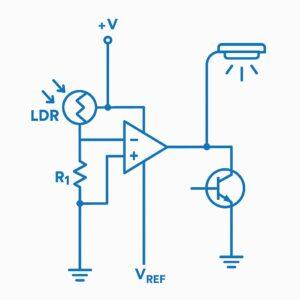
Think of an LDR like sunglasses for electricity. When it’s bright outside, the LDR’s resistance drops; when it’s dark, resistance rises. In a basic LDR voltage divider circuit, the LDR sits with a fixed resistor to create a small “measuring station” that changes voltage with daylight. Your controller or a comparator watches that voltage and decides: night = ON, day = OFF.
Why people choose it: ultra-low cost, tiny part count, and it has worked reliably for decades.
Trade-offs to note: LDRs react more slowly than silicon sensors, their switch point can drift with temperature and age, and units don’t always match each other perfectly. Some LDRs use cadmium sulfide (CdS); if you sell into the EU/UK, ask your solar street light supplier for RoHS documentation.
2) Photodiode vs Phototransistor vs LDR: picking precision over simplicity
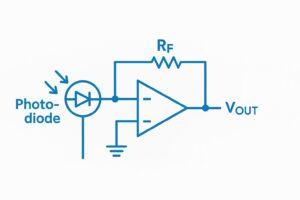
If your question is “How exact and how fast should my switching be?” this is the fork in the road.
- Photodiode: converts light to a tiny current with excellent linearity and fast response. Typically paired with a transimpedance amplifier for very clean thresholds.
- Phototransistor: adds built-in gain (more sensitivity), but with less linearity and a bit slower than a photodiode.
Compared with an LDR, both silicon options deliver tighter, more repeatable dusk/dawn points and better stability over temperature, ideal for municipal streets, parking areas, and any spec-driven project where “roughly dark” isn’t good enough.
3) Ambient Light Sensor for Solar Street Lights (ALS IC): digital lux, smarter control
An ALS is a small chip (often with visible + IR photodiodes and filtering) that approximates the human eye’s response and reports lux directly over I²C. Translation: your controller can say “turn on at 20 lux, off at 40 lux” instead of chasing a drifting analog voltage. ALS parts also reject IR better (less fooled by sunsets or headlamps) and integrate cleanly with modern drivers and firmware. If you want predictable, standards-friendly behavior—and easy future tweaks in software—ALS is the most flexible path.
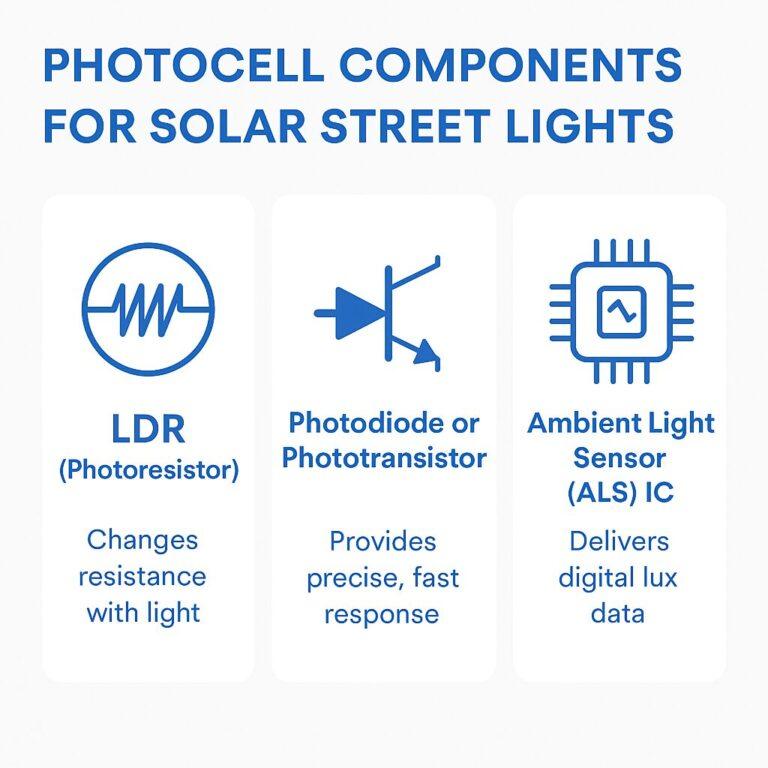
Bottom line is that for residential paths and campuses, an LDR still delivers reliable dusk-to-dawn control at the best price. For higher stakes (city corridors, garages, spec’d projects), choose photodiode/phototransistor or an ALS for tighter, repeatable performance.
What Are the Sockets and Standards Behind the Light Sensor for Solar Street Lights?
- ANSI C136 “twist-lock” photocontrols (3/5/7-pin)
This is the classic round socket you see on top of many street lights. You literally twist a photocell or node into place. The 7-pin version adds dimming/communication pins so the same port can host anything from a basic photocell to a smart controller. For maintenance, it’s a dream—swap in seconds, no tools.
2. Zhaga Book 18 / D4i low-voltage node (40 mm interface)
This compact, sealed interface is built for modern LED street lights. It supports daylight harvesting, diagnostics, and even wireless controls, and it’s designed to be tool-free. Pair it with D4i drivers for rich fixture data and future-proof upgrades.
Why you should care (even off-grid): Choosing a luminaire or controller that supports one of these ecosystems makes spares, upgrades, and third-party compatibility far easier. It also gives you room to grow—from a simple photocell today to a smarter node later—without changing the fixture.
How Dusk-to-Dawn Light Sensor Actually Works (And Why Hysteresis Matters)
When the sky hovers between light and dark (sunset, clouds, headlights), a naïve sensor can “chatter,” rapidly turning the lamp on and off. The fix is hysteresis, which simply means you use two thresholds instead of one:
- A lower threshold to turn ON (it must get this dark), and
- A higher threshold to turn OFF (it must get this bright).
You create this with a comparator and a tiny feedback path—often called a Schmitt trigger. In practice, hysteresis adds noise immunity and makes transitions crisp. It also keeps electronics happy by avoiding rapid switching. Whether you use an LDR, a photodiode, or an ALS, adding hysteresis (and a short time delay) is the easiest way to make your light sensor for solar street lights feel “confident,” not indecisive.
The LDR voltage divider circuit (practical wiring)
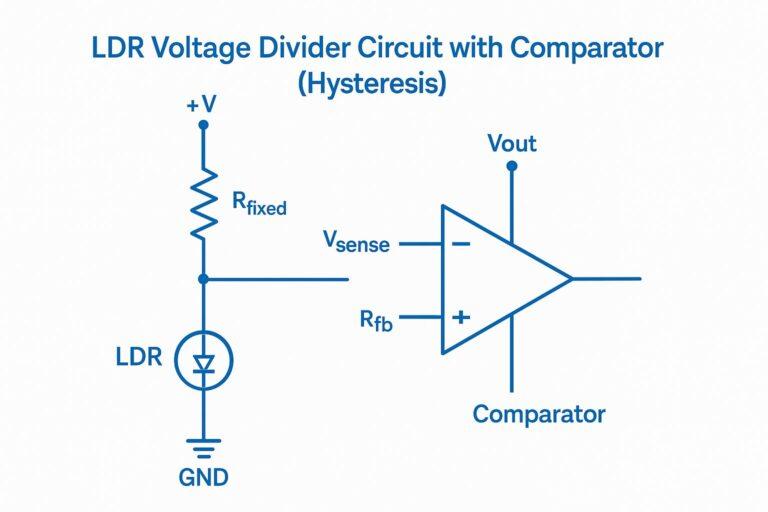
A minimal LDR voltage divider circuit looks like this:
- Choose Rfixed near the LDR’s mid-range resistance at the desired threshold (e.g., the LDR is ~20 kΩ at 20 lux, so start with ~20 kΩ).
- Add RC filtering (e.g., 10 kΩ + 100 nF) to slow fast transients.
- Feed Vsense to a comparator with positive feedback to implement hysteresis, or into a microcontroller ADC if you’re using firmware thresholds.
- Calibrate on site—urban glow and reflective facades can require a few lux of margin.
For a step-by-step divider-calibration approach (including using lux meters and plotting V vs. lux), see practical LDR guides used in physics labs.
Photodiode or phototransistor front-ends
If you’re building a precision photocell:
- Photodiode → transimpedance amplifier (TIA) → comparator/ADC.
- Phototransistor → collector resistor → comparator/ADC (simpler, more gain, less linear).
Choosing between photodiode vs phototransistor vs LDR depends on the tradeoff between precision and simplicity. Photodiodes are preferred when you want a clean lux mapping and fast edges; phototransistors are a good middle ground; LDRs are fine for budget dusk-to-dawn when a few-lux drift is acceptable.
ALS IC path: when “digital lux” pays off
Modern ambient light sensor for solar street lights filter IR and approximate photopic eye response. That means your controller can use a lux threshold rather than an arbitrary ADC voltage, making behavior portable between sites and seasons. These parts also support large dynamic range (from moonlight to bright sun) and work behind dark lenses.
Pro tip: ALS + firmware lets you add logic such as “hold-on delay after sunrise” or “ignore spikes under 2 s,” which greatly improves stability near twilight.
Real-World Placement and Commissioning Tips
- Mount for sky view. Place the sensor where it sees the ambient sky, not the luminaire’s own beam. Avoid shadows from arms/signage. (Twist-lock and Zhaga nodes are designed for exactly this exposure.)
- Use delays/hysteresis. Whether analog or firmware, always add time delay (seconds) and upper/lower thresholds (lux gap).
- Calibrate on site. Start near 15–25 lux for turn-on, then tune to your lighting plan and local glare. Practical LDR calibration methods use a lux meter and a plotted V-lux curve.
- Mind compliance. If your LDR is CdS-based and you sell into EU/UK, get RoHS statements; exemptions were amended in May 2024. If in doubt, prefer silicon light sensors.
Power Choices That Make a Light Sensor for Solar Street Lights Perform Like A Pro
You can nail the sensing side, whether you use an LDR voltage divider circuit, a silicon approach in the photodiode vs phototransistor vs LDR debate, or a digital ambient light sensor for solar street lights and still end up with poor night-time performance if the energy system is undersized.
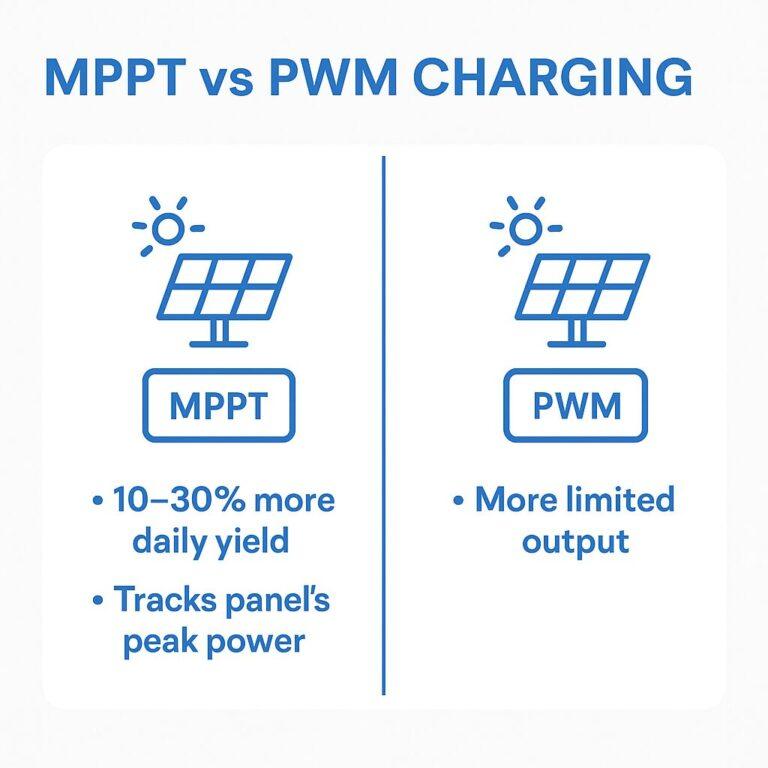
Sensors only decide when to turn on; the panel + controller + battery determine whether the light can stay on until sunrise, especially in winter. Two upgrades make the biggest difference in the field: MPPT charging and LiFePO₄ batteries.
- MPPT vs PWM charging: MPPT tracks the panel’s sweet spot for 10–30% more daily yield (climate-dependent), which directly extends night-time autonomy and reduces dimming in winter.
- LiFePO₄ batteries: Safe chemistry with long cycle life and stable performance across temperatures, why most modern solar street lights use it. Validate spec sheets for cycle-life, temperature derating, and BMS protections.
Buying Checklist (So You Don’t Pay for Maintenance)
Whether you source direct or through a solar street light supplier, ask for the following:
- Sensor type & curve: LDR part code (or photodiode/ALS IC) and its spectral response. For ALS, confirm photopic matching and IR rejection.
- Thresholds & hysteresis: Documented lux points (on/off), not just “dusk-to-dawn.”
- Socket/interface: ANSI C136 twist-lock or Zhaga Book 18/D4i compatibility for future upgrades.
- Controller & battery: MPPT yes/no; LiFePO₄ specs and BMS protections. Yield claims should be conservative and climate-specific.
- Compliance: RoHS/REACH documentation (especially if any CdS components are present).
Troubleshooting a Light Sensor for Solar Street Lights
- Light always ON (even in daylight).
Common causes are a shaded sensor (mounted under eaves or behind signage), a dirty or painted LDR window, the LDR voltage divider circuit wired upside-down (LDR and fixed resistor swapped), or a firmware dusk threshold set too high. Fixes: re-mount the light sensor for solar street lights with a clear sky view, clean the lens, and confirm the divider feeds the comparator/ADC in the correct polarity. If you’re using a silicon path in the photodiode vs phototransistor vs LDR choice, verify biasing and that the TIA output isn’t saturating in bright sun. Finally, check for connector corrosion that holds the input at a false “dark” voltage. - Light always OFF (even at night).
The most frequent issue is self-illumination: the luminaire beam hits the sensor and convinces it that it’s daytime. Shield or relocate the sensor so it “sees” the sky, not the lamp. If you use an ambient light sensor for solar street lights, make sure the cover glass isn’t too dark or IR-heavy; some lenses block visible light more than IR and skew readings. Raise the dusk threshold a little, and confirm comparator polarity (non-inverting vs inverting) and pull-ups. - Flicker at dawn/dusk. This almost always means insufficient hysteresis. Add or increase comparator hysteresis (Schmitt trigger) so the turn-on and turn-off points are a few lux apart. Add a short time delay in firmware and a small RC filter (e.g., 10 kΩ/100 nF) to reject momentary cloud or headlight spikes. In glare-heavy city centers, swap to an ambient light sensor for solar street lights with photopic filtering to avoid IR tricks at sunset.
- Seasonal under-performance. If lights dim or shut off before dawn during long winter nights, addressing energy yield beats tweaking thresholds. Ask your solar street light supplier about upgrading to MPPT charging and increasing LiFePO₄ capacity. More harvested watt-hours and a larger battery buffer will stabilize night-time runtime better than any sensor change.
For more troubleshooting tips, read our blog.
FAQs: Light Sensor for Solar Street Lights
What does a light sensor actually do in a solar street light?
It measures ambient light and triggers the luminaire on at dusk and off at dawn. This “photocell” behavior can be implemented with an LDR, a photodiode/phototransistor circuit, or a digital ambient light sensor for solar street lights.
Which is better: photodiode vs phototransistor vs LDR?
- LDR: lowest cost, simple, but slow and drifty.
- Phototransistor: higher sensitivity, moderate linearity/speed.
- Photodiode: best linearity and speed; more precise thresholds. Choose based on how tightly you need to control on/off lux.
Can I just use an LDR? When does it go wrong?
Yes, if your project tolerates a few-lux variation and modest drift, an LDR-based LDR voltage divider circuit with comparator is fine. It goes wrong when there’s heavy light pollution, strict uniformity requirements, or compliance constraints (RoHS for CdS LDRs). Then go silicon (photodiode/ALS).
Do I need ANSI C136 or Zhaga-D4i compatibility?
If your luminaire supports it, yes, it simplifies upgrades (e.g., swap a basic photocell for a smart node) and keeps you in a common ecosystem of nodes and sensors.
My light flickers at twilight. What should I change?
Increase hysteresis and add a short time delay; if using an LDR, add a small RC filter at the divider output. Precision projects may benefit from an ALS IC to avoid spectral quirks.
Does MPPT really matter for dusk-to-dawn reliability?
Yes, MPPT typically harvests more energy per day than PWM (climate-dependent), which directly improves night-time runtime and reduces winter dropouts.
Final Thoughts: How the DEL Team Can Help You
A light sensor for solar street lights is more than an accessory; it’s the brain that decides when your site is safe, visible, and efficient. Whether you choose an LDR voltage divider circuit for cost-effective dusk-to-dawn control, step up to silicon in the photodiode vs phototransistor vs LDR decision for tighter thresholds, or deploy an ambient light sensor for solar street lights for digital-lux precision, the outcome depends on two things: clean installation (sky view, hysteresis, calibration) and a reliable energy stack (MPPT charging + LiFePO₄ batteries). Get those right and your lights stay bright all night.
DEL Illumination engineers and supplies end-to-end solar street lighting—sensors, drivers, optics, MPPT controllers, and LiFePO₄ packs that are sized for your latitude and load. We design to real-world constraints: light pollution, coastal fog, heat, and long winter nights.
Tell us your site details—latitude, pole height, spacing, target lux, nightly hours, and any constraints—and we’ll send you a spec-backed recommendation.