
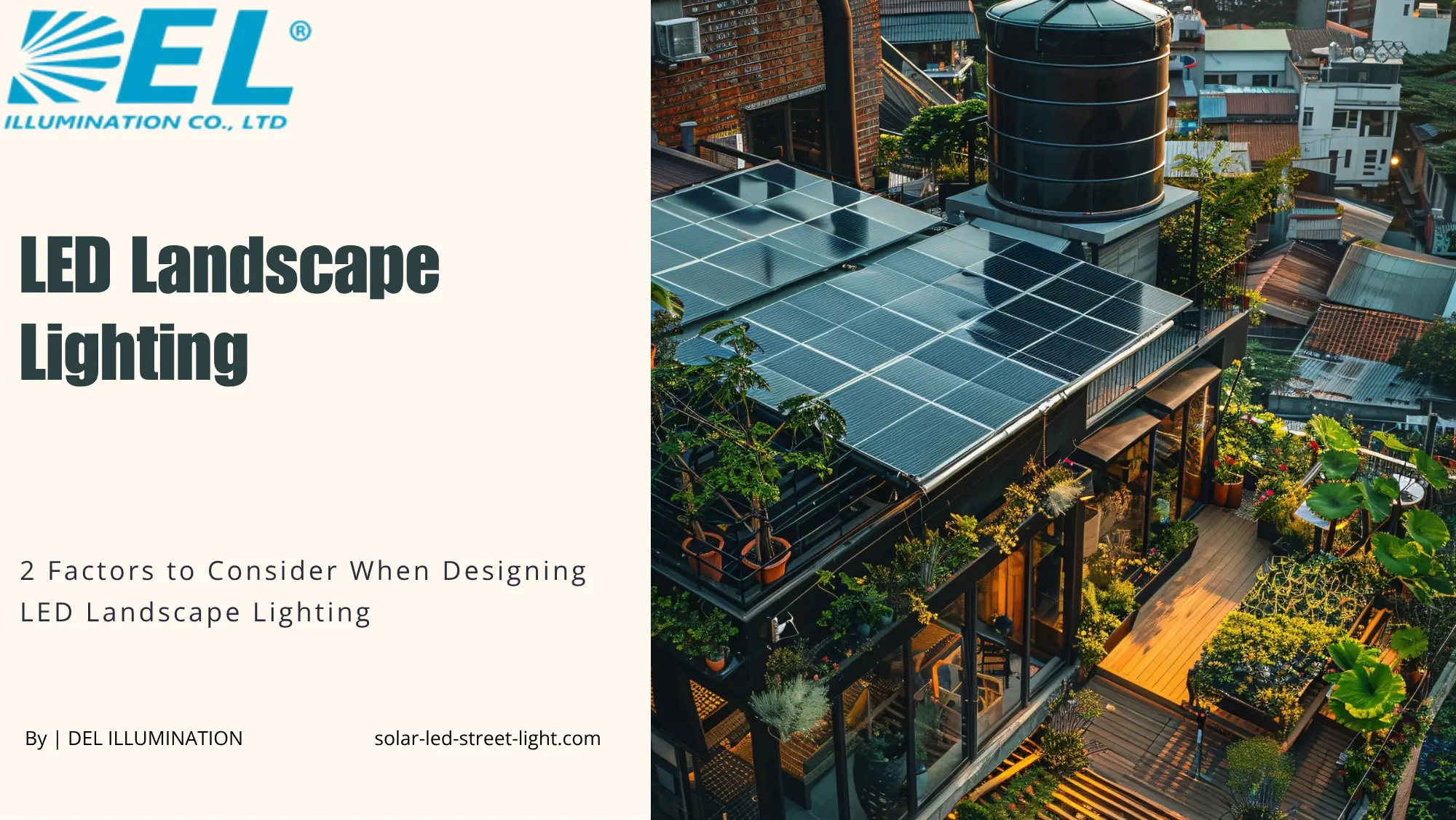
The purpose of LED landscape lighting is to coordinate the landscape with the building features merged with the surrounded view, beautifying the environment. For a broader look at how LED technology performs outdoors, our comparison of HPS lights vs LEDs in outdoor solar street lamps is a helpful companion read.
What Are the Factors to Consider When Designing the LED Lighting of Building Landscape?
Let’s explore the factors you should consider in 2026:
1. Viewing Direction and Distance
Lighting position as the main viewing direction must be confirmed before the design of LED landscape lighting for building surfaces. Secondly, take into account the viewing distance, which will affect the visual clarity when people are present. At the same time, the level of lighting should be decided based on how far the typical viewer will be standing from the fixture. Our guide on how to calculate the distance for LED solar area lights offers useful principles for planning light spread over distance.
2. Surrounded Environment and Background
The lighting level of the surrounding environment will influence the illumination of the main body of the building. If the surrounding environs are too dark, only a little light is enough to illuminate the main body; if the surrounding environment is bright, stronger and brighter lights are needed to illuminate and highlight the main body. This contrast principle is one of the most overlooked factors in effective LED landscape lighting design.
How to Design Your LED Lighting Landscape Fixtures
LED lighting design for building landscapes can roughly be divided into the following steps:
1. Decide the Expected Light Effect
The different appearances of buildings will call for different lighting effects, so it should be decided according to the features of the building. A historic facade may call for a warm, subtle wash of light, while a modern structure might benefit from crisper, more directional beams.
2. Select the Suitable Light Source
The selected light source should be considered in terms of light color, color rendering, efficiency, lifetime, and other aspects. The combination of light color and the exterior wall of the building is also very important. For example, golden brown bricks are best illuminated with warm light, and a light source that is high pressure sodium or halogen is a fitting choice for that palette. The U.S. Department of Energy offers helpful guidance on LED color rendering and efficiency.
3. Decide the Required Illumination
Illumination is mainly decided according to the light and shadow of the surrounding environment and the color of the material on the exterior wall of the building. It generally focuses on the main facade, and the illumination of the sub facade is only half of the main facade under common conditions. The differences between light and shadow can highlight the stereoscopic vision of the building, which is one of the defining goals of well executed LED landscape lighting.
4. LED Lighting: Select Suitable Fixtures
The shapes of the fixtures used in LED landscape lighting also differ for different buildings. Square floodlights are suggested for large angles of light, round lights for small angles, narrow angle lights for long distance projections, and wide angle lights for uniform light projections. For decorative outdoor lighting ideas, our post on the 5 benefits of solar LED umbrella lights outdoors explores another creative fixture option.
5. Calculation of Illumination and Light Amount
The final decision on the number of lights needs to consider the light source, fixture output, installation locations, and other criteria to ensure the lighting effect will be close to the expected standard after installation. When the building is viewed at night, this calculation reflects a significant effect on its appearance.
Types of LED Lighting Fixtures
When it comes to LED landscape lighting, choosing the right type of fixture is crucial. Here are three common types of LED fixtures for landscapes:
1. Wall Mounted Fixtures
Wall mounted LED lighting fixtures are a great option for illuminating outdoor walls, facades, and other vertical surfaces. These fixtures are typically mounted on the wall and can be pointed in any direction. Wall mounted LED fixtures can be used to create a dramatic effect on a garden wall or to provide ambient lighting for an outdoor living area.
2. Freestanding Fixtures
Freestanding LED lighting fixtures are standalone lights that can be placed anywhere in the landscape. These fixtures can be used to highlight a specific area or object, such as a sculpture, a tree, or a pathway. Freestanding fixtures are available in different styles and sizes to suit any landscape design. Our 7 tips for solar park lights design offer more ideas for lighting open outdoor spaces.
3. Deck and Step Lights
Deck and step lights are small, low level LED lighting fixtures that are installed directly into steps, decks, or other flat surfaces. These fixtures are designed to provide safe and effective lighting for outdoor steps, walkways, and decks. Deck and step lights are available in a variety of styles and colors to match any landscape design.
PS: If you have any requirements for solar LED light, please feel free to contact us.
You may want to check out our post on what photovoltaic street lights are to understand the solar technology behind quality LED lighting.
Harness the Sun. Get Solar Power Today!
FAQs: LED Landscape Lighting
1. What’s the most commonly overlooked factor in LED landscape lighting design?
The surrounding environment and background brightness is often overlooked. Many people focus only on the fixture and the building surface, without accounting for how a dark versus bright surrounding environment changes how much light is actually needed to make the main facade stand out.
2. How do I choose the right light color for LED landscape lighting on a building facade?
Match the light color to the exterior wall material. For example, golden brown brick generally pairs well with warm light sources such as high pressure sodium or halogen, while other facade materials may call for a cooler or more neutral color temperature. Getting this combination wrong can wash out the building’s natural texture and color.
3. What type of LED landscape lighting fixture works best for a garden pathway?
Freestanding fixtures or deck and step lights are usually the best fit for pathways, since they’re designed to sit low, provide safe visibility for walking, and can be placed flexibly to follow the path’s layout. Wall mounted fixtures are generally better suited for vertical surfaces like facades and garden walls.
4. Why does the sub facade of a building typically get less illumination than the main facade?
Under common lighting design conventions, the sub facade is illuminated at roughly half the intensity of the main facade. This contrast helps draw visual attention to the primary viewing angle of the building, creating a more deliberate and layered lighting effect rather than lighting every surface equally.
5. How is the correct number of LED landscape lighting fixtures calculated for a project?
The final count depends on the light source’s output, the type of fixture, installation locations, and the expected illumination standard for the building. This calculation is typically done as one of the last design steps, after the light effect, light source, required illumination, and fixture type have already been decided.