

A municipal procurement officer recently approved a $1.2 million solar street lighting contract based on the lowest bid, celebrating a 60% cost savings compared to the runner-up proposal. Eighteen months later, the same municipality faced $850,000 in emergency replacement costs after 38% of the generic fixtures failed completely. What appeared as smart budgeting transformed into a financial disaster that cost taxpayers nearly double the original project value.
This scenario repeats across Ownership for EPC Projects worldwide because procurement decisions focus on initial equipment cost rather than total cost of ownership over the system’s operational life. For solar LED street lighting, the difference between German-engineered systems and generic alternatives extends far beyond purchase price. It encompasses installation efficiency, maintenance frequency, component replacement cycles, warranty enforceability, and ultimately project bankability. Understanding true TCO becomes critical when projects involve 10-15 year financing terms and performance guarantees that create legal obligations extending decades into the future.
This analysis breaks down actual costs across every phase of solar street lighting EPC projects, comparing German-designed systems against generic alternatives over 10-year periods. The findings reveal why sophisticated buyers increasingly reject low-bid equipment regardless of upfront savings.
Understanding Total Cost of Ownership in Solar Street Lighting EPC Contracts
Total cost of ownership represents the complete financial burden of acquiring, installing, operating, and maintaining solar street lighting systems throughout their functional lifespan. Unlike simple purchase price comparisons, TCO analysis captures hidden costs that emerge years after initial deployment and often exceed the original equipment investment.
For EPC contracts, TCO calculations must account for multiple cost categories beyond fixture purchase. Installation expenses include foundation work, pole erection, electrical connections, and commissioning testing. These costs vary based on equipment design, with integrated systems requiring less installation labor than multi-component alternatives. Operating costs encompass monitoring system fees, insurance premiums, and administrative overhead. Maintenance includes scheduled cleaning, inspections, and minor repairs. Component replacements represent major cost events triggered by battery degradation, LED failures, or control system malfunctions.
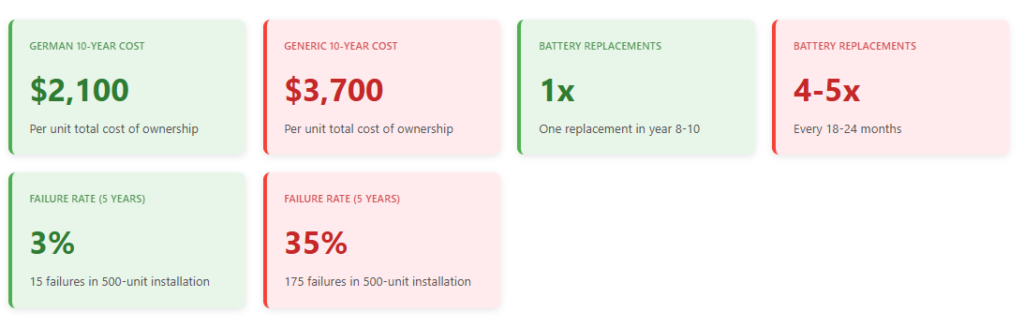
The critical difference between German-engineered and generic systems manifests most clearly in replacement cycles and failure rates. Industry research tracking over 25,000 installations found German-engineered systems using third-party certified components demonstrated 3% cumulative failure rates over five years. Generic self-certified systems from the same installation cohorts exceeded 35% failure rates over identical periods. Each failed fixture triggers service calls averaging $150-225 including labor, traffic control, and equipment costs. For a 500-unit installation, the difference between 15 failures and 175 failures represents $24,000 versus $280,000 in emergency maintenance costs.
Battery replacement cycles create another massive TCO differential. German-engineered systems specify A-class LiFePO4 batteries with verified 5,000+ cycle ratings and 8-10 year functional lifespans. Generic systems typically use recycled lithium-ion cells rated for 500-800 cycles, requiring replacement every 18-24 months. Battery replacement costs range from $200-400 per fixture including parts and installation labor. Over 10 years, a 500-unit project using generic batteries requires 4-5 complete battery replacements totaling $400,000-1,000,000. German-engineered systems need one replacement at year 8-10, costing $100,000-200,000.
Warranty terms significantly impact TCO calculations. Generic manufacturers typically offer 1-2 year limited warranties covering manufacturing defects but excluding normal wear. German-engineered systems provide 5-10 year comprehensive warranties including linear performance guarantees. When components fail after warranty expiration, procurement agencies absorb full replacement costs. The difference between 2-year and 10-year coverage periods means generic system failures occurring in years 3-10 create unbudgeted expenses that German-engineered warranties would cover.
Financing costs represent often-overlooked TCO elements that compound over project lifespans. Projects using properly certified equipment secure financing at 5.5-6.5% interest rates. Projects with inadequate certification face 7.8-9.2% rates or outright rejection. On a $2 million project with 10-year financing, the difference between 5.5% and 7.8% interest rates totals $275,000 in additional financing costs. This single factor often exceeds the upfront equipment savings that generic systems appear to offer.
Year-by-Year Cost Breakdown: German vs Generic Systems
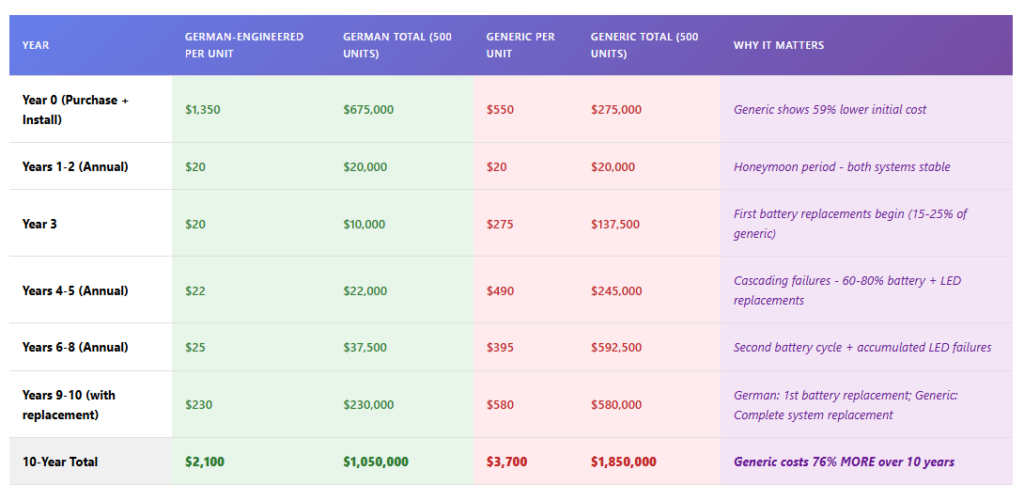
Examining costs chronologically reveals how generic systems’ initial advantages erode rapidly while German-engineered alternatives deliver increasing value over time. This year-by-year analysis uses a 500-unit municipal street lighting installation as the baseline for comparison.
Year 0 represents equipment procurement and installation. German-engineered systems cost $800-2,500 per fixture depending on wattage and specifications, with installation averaging $250-350 per unit. For a 500-unit project with mid-range specifications, total year 0 investment reaches $675,000-1,425,000. Generic systems cost $300-1,200 per fixture with similar installation expenses, totaling $275,000-775,000. At this stage, generic systems show apparent savings of $400,000-650,000 or approximately 59% lower initial cost.
Years 1-2 typically proceed smoothly for both system types as new equipment operates within design parameters. Maintenance costs remain minimal at $15-25 per fixture annually for basic cleaning and inspections, totaling $7,500-12,500 across the installation. Both systems perform adequately during this honeymoon period, reinforcing procurement officers’ confidence in low-bid selections.
Year 3 marks the inflection point where TCO trajectories diverge dramatically. Generic system batteries begin showing capacity degradation from thermal stress and charge cycle accumulation. LED output drops noticeably as junction temperatures exceed design limits due to inadequate thermal management. Control systems experience higher failure rates as low-quality components reach end-of-life. Annual maintenance costs for generic systems climb to $65-90 per fixture as service calls increase. First battery replacements begin, affecting 15-25% of generic installations at $250-400 per fixture. Year 3 costs for generic systems reach $105,000-187,500 compared to $7,500-12,500 for German-engineered systems maintaining stable performance.
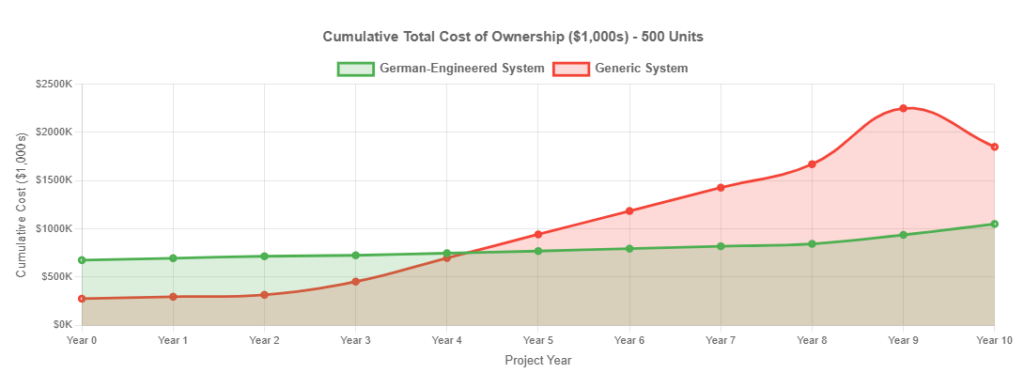
Years 4-5 see generic system degradation accelerate. Battery replacements extend to 60-80% of fixtures. LED failures require luminaire replacements across 20-35% of installations. Combined replacement costs reach $175,000-320,000 annually. German-engineered systems continue stable operation with maintenance costs remaining at $15-25 per fixture. Cumulative costs through year 5 total approximately $900,000-1,900,000 for generic systems versus $735,000-1,500,000 for German-engineered alternatives. The initial cost advantage has disappeared entirely by year 5.
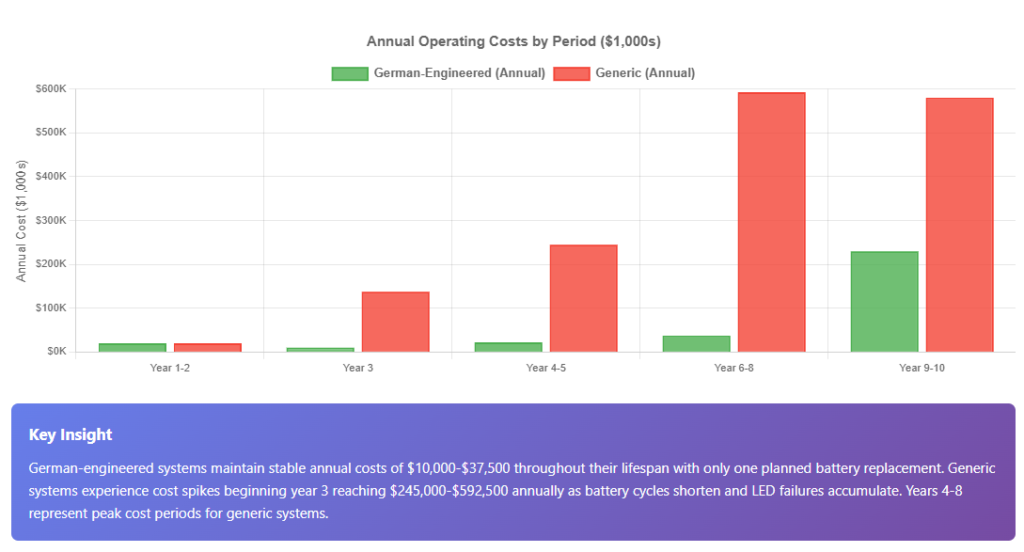
Years 6-8 require second complete battery replacement cycles for generic systems, adding another $125,000-200,000 in costs. Accumulated LED failures now affect 45-60% of generic fixtures. Multiple service calls to address recurring problems drive maintenance costs to $85-110 per fixture annually. German-engineered systems reach their first scheduled battery replacement in years 8-10, representing a planned $100,000-200,000 expense that procurement teams budget accordingly. No emergency replacements occur because components function within design specifications.
Years 9-10 complete the analysis period. Generic systems often require complete fixture replacements as accumulated failures, degraded performance, and unavailable replacement parts make continued operation uneconomical. Replacement costs approach initial installation expenses. German-engineered systems complete scheduled battery replacement and continue operating at 85-90% of original performance levels, positioned to deliver another 5-7 years of service life.
Total 10-year costs for the 500-unit installation reach $1,850,000-3,100,000 for generic systems compared to $1,050,000-1,850,000 for German-engineered alternatives. Generic systems that appeared 59% cheaper initially cost 38-72% more over 10 years. The apparent $400,000-650,000 upfront savings transforms into $800,000-1,250,000 in excess costs.
Component Quality: The Foundation of TCO Differences
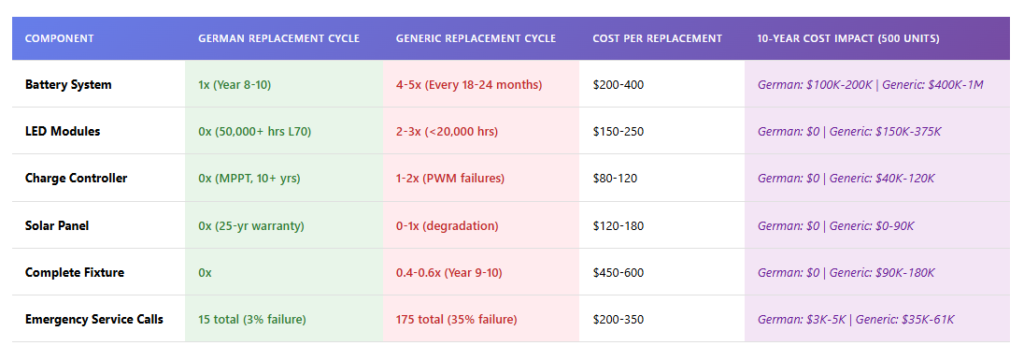
Total cost of ownership disparities between German-engineered and generic solar street lights originate from fundamental component quality differences that compound across system lifespans. Each major component category demonstrates measurable performance gaps that directly translate to recurring costs.
Battery systems account for 30-40% of initial equipment costs and represent the largest TCO variable. German-engineered systems specify A-class LiFePO4 batteries with documented manufacturing traceability, third-party verified capacity ratings, and comprehensive battery management systems. These batteries deliver 5,000+ charge cycles at 80% depth of discharge while maintaining capacity retention above 80%. Temperature management systems keep cells within optimal operating ranges even during extreme weather. The battery management system includes cell-level balancing, precision voltage monitoring, and multiple redundant protection circuits.
Generic systems typically use D-class recycled lithium-ion cells purchased from secondary markets. These cells lack manufacturing documentation, show inconsistent capacity ratings, and employ basic charge controllers without sophisticated battery management. Actual cycle life rarely exceeds 500-800 cycles before capacity degradation renders batteries unusable. Temperature extremes accelerate degradation because generic systems lack adequate thermal management. The replacement every 18-24 months cycle creates predictable financial obligations that procurement teams frequently fail to budget adequately.
LED modules and thermal management systems create another critical TCO differential. German-engineered fixtures use LED arrays with complete LM-80 testing data showing projected L70 life exceeding 50,000-100,000 hours. Advanced thermal management systems include properly sized heat sinks, thermal interface materials with verified conductivity ratings, and housing designs that maximize convective cooling. Junction temperatures remain below manufacturer specifications even during peak ambient conditions. This thermal discipline preserves LED lifespan and maintains color consistency.
Generic fixtures often use LED modules with incomplete or absent LM-80 testing. Thermal management systems employ undersized heat sinks or poor thermal coupling between LEDs and heat dissipation surfaces. Junction temperatures regularly exceed 85°C during summer operation, accelerating LED degradation and shortening functional life to under 20,000 hours. The resulting LED failures in years 3-5 require complete luminaire replacements because generic manufacturers rarely stock compatible replacement modules.
Solar panels represent a smaller percentage of initial costs but demonstrate significant efficiency differences. German-engineered systems specify monocrystalline panels with 23%+ conversion efficiency from manufacturers with established quality reputations. Panel sizing follows 3-4x load power ratios to ensure adequate charging even during extended cloudy periods. Panels carry 25-year linear performance warranties from manufacturers with financial stability to honor long-term commitments.
Generic systems often use polycrystalline panels with 15-18% efficiency and undersized panel arrays at 2-2.5x load power ratios. This marginal sizing creates charging deficits during cloudy weather that accelerate battery degradation through deep discharge cycles. Warranty claims prove difficult when manufacturers disappear or refuse to honor commitments for panels sourced through intermediaries.
Charge controllers create efficiency gaps that compound daily across system lifespans. German-engineered systems employ MPPT controllers with 95-98% conversion efficiency, optimized tracking algorithms, and comprehensive data logging. These controllers maximize energy harvest from available solar radiation and provide diagnostic information for predictive maintenance. Generic systems use PWM controllers with 70-75% efficiency, losing 20-25% of potential solar energy daily. Over 10 years, this efficiency gap translates to thousands of lost charging hours and accelerated battery cycling.
The cumulative effect of component quality differences manifests in dramatically different maintenance and replacement costs. German-engineered systems require scheduled maintenance at predictable intervals with component replacements occurring only after design lifespans. Generic systems experience cascading failures as one weak component stresses others, creating unpredictable maintenance emergencies and unbudgeted replacement costs.
Hidden Costs That Destroy Generic System Economics
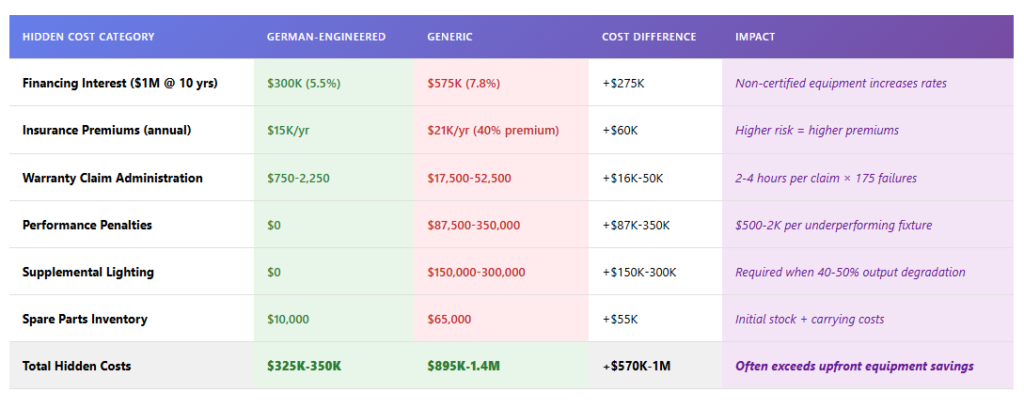
Beyond direct component replacement expenses, generic solar street lighting systems generate numerous hidden costs that procurement analyses typically overlook. These indirect costs often exceed equipment savings and create operational difficulties that impact project stakeholders for years.
Emergency service calls represent the most visible hidden cost. When street lights fail unexpectedly, municipalities must dispatch maintenance crews often during premium overtime hours. Traffic control requirements for roadside work add $75-150 per service call. Diagnostic time to identify failures in systems lacking monitoring capabilities costs $50-100 per fixture. Parts procurement delays extend outages when replacement components aren’t stocked locally. Total service call costs reach $200-350 per failed fixture compared to $25-40 for scheduled maintenance of functioning systems.
Performance degradation creates lighting deficiencies that violate contract requirements and municipal codes. Generic systems showing 40-50% light output reduction after 3-4 years fail to meet illumination standards for public safety. Municipalities face liability exposure when inadequate lighting contributes to accidents or crime. Supplemental lighting installations to address deficiencies cost $150,000-300,000 for typical 500-unit projects. EPC contracts with performance guarantees trigger penalty clauses ranging from $500-2,000 per underperforming fixture, potentially totaling $250,000-1,000,000 in contractor penalties.
Warranty claim administration consumes significant staff resources when dealing with generic manufacturers. Documenting failures, photographing conditions, shipping failed components for analysis, and pursuing reimbursement requires 2-4 hours per claim. With 35% failure rates over five years, a 500-unit installation generates 175 warranty claims consuming 350-700 staff hours. At $50-75 per hour including overhead, warranty administration costs reach $17,500-52,500. German-engineered systems with 3% failure rates generate 15 claims consuming $750-2,250 in administrative costs.
Financing cost increases affect projects funded through municipal bonds or commercial loans. Generic systems without adequate third-party certification face interest rate premiums of 1.5-2.3 percentage points. This seemingly small difference compounds over 10-year financing periods. On a $1.5 million project financed at 7.8% instead of 5.5%, additional interest costs reach $207,000. Projects securing favorable financing through proper equipment certification effectively receive this amount as cost avoidance.
Insurance premiums increase when projects use non-certified equipment or demonstrate poor performance history. Insurers evaluate component quality, warranty terms, and historical failure rates when pricing coverage. Projects with German-engineered systems qualify for preferred rates while generic system projects face 25-40% premium increases. On annual insurance costs of $15,000-25,000, this translates to $3,750-10,000 in excess premiums annually or $37,500-100,000 over 10 years.
Reputational damage represents an unquantifiable but real cost when municipalities deploy failed lighting systems. Public complaints about dark streets, social media criticism of wasteful spending, and news coverage of procurement failures harm civic reputations. Procurement officials who approved low-bid contracts face professional consequences when systems fail spectacularly. Future procurement processes become more difficult as elected officials demand excessive oversight to avoid repeating failures.
Project delays from equipment failures create cascade costs across multiple stakeholders. Construction projects dependent on adequate lighting face schedule disruptions. Economic development initiatives lose momentum when poor lighting creates perception problems. Public events require temporary lighting rentals at $500-1,500 per event. These indirect impacts rarely appear in TCO calculations but represent real costs absorbed by taxpayers and businesses.
The hidden cost accumulation often exceeds $500,000-1,200,000 over 10 years for 500-unit generic system installations. Combined with direct replacement costs, total excess spending reaches $1,300,000-2,450,000 compared to German-engineered alternatives. The initial equipment savings of $400,000-650,000 creates net losses of $900,000-1,800,000.
EPC Contract Structure and Long-Term Cost Implications
Engineering, Procurement, and Construction contract terms directly influence total cost of ownership through risk allocation, performance guarantees, warranty structures, and maintenance obligations. Understanding how contract language affects 10-year costs helps procurement teams structure agreements that protect municipal interests.
Performance guarantees create financial backstops when systems underperform. Well-structured EPC contracts specify minimum light output levels, operational uptime percentages, and energy production targets. Failure to meet guaranteed performance triggers penalty payments from contractors to project owners. Typical penalty structures charge $500-2,000 per underperforming fixture annually. For a 500-unit installation where 35% of generic fixtures fail performance standards, annual penalties reach $87,500-350,000. Contractors deploying German-engineered systems avoid these penalties because systems maintain performance within guaranteed parameters.
Warranty pass-through provisions determine whether project owners receive full component warranty benefits. Responsible EPC contracts require contractors to assign manufacturer warranties directly to owners and facilitate warranty claims throughout coverage periods. Generic system contracts often limit contractor warranty obligations to 1-2 years despite component manufacturers offering longer coverage. This gap leaves owners responsible for warranty claim administration and creates disputes about coverage eligibility. German-engineered system contracts typically provide comprehensive warranty management throughout 5-10 year coverage periods.
Maintenance service agreements included in EPC contracts significantly affect long-term costs. Contractors offering maintenance packages price services based on expected service call frequency and component replacement probability. German-engineered system maintenance contracts cost $35-55 per fixture annually because service calls remain minimal. Generic system maintenance contracts cost $85-140 per fixture annually to cover frequent failures and replacements. Over 10 years, this $50-85 annual difference totals $25,000-42,500 per fixture or $12,500,000-21,250,000 for 500-unit installations. Many municipalities reject expensive generic system maintenance packages, choosing instead to self-perform maintenance and absorb all replacement costs.
Spare parts inventory requirements create upfront costs and ongoing carrying expenses. Generic systems require extensive spare parts stocks because component failures occur unpredictably and manufacturers provide limited replacement availability. Municipalities must stock batteries, LED modules, controllers, and complete fixtures to enable rapid repairs. Initial spare parts inventory costs reach $50,000-100,000 for 500-unit installations. Annual carrying costs including storage, insurance, and obsolescence total $5,000-10,000. German-engineered systems require minimal spare parts because failures remain rare and manufacturers maintain long-term parts availability.
Asset management and monitoring system costs vary dramatically between system types. German-engineered systems include integrated monitoring providing real-time performance data, predictive maintenance alerts, and remote diagnostics. These systems enable proactive maintenance scheduling and early problem detection. Generic systems often lack monitoring capabilities, requiring physical inspections to identify failures. Installing retrofit monitoring systems costs $75-150 per fixture or $37,500-75,000 for 500-unit installations.
Decommissioning and replacement costs become relevant when generic systems reach end-of-life in years 8-10 while German-engineered systems continue operating. Removing failed generic systems and installing replacements costs $400-600 per fixture including disposal, new equipment, and installation labor. For 500 units, complete replacement reaches $200,000-300,000. German-engineered systems avoid this expense, continuing operation through years 15-20 with only scheduled battery replacements.
EPC contract structure determines whether these costs represent contractor obligations or owner responsibilities. Well-negotiated contracts using German-engineered equipment transfer most long-term cost risks to contractors who possess expertise and economies of scale to manage them efficiently. Poorly structured contracts using generic equipment leave owners exposed to cascading costs they’re ill-equipped to manage.
Making TCO-Based Procurement Decisions
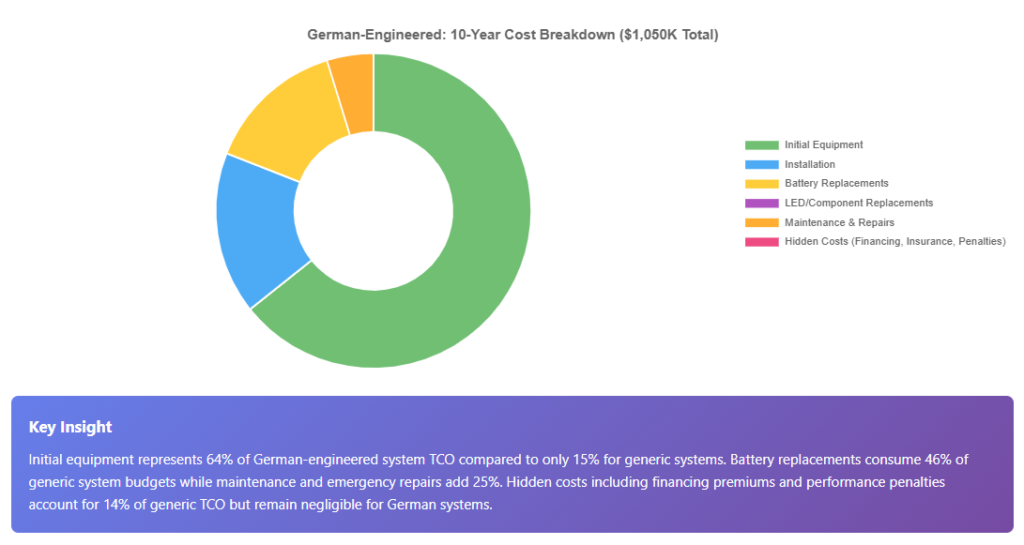
Transitioning from purchase-price procurement to total cost of ownership analysis requires systematic approaches that capture all relevant costs and evaluate them across project lifespans. Forward-thinking municipalities and private developers now employ comprehensive TCO methodologies that consistently identify German-engineered systems as optimal value propositions.
The TCO calculation framework begins with complete equipment cost documentation including all components, shipping, duties, and contingencies. Installation cost estimates should reflect actual site conditions rather than theoretical averages. Annual operating costs encompass insurance, monitoring fees, and administrative overhead. Maintenance costs require year-by-year projections accounting for increasing service frequency as systems age. Component replacement costs must include both parts and installation labor with realistic scheduling based on actual product lifespans rather than marketing claims.
Warranty value calculations subtract covered costs from gross TCO totals. A 10-year comprehensive warranty covering $400,000 in potential replacement costs has $400,000 present value that directly offsets equipment costs. Generic system 2-year warranties provide minimal TCO impact because most failures occur after warranty expiration. Discounting future costs to present value using appropriate rates (typically 3-5%) accounts for time value of money and enables accurate comparisons.
Risk-adjusted TCO analysis applies probability weightings to cost estimates. Generic systems demonstrating 35% failure rates warrant probability-weighted replacement cost calculations. If battery replacement costs $300 per fixture and affects 35% of installations, expected cost equals $105 per fixture rather than zero. German-engineered systems with 3% failure rates show expected replacement costs of $9 per fixture. Probability weighting prevents optimistic scenarios from skewing TCO comparisons.
Financing cost integration adds interest expenses to equipment and installation costs. Projects financed over 10 years at 5.5% interest incur interest costs approximately equal to 30% of principal. Equipment savings that increase financing rates eliminate themselves through higher interest payments. TCO models should calculate actual debt service payments across full financing terms rather than comparing nominal equipment costs.
Sensitivity analysis tests TCO results across variable ranges. Battery lifespan estimates varying from 18 months to 10 years create dramatically different outcomes. Service call cost assumptions between $150-350 per incident swing results significantly. Testing multiple scenarios reveals whether conclusions remain valid across reasonable assumption ranges or depend critically on optimistic projections.
Lifecycle extension value accounts for continued operation beyond 10-year analysis periods. German-engineered systems operating 15-20 years provide 5-10 additional years of utility beyond generic system lifespans. The present value of avoiding second complete system replacements adds substantial value to German-engineered alternatives. 10-year TCO analysis systematically understates German-engineered system value by truncating analysis before full lifespan advantages materialize.
Procurement scoring methodologies should weight TCO heavily relative to initial equipment cost. Responsible systems allocate 60-70% of procurement scores to lifecycle costs and 30-40% to initial costs. This weighting reflects economic reality that 10-year costs matter more than year-zero costs. Procurement processes emphasizing lowest initial bid guarantee poor TCO outcomes and transfer wealth from taxpayers to manufacturers of inferior equipment.
Conclusion
Total cost of ownership analysis for solar street lighting EPC projects consistently demonstrates that German-engineered systems deliver superior economic value despite higher initial costs. The apparent 59% equipment savings offered by generic alternatives transforms into 38-72% higher total costs over 10-year periods as frequent replacements, emergency repairs, and warranty gaps create cascading expenses.
Three critical factors drive these outcomes: component quality differences that manifest in dramatically different replacement cycles, warranty coverage gaps that transfer costs from manufacturers to owners after brief coverage periods, and hidden costs including financing premiums, insurance increases, and performance penalties. Procurement decisions focusing exclusively on initial equipment costs systematically select the most expensive long-term alternatives while rejecting options that minimize taxpayer burden.
Forward-thinking municipalities and developers now employ comprehensive TCO methodologies that account for all lifecycle costs, probability-weight risk scenarios, and value warranty coverage appropriately. These analyses consistently identify German-engineered systems as optimal investments that deliver predictable budgets, reliable performance, and minimized operational burdens across decades-long service lives.
Ready to implement TCO-based procurement for your next solar street lighting project? Visit solar-led-street-light.com to access detailed TCO calculation tools, review component specifications, and consult with German engineering experts who can help structure EPC contracts that protect your long-term interests and deliver maximum value to stakeholders.
Frequently Asked Questions
How do I calculate total cost of ownership for a solar street lighting project?
Calculate TCO by summing all costs across the equipment’s lifespan: initial equipment and installation costs, annual maintenance expenses, component replacement costs with realistic scheduling, warranty claim administration, financing interest payments, and insurance premiums. Discount future costs to present value using 3-5% rates and apply probability weighting to replacement costs based on expected failure rates. Include soft costs like staff time for warranty claims and potential performance penalties. Comprehensive TCO calculations typically reveal 10-year costs running 2-4 times initial equipment costs for generic systems compared to 1.5-2 times for German-engineered alternatives.
Why do generic solar street lights cost more long-term despite lower purchase prices?
Generic systems use inferior components that fail faster and more frequently than German-engineered alternatives. Recycled lithium-ion batteries requiring replacement every 18-24 months create recurring costs totaling $400,000-1,000,000 over 10 years for 500-unit installations compared to $100,000-200,000 for LiFePO4 batteries replaced once. LED failures from poor thermal management require complete luminaire replacements. Higher failure rates (35% vs 3%) generate dramatically more service calls. Short warranty periods leave owners absorbing all replacement costs after years 1-2. Hidden costs including financing premiums, insurance increases, and performance penalties further compound economic disadvantages.
What warranty terms should EPC contracts specify for solar street lights?
Require minimum 5-year comprehensive warranties covering all components including batteries, LEDs, solar panels, and control systems. Warranties should specify linear performance guarantees rather than simple minimum thresholds, covering both parts and installation labor for replacements. Demand warranty pass-through provisions assigning manufacturer warranties directly to project owners. Include warranty claim administration support from contractors throughout coverage periods. Verify warranty financial backing through insurance policies or parent company guarantees. Reject contracts limiting contractor warranty obligations to 1-2 years regardless of component manufacturer coverage periods.
How does equipment quality affect project financing terms?
Lenders evaluate component certifications, manufacturer reputations, and performance track records when pricing project financing. Equipment with third-party verified certifications qualifies for interest rates 1.5-2.3 percentage points lower than self-certified alternatives. On $2 million financed over 10 years, this difference totals $180,000-275,000 in additional interest costs. Projects lacking adequate certification face outright financing rejection regardless of interest rate. Banks recognize that poor equipment quality creates default risk through performance failures triggering penalty payments. Proper certification effectively provides financing cost avoidance exceeding typical equipment cost differences between generic and German-engineered systems.
What are the most expensive hidden costs in solar street lighting projects?
Emergency service call expenses from unexpected failures cost $200-350 per incident including labor, traffic control, and diagnostics. Performance penalty payments when systems fail to meet guaranteed light levels reach $500-2,000 per fixture annually. Financing rate premiums from inadequate certification total $180,000-275,000 on $2 million projects. Warranty claim administration consuming 2-4 hours per claim costs $17,500-52,500 for installations experiencing 35% failure rates. Insurance premium increases of 25-40% add $37,500-100,000 over 10 years. Supplemental lighting installations to address failed systems cost $150,000-300,000. These hidden costs often exceed initial equipment savings from low-bid selections.
Should maintenance agreements be included in EPC contracts?
Include maintenance agreements only when contractors deploy equipment they’re confident will remain reliable. German-engineered system maintenance contracts at $35-55 per fixture annually provide value through professional service and predictable budgets. Generic system maintenance contracts at $85-140 per fixture annually simply price in expected high failure rates, offering poor value. Evaluate whether the contractor assumes genuine maintenance risk or simply marks up expected failure costs. Well-designed German-engineered systems require minimal maintenance beyond scheduled cleaning and inspections that municipalities can self-perform efficiently. Avoid maintenance agreements that effectively insure contractors against deploying inferior equipment.
How do I compare bids with different equipment specifications?
Develop comprehensive TCO models for each bid incorporating realistic maintenance schedules, component replacement cycles based on verified product lifespans, warranty coverage value, and financing cost differences. Reject bids lacking third-party component certifications regardless of price. Weight lifecycle costs at 60-70% of total procurement scores with initial costs at 30-40%. Require detailed component specifications including battery chemistry and class, LED LM-80 test reports, solar panel efficiency ratings, and charge controller types. Verify manufacturer financial stability to honor long-term warranties. Calculate total 10-year costs including all direct and indirect expenses rather than comparing year-zero equipment costs.
What component specifications most impact total cost of ownership?
Battery type and quality most significantly impact TCO. A-class LiFePO4 batteries with 5,000+ cycles and 8-10 year lifespans versus recycled lithium-ion with 500-800 cycles and 18-24 month lifespans create $300,000-800,000 cost differences on 500-unit installations. LED thermal management determines whether modules achieve 50,000-100,000 hour L70 life or fail under 20,000 hours requiring complete replacements. MPPT controller efficiency at 95-98% versus PWM at 70-75% affects daily charging and battery stress. Solar panel efficiency and sizing determines whether systems maintain performance during extended cloudy periods or experience chronic battery degradation from deep discharge cycling.
References
National Renewable Energy Laboratory. (2024). Solar Photovoltaic System Cost Benchmarks: Q1 2024. https://www.energy.gov/eere/solar/solar-photovoltaic-system-cost-benchmarks
International Renewable Energy Agency. (2025). Renewable Power Generation Costs in 2024. https://www.irena.org
Transparency Market Research. (2025). Solar EPC Market Growth, Trend & Forecast 2035. https://www.transparencymarketresearch.com/solar-epc-market.html
Allied Market Research. (2024). Global Solar EPC Market Size, Share & Trends Analysis Report 2024-2034. https://www.alliedmarketresearch.com
Renewable Watch. (2025). Solar Margins: Cost trends across EPC projects. https://renewablewatch.in
Global Market Insights. (2025). North America Utility Solar EPC Market Size Report 2025-2034. https://www.gminsights.com/industry-analysis/north-america-utility-solar-epc-market
EnGoPlanet. (2024). Solar Street Light Price and Installation Cost Analysis. https://www.engoplanet.com
Inlux Solar. (2025). Solar Street Light Price Guide 2026: Retail vs Wholesale Costs. https://www.inluxsolar.com/solar-street-light-price-guide-2026
Quen Lighting. (2025). Solar Street Light Cost Guide: Price, Manufacturers & Value. https://www.quenenglighting.com/guides/solar-street-light-cost-guide.html
Solar LED Street Light. (2025). Solar Street Light ROI – TOP 5 factors. https://solar-led-street-light.com/5-factors-solar-street-light-roi
Disclaimer
This article is for informational purposes only and does not constitute professional engineering, installation, or procurement advice. Performance specifications and costs may vary based on project requirements, location, and local regulations. Always consult qualified solar energy professionals and legal advisors before making procurement decisions.
For expert consultation on solar LED street lighting solutions, visit solar-led-street-light.com or contact our team for a customized quote.