
Updated on 8 July 2026
Road lighting is the silent guardian of our infrastructure. When designed correctly, it goes unnoticed. But if it’s designed poorly, the consequences are immediate and could be even tragic.
Even the data shows the same. According to the National Security Council (NSC), 50% of traffic deaths happen at night. That’s exactly why road lighting standards are so rigorously defined.
But for many engineers and planners, going through this regulatory phase is where the real headache begins. What is EN 13201? How does the European Standard differ from the IESNA Guide used in North America? And more importantly, if you are designing a project for 2026, which lighting classes apply to you?
In this blog, we will decode all these, including the performance requirements, calculations, and main differences between EN 13201 and IESNA.
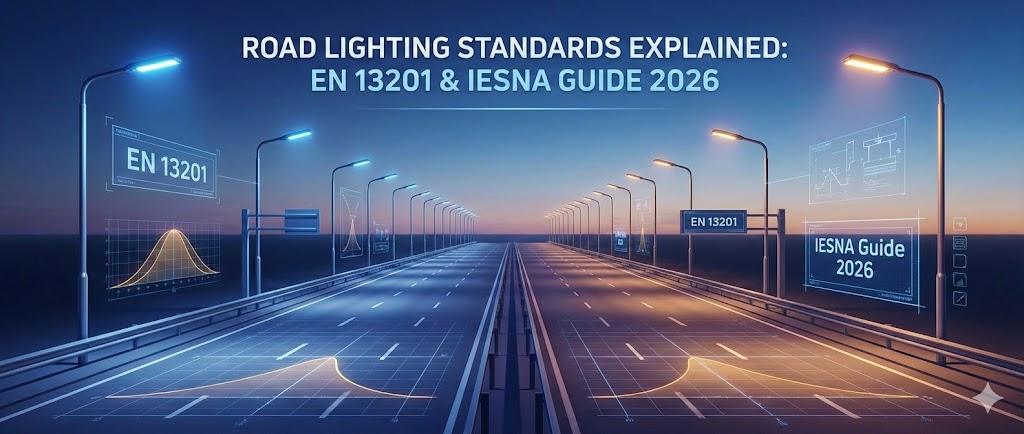
What Are Road Lighting Standards?
Road Lighting Standards are internationally accepted guidelines that define how roads should be illuminated to support road safety, visual performance, and energy efficiency. They ensure that drivers can see clearly, react faster, and avoid accidents.
Standards such as EN 13201 (European Standard) and the IESNA Guide regulate:
- luminance
- uniformity
- glare limits
- lighting classes
- energy performance
Why Are Road Lighting Standards So Important?
It is often tempting to view road lighting standards as just another layer of bureaucracy. But in fact, it is the foundation of risk management and public trust. Here is why adhering to standards like EN 13201 or the IESNA Guide is non-negotiable for modern infrastructure:
- Enhances Road Safety & Reaction Time: Proper lighting ensures optimal visual performance, allowing drivers to detect hazards seconds earlier. This split-second difference is often the deciding factor in preventing fatal accidents at night.
- Mitigates Legal Liability: Compliance acts as a legal shield for municipalities and contractors in the event of an accident. It proves that your design met all necessary performance requirements and that you exercised due diligence.
- Maximizes Energy Efficiency: Standards prevent over-lighting, which is a common and costly mistake. As you calculate the exact requirements for specific lighting classes, you ensure you aren’t wasting electricity or inflating operational costs.
- Reduces Light Pollution: Modern guidelines include strict cut-off classifications to keep light on the road and out of the sky. This protects local ecosystems and ensures your project complies with dark-sky regulations.
- Ensures Consistency for Drivers: Standardization creates a predictable driving environment. This consistency helps drivers process visual information faster and reduces fatigue on long journeys.
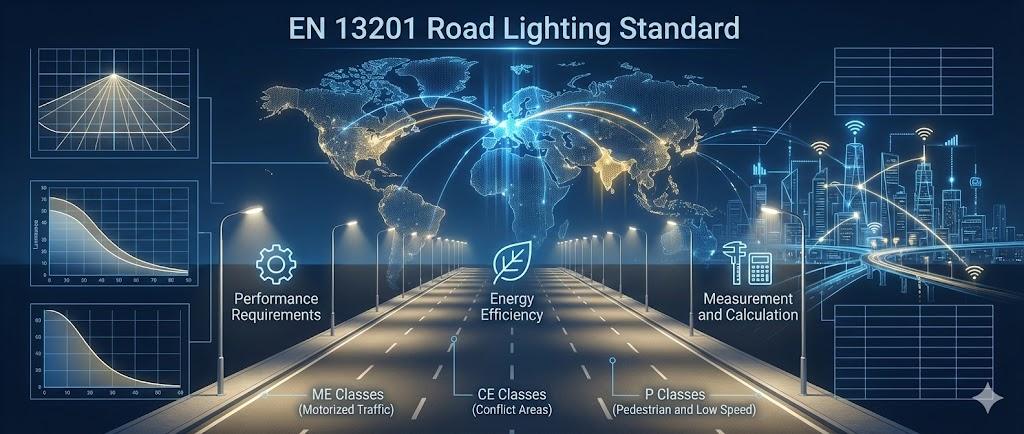
Overview of EN 13201 Road Lighting Standard (Europe & India adoption)
Now, let’s go through the specifics of EN13201 road lighting standards.
What is EN 13201?
EN 13201 is a widely adopted European Standard that defines how road lighting should be designed, measured, and evaluated. It provides a structured framework for defining lighting classes and performance requirements to make sure that every road prioritizes both road safety and energy efficiency.
Where is EN 13201 Used?
EN 13201 is followed in many parts of the world because of its clarity. You will commonly see it applied in:
- European Union (EU) countries
- United Kingdom
- Middle East
- India
- Southeast Asian countries like Malaysia, Indonesia, and Vietnam
- Africa
Components of EN 13201: A Complete Breakdown
The EN13201 framework divided into six interconnected parts:
1. EN 13201-1: Selection of Lighting Classes
This foundational document helps you determine what level of lighting your road actually needs. Check out the main road lighting classes:
- ME Classes
These classes apply when people mainly drive using luminance contrast.
| Class | Areas |
| ME1 | Highways and motorways with high speeds (>70 km/h) |
| ME2 | Major traffic routes with moderate speeds (50-70 km/h) |
| ME3a/ME3b/ME3c | Urban arterial roads with mixed traffic |
| ME4a/ME4b/ME4c | Residential distributor roads that have lower traffic volumes |
| ME5 | Low-traffic residential streets |
- CE-Classes
These lighting classes address locations where vehicles, cyclists, and pedestrians interact.
| Class | Areas |
| CE0 | Major traffic intersections requiring highest visibility |
| CE1 | Important conflict areas with moderate complexity |
| CE2 | Standard urban intersections |
| CE3 | Minor conflict zones |
| CE4 | Low-priority crossing points |
| CE5 | Minimal conflict areas |
- P-Classes
When road users move slowly or on foot, the lighting strategy shifts entirely to illuminance-based criteria.
| Class | Areas |
| P1 | City centers and main shopping streets |
| P2 | Urban pedestrian zones with moderate activity |
| P3 | Suburban footpaths and residential walkways |
| P4 | Rural paths with occasional use |
| P5 | Low-priority pedestrian routes |
| P6 | Minimal lighting for basic orientation |
| P7 | Very basic recognition lighting |
2. EN 13201-2 – Performance Requirements
Once the lighting class is selected, Part 2 defines how well the lighting must perform. This includes quantified performance requirements, such as:
- minimum and average luminance
- minimum illuminance values
- overall and longitudinal uniformity
- threshold increment (TI)
- surround ratio
- veiling luminance
3. EN 13201-3 – Calculation of Performance
Part 3 answers one of the most common doubts of an engineer: How do we calculate and prove compliance? It explains:
- how calculation grids must be placed
- number of calculation points
- correct geometry for roads
- averaging methods
- compliance tolerance limits
4. EN 13201-4 – Measurement Methods
While Part 3 talks about design calculation, Part 4 focuses on how performance is measured on-site after installation. It covers:
- field measurement techniques
- placement of measurement points
- night-time survey methodology
- instruments to be used
- dealing with traffic & environmental conditions
5. EN 13201-5 – Energy Performance Indicators
Updated to meet modern sustainability goals, Part 5 focuses entirely on Energy Efficiency. It introduces metrics to ensure you’re creating the lighting system responsibly:
- PDI (Power Density Indicator): Measures the energy needed per square meter (W/m^2).
- AECI (Annual Energy Consumption Indicator): Estimates the total energy used over a year (kWh/m^2/year), factoring in dimming schedules and smart controls.
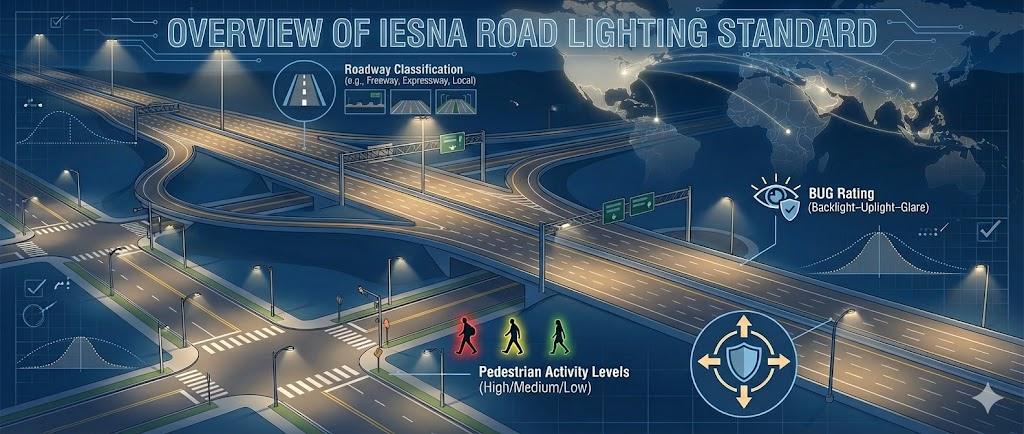
Overview of IESNA Road Lighting Standard (ANSI/IES RP-8-18 / latest)
The IESNA Guide is one of the most widely referenced Road Lighting Standards in the world, especially for projects following North American design practice. Let’s check it out!
What is IESNA?
The Illuminating Engineering Society of North America (IESNA) is a professional body that develops lighting guidelines used by designers, EPC contractors, and city authorities. Its road lighting guidance (commonly known as IES or IESNA Guide) sets the rulebook for roadway lighting design in many countries similar to how EN 13201 works under the European Standard framework.
Where is IESNA Used?
The IESNA Guide is applied across a wide range of countries and regions, especially where North American engineering norms are followed. You will usually see it referenced in:
- United States
- Canada
- Mexico
- Caribbean countries
- Middle East
- Philippines and parts of Southeast Asia
Main IESNA Road Lighting Standard Requirements (ANSI/IES RP-8)
Here are the core components you need to know when designing a road lighting system under IESNA guidelines:
- Roadway Classification System
Instead of using abstract codes (like M1 or M2), IESNA categorizes roads by their physical definition and traffic flow.
- Freeway: Divided highways with full control of access (no stoplights).
- Expressway: Divided highways with partial control of access.
- Major (Arterial): The principal network for through traffic flow.
- Collector: The roads that connect locals to majors.
- Local: Streets used primarily for direct access to properties (residential).
- Pedestrian Activity Levels
IESNA divides pedestrian areas based on conflict levels:
| Pedestrian Classification | Characteristics |
| High | Commercial areas with significant pedestrian traffic |
| Medium | Intermediate areas like suburban shopping strips |
| Low | Very low pedestrian presenc |
- Control of Glare and Discomfort
Glare is a major safety hazard. It causes fatigue, slower reaction, and stress while driving.
IESNA controls this through:
- limits on disability glare
- controlled luminance from luminaires
- proper mounting height and tilt selection
- BUG Rating
Even though it is not a calculation method for the road itself, the BUG rating is essential for equipment selection within IESNA standards, especially for energy efficiency and environmental care. Here’s what BUG stands for:
- Backlight: Light spilling behind the pole (e.g., into someone’s bedroom window).
- Uplight: Light wasting energy by shooting into the sky (Sky Glow).
- Glare: High-angle light that annoys drivers.
EN 13201 VS IESNA: Main Differences in Road Lighting Standards
Have a look at the main differences between EN 13201 and IESNA:
| Criteria | EN 13201 | IESNA |
| Classification Approach | Uses strict lighting classes (M, C, P) based on specific parameters like speed and geometry. | Uses a matrix of road types combined with pedestrian conflict areas. |
| Glare Control | Through Threshold Increment. It measures the percentage increase in contrast required to see an object. Target is usually 10-15%. | Through Veiling Luminance Ratio. It measures the veiling effect of light on the eye. Target is usually <0.3. |
| Uniformity Measurement | Requires both Overall Uniformity and Longitudinal Uniformity | Uses an Average-to-Minimum ratio to determine uniformity |
| Pedestrian Areas | Dedicated classes (P1–P6) specifically for pedestrian-only or low-speed zones | Adjusts the requirement of the main road based on pedestrian volume (High/Med/Low). |
| Observation Distance | The standard calculation places the observer 60m from the calculation field. | IESNA typically places the observer approx. 83m away (based on stopping distances). |
Frequently Asked Questions (FAQs)
- How do I design a lighting system as per road lighting standards?
To design a compliant system, first define your road parameters. Then, use photometric software like DIALux to simulate the layout and make sure that your fixture spacing and optics meet the calculation of performance metrics for uniformity and glare before installation.
Also Read: How to Prepare Technical Specs and BOQ for Solar Street Light Projects
- What is the difference between EN 13201 and IESNA?
The European Standard (EN 13201) uses a rigid classification system (M, C, P) based on specific road geometries and speeds. In contrast, the IESNA Guide uses a descriptive matrix that combines roadway types with pedestrian conflict levels to determine the required light levels.
- What is the standard height for street lights?
Pole height is determined by the road width and desired Visual Performance, but it typically ranges from 4–6 meters for residential streets and pedestrian paths to 8–12 meters for highways.
- What is the recommended lux level for street lighting?
There is no single magic number. It depends entirely on your project’s Selection Criteria. Generally, main roads target 15–30 Lux, while residential and low-traffic areas aim for 5–10 Lux to balance safety with energy efficiency.
- Does solar lighting meet IESNA standards?
Yes, high-quality solar street lights can fully meet road lighting standards like IESNA if they are sized with the correct lumen output and battery autonomy. The main point is ensuring the fixture maintains the required brightness levels all night without dimming below the safety threshold.
Conclusion
As we look toward 2026, the challenge for project managers is changing. It is no longer enough to just meet the road lighting standards. You have to meet it sustainably without compromising on the rigorous performance requirements of EN 13201 or the IESNA.
This is often where the doubt creeps in. Can off-grid solar really handle the intensity of a highway or the strict uniformity of a busy intersection?
The answer is yes, but only if the engineering is precise.
At DEL Illumination, we engineer compliant solar street lighting projects. That’s why our systems are designed from the ground up to hit those critical lux levels and uniformity ratios. It ensures that your transition to green energy never means a step down in safety. Contact us now to know more!