
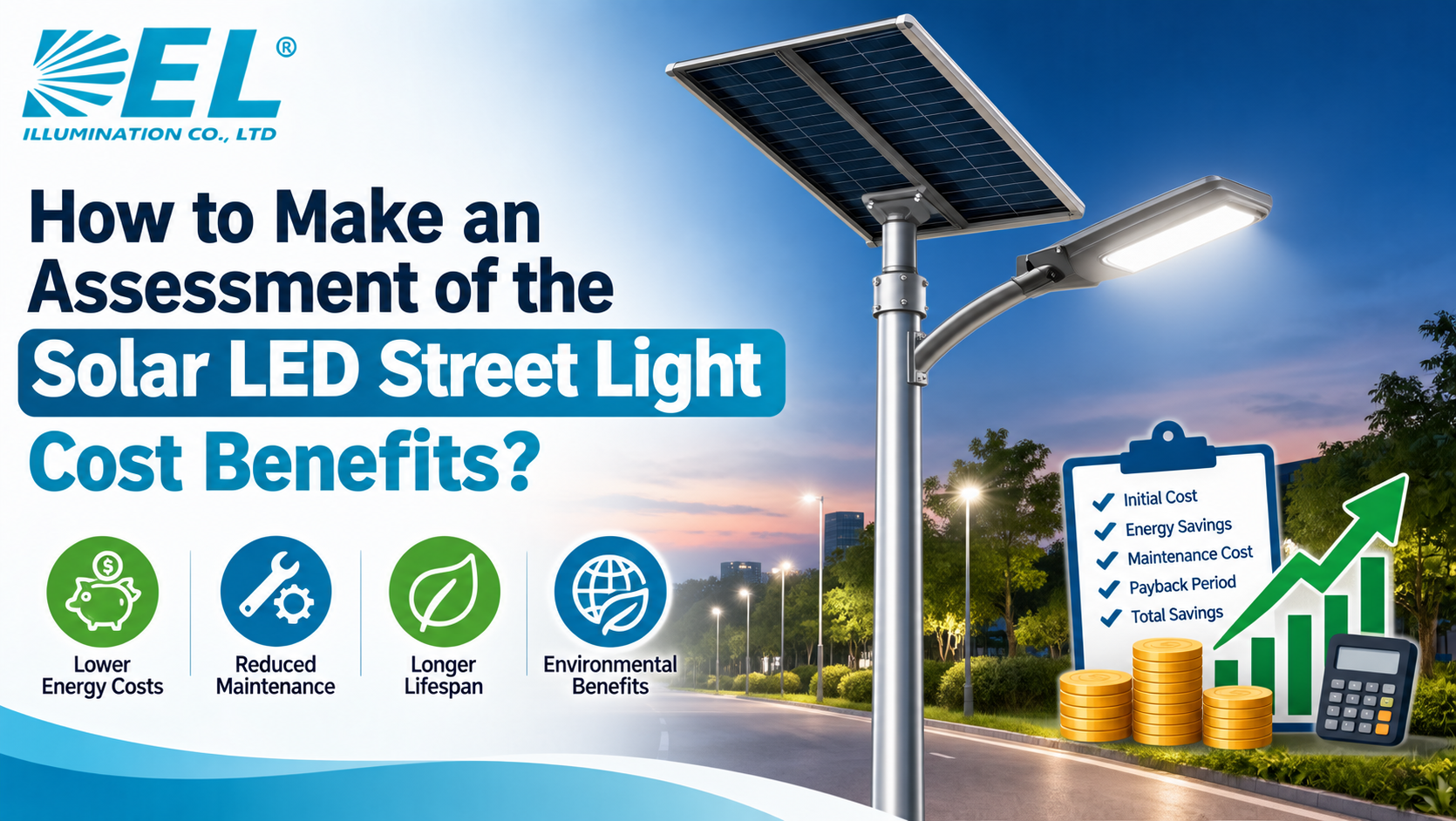
Solar LED street lights are efficient, high performing fixtures that run entirely on solar energy without needing any other power source. What’s less widely understood is just how significant the solar LED street light cost benefits are compared with traditional street lighting, and how much value that represents for anyone weighing the investment.
A number of studies have looked at solar LED street light benefits from both qualitative and quantitative angles. Some researchers have focused on the underlying reasons for the cost effectiveness of these fixtures, while others have calculated the actual cost benefits in concrete numbers across different installations worldwide. This article walks through both: the reasons behind solar LED street light cost benefits, and a simple framework you can use to work out the numbers for your own project.
If you’re comparing fixtures directly, the All in One Solar Street Light is a useful reference point, since it’s engineered specifically to maximize the solar LED street light cost benefits covered below.
Reasons behind solar LED street light cost benefits
Several factors play a role in the cost benefits solar street lights deliver over traditional fixtures. The most significant ones are summarized below.
High energy savings. Solar LED street lights use far less energy than traditional high pressure sodium fixtures. Studies show LED street lights need roughly 80 percent less energy to deliver the same standard of performance, which is one of the biggest drivers of solar LED street light cost benefits on its own.
Longer lifespan. The LEDs used in solar street lights last considerably longer than traditional lamps or incandescent bulbs, thanks to the efficiency of the underlying technology. That extended service life is a major part of why solar LED street light cost benefits compound over time rather than fading after a few years.
Lower operation and maintenance costs. Most solar LED street lights are effectively maintenance free and can run for extended periods without faults. Studies suggest solar LED street lights save around 50 percent more on operation and maintenance costs than traditional lighting, which meaningfully increases the overall solar LED street light cost benefits over a project’s lifetime.
Flexible deployment. Because there’s no need for wiring back to the grid, these fixtures can be installed almost anywhere in a city without additional infrastructure. Traditional lighting, by contrast, needs separate power resources run to every location, which adds real cost that solar avoids entirely.
A simple framework for comparing costs
To work out the solar LED street light cost benefits for a specific project, a standard framework can be applied to any fixture you want to analyze:
- Calculate the total wattage of the light or series of lights needed to achieve the desired level of illumination.
- Work out the total energy consumption for a single day of operation.
- Use the daily figure to calculate annual energy consumption for the fixture.
- Apply local electricity rates to that annual consumption to arrive at the actual yearly running cost.
Traditional lamp example
If a 250 watt bulb operates for 12 hours a day, its daily energy use comes to 12 multiplied by 250 watts, or 3 kilowatt hours. Over a year, that works out to 365 multiplied by 3 kilowatt hours, or roughly 1.095 megawatt hours.
At a rate of $1 per kilowatt hour, that annual consumption would cost approximately $1,095.
LED light example
A 40 watt solar LED street light can typically replace that same 250 watt traditional lamp, thanks to its much higher efficiency. Running that 40 watt fixture for 12 hours a day, 365 days a year works out to roughly 0.175 megawatt hours annually.
At the same $1 per kilowatt hour rate, the annual energy cost comes to roughly $175, a clear illustration of how large the solar LED street light cost benefits can be once you run the numbers.
Putting the numbers in context
Comparing the two examples above, the difference in annual running cost alone, roughly $1,095 versus $175, shows how significant solar LED street light cost benefits are in practice, even before factoring in maintenance and lifespan advantages. According to the International Energy Agency, continued improvements in solar panel and LED efficiency are making these cost benefits even more pronounced as the technology matures.
If you want help running these numbers for your own project, our service page covers how our team supports cost analysis and fixture selection before installation begins.
Conclusion
Solar LED street light cost benefits are significant when measured against traditional lighting, and the research backs this up consistently. Between roughly 80 percent lower energy use and around 50 percent lower operation and maintenance costs, the combined solar LED street light cost benefits add up to a strong case for solar over traditional fixtures in most projects. If you would like help assessing solar LED street light cost benefits for your own site, reach out through our contact page and our team can walk you through it.
Frequently asked questions
How much less energy do solar LED street lights use than traditional lights?
Studies generally show around 80 percent lower energy consumption compared with traditional high pressure sodium fixtures, which is one of the main drivers of solar LED street light cost savings.
How do I calculate the running cost of a street light?
Multiply the fixture’s wattage by its daily operating hours to get daily energy use, multiply that by 365 for annual use, then apply your local electricity rate to get the yearly cost.
Do solar LED street lights really need less maintenance?
Yes. Most models are effectively maintenance free, and studies suggest they save around 50 percent more on operation and maintenance costs compared with traditional street lighting.
Are solar LED street lights more expensive to install than traditional lights?
Upfront costs can be higher, but the absence of grid wiring and the lower running and maintenance costs typically make solar the more cost effective option over the system’s lifetime.
What makes solar LED street lights easier to deploy than traditional lighting?
Since they don’t need a grid connection, solar fixtures can be installed almost anywhere without laying new cabling or building extra infrastructure, which traditional lighting typically requires.