
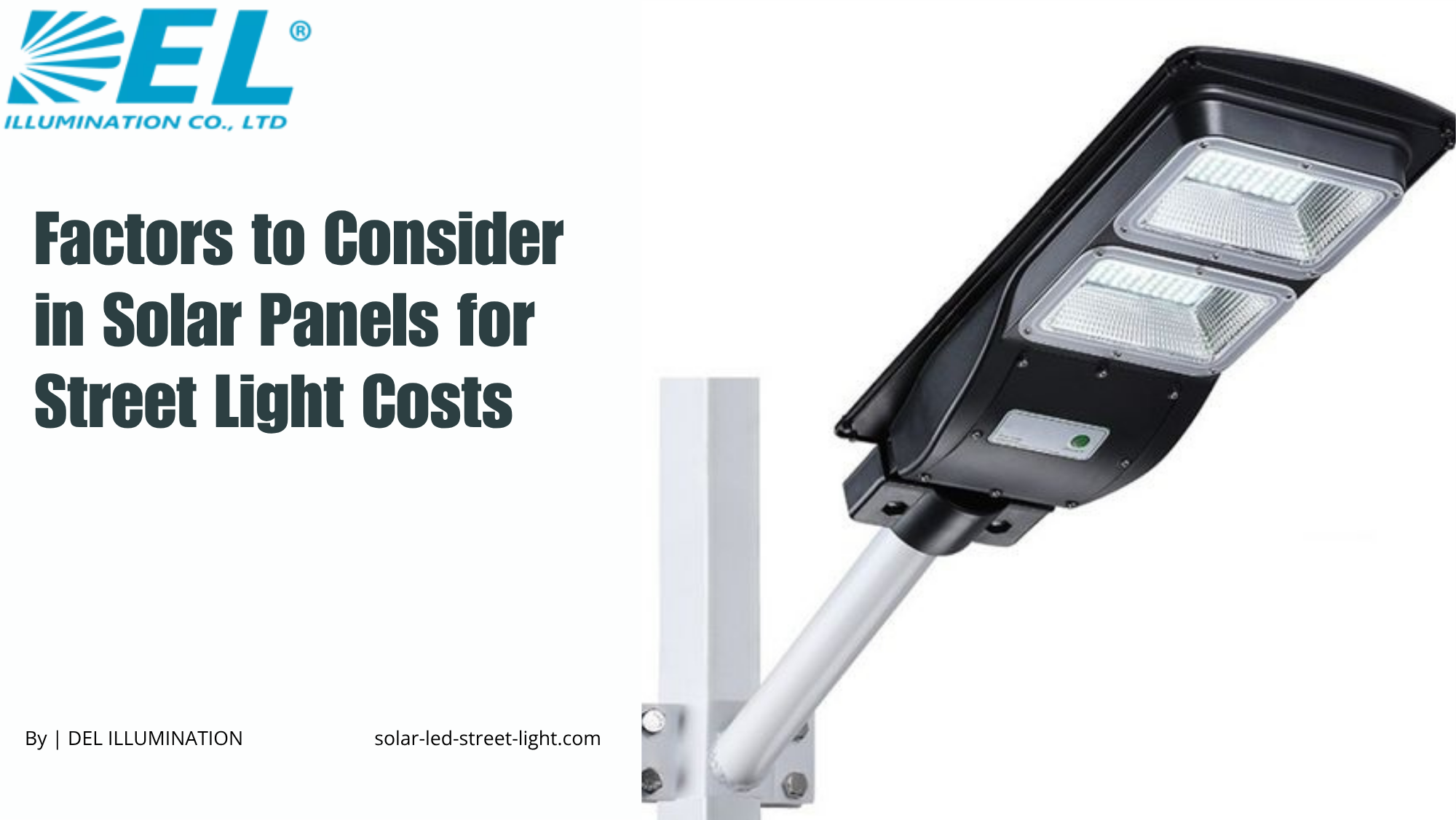
Most people, when they hear about solar power, assume that new products on the market are always expensive. However, that is not the case, since most studies and reports show that solar is indeed about half the cost you would incur using traditional systems. Solar Panels for Street Lights Costs can be reduced even further when you choose to optimize each component of the street light system. Unlike an ideal situation, the process of purchasing the various parts for a project needs thorough consideration, careful planning, and serious decision making. Our All in One Solar Street Lights range is a useful starting point for pricing a complete system.
In this article, we will focus on the solar panel, which is the power source of the system. There are various factors of consideration in Solar Panels for Street Lights Costs. Here are some of the factors that might be of interest to your project.
Sizing of the Solar Panel
The size of the solar panel to use for your solar street light project relies on a couple of factors, such as the temperature of the area, the insolation, and the shading. However, the principal determiner for the size of the solar panel is the wattage of the lighting fixture, and it feeds directly into Solar Panels for Street Lights Costs.
The power requirement of the entire street light system will help in deciding the number of solar panels you will need in the design. Lowering the wattage of the light source can help reduce the Solar Panels for Street Lights Costs related to installation.
If you are familiar with the relationship between the PV module and power capacity, then you know that an increase in power capacity means more Watt peak (Wp) and higher costs. You can quickly reduce the wattage by optimizing the lighting fixture, the electric circuitry, and the battery.
Optimization in terms of the light source means doing proper calculations of the illumination required with traffic patterns in mind. An analysis to determine the right traffic hours on the street will reduce the need for a full 12 hours of lighting (6 pm to 6 am).
Still on the lighting fixture, optimization can be achieved by using new technology and innovations that reduce power consumption. Currently, the most useful considerations are the use of LED or HPS, adaptive lighting techniques, and automation.
When you have lowered the wattage of the luminaire, you can now work on reducing energy loss in the switch circuitry. This form of optimization requires that the wiring is leakproof and that there are no signs of short circuiting in the system.
Before you move on to the battery, ensure that the switch circuit is energy efficient. The battery is responsible for supplying electricity to the luminaires that provide light at night. Besides being storage for energy, your battery should maintain the required illumination for the expected period, charge fast, and retain more power.
You can only optimize your battery use by selecting a product with high energy savings. Here, an expert would tell you to analyze the battery type, brand, charging and discharging rate, life span, and other features that support your goal to lower the wattage of the system. Each of these choices quietly shapes Solar Panels for Street Lights Costs over the life of the project.
The optimization of the other components of the solar street light gives you an estimate of the power capacity to work with when designing your solar panel and street light system. This step involves electrical calculations related to solar power. The Panel Generation Factor (PGF) is also a critical element in the sizing of the solar panel for your street light system. Our Solar Lighting Project Checklist walks through these sizing inputs in a practical order.
Type of Solar Panel
Any PV module can be useful in a solar street light project. Since our goals and budgets differ, some buyers go deeper to determine the specific solar panels that are cost effective and energy efficient, which has a direct bearing on Solar Panels for Street Lights Costs.
Two types of photovoltaic cells you will find in modern solar street light systems are mono crystalline silicon and multi or poly crystalline silicon, also called wafer based crystalline silicon solar cells. When choosing the type of solar panel to use, it is essential to consider its conversion rate and efficiency. These two features can significantly reduce your Solar Panels for Street Lights Costs.
In modern solar powered street lights, the PV module is either integrated into the lighting fixture or the pole itself, or mounted on the lighting source. These designs can be challenging when you wish to maximize the use of integrated photovoltaic panels, due to their low levels of freedom.
Traditional and some modern solar street light systems use independent PV modules, which makes it easy for optimization to help reduce the overall Solar Panels for Street Lights Costs. The flexibility of independent PV panels also makes it easy to adjust the directional angle for maximum absorption of sunlight.
Solar Panel Optimization
In the optimization of the solar panel, the goal is to ensure that the product works as per the design. It takes into account the mounting, the surrounding area, the local weather conditions, the latitude and climate of the site, the shading, and other factors controlling the inputs and outputs of the equipment.
Keeping the solar panel clean is another way of ensuring that you are using the full potential of the cells. It is important to note that there are certain factors you cannot control, so focus only on the variables that you can change. According to the International Energy Agency, solar PV module prices have fallen dramatically over the past decade, which continues to push Solar Panels for Street Lights Costs downward year on year.
Solar Panels for Street Lights Costs: Conclusion
The lifetime cost of the lighting system relies on the solar panel and the components around it. Therefore, the sizing, the type or selection, and the optimization of the PV module are the three main factors of consideration in Solar Panels for Street Lights Costs.
Working on these three variables can significantly lower the lifetime Solar Panels for Street Lights Costs. You do not need an oversized PV module if you have no plans to store surplus energy. What you need is a fully functioning panel that converts enough solar energy into electric energy to meet the required power capacity. If you would like help sizing a system for your site, reach out through our Contact page.
Frequently Asked Questions
What determines Solar Panels for Street Lights Costs?
The main drivers are the wattage of the lighting fixture, the size and type of PV module, and how well the whole system is optimized. Lower wattage and efficient components reduce the panel size you need, which lowers overall cost.
Are mono crystalline or poly crystalline panels cheaper for street lights?
Poly crystalline panels usually cost less per watt, while mono crystalline panels offer higher efficiency in a smaller area. The better value depends on your available mounting space, local sunlight, and long term energy needs.
Can I reduce Solar Panels for Street Lights Costs without losing performance?
Yes. Optimizing the light source, tightening the wiring against energy loss, choosing an efficient battery, and correctly sizing the panel all cut cost while keeping the required illumination through the night.
Does keeping panels clean really affect cost?
Indirectly, yes. A clean panel captures more sunlight, so it delivers its rated output and lets you specify a smaller, cheaper module rather than oversizing to compensate for dirt and shading losses.
How do I size a solar panel for a street light?
Start from the fixture wattage and required lighting hours, factor in local insolation, temperature, and shading, then apply the Panel Generation Factor. This gives the power capacity your panel must supply each day.