
LED solar street lights have revolutionized outdoor lighting by combining renewable energy with cutting-edge LED technology. These innovative systems reduce energy costs by up to 80% while providing reliable illumination for streets, parking lots, and public spaces. Since the invention of the battery (1800), lighting bulb (1878), and solar cells (1888), the evolution has continued through the 20th century with inverters (1980) and charge controllers, culminating in today’s advanced LED solar street light systems.
Modern innovations focus on maximizing energy efficiency and reducing costs through smarter designs and advanced control systems. Let’s explore the four major innovations transforming LED solar street lighting in 2025.
1. All-in-One Design and Energy Efficiency Innovations
The all-in-one solar street light represents a breakthrough in compact design. Originally, LED was designed for separate lighting fixtures, but these integrated systems combine solar panels, LED lights, rechargeable batteries, and controllers into a single, streamlined unit. This eliminates complex wiring and reduces installation time by up to 70%.
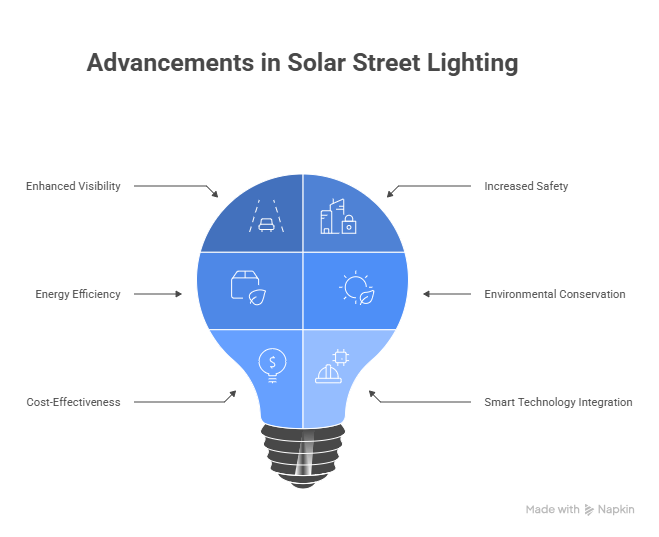
Advanced Battery Technology
Modern all-in-one designs feature built-in lithium-ion (Li-ion) batteries that offer:
- Higher energy density than traditional batteries
- Longer lifespan (5-7 years average)
- Faster charging capabilities
For larger installations, Lithium Iron Phosphate (LiFePO4) batteries provide enhanced safety, cleaner operation, and extended service life, making them ideal for all-in-two solar street lights that separate the solar panel from the fixture.
Superior Luminous Efficacy
LED technology achieves 90-112 lumens per watt the highest luminous efficiency of any street lighting technology. This means brighter illumination using less energy. Advanced lens designs further reduce light pollution and glare with shatterproof, crystal-clear optics that direct light precisely where needed.
2. Smart Control and Sensor InnovationsTechnology
Intelligent brightness control transforms how solar street lights operate. Since brighter lamps consume more energy, smart sensors automatically adjust light intensity based on real-time conditions, extending battery life by 40-60%.
Motion and Light Sensing Technology
Modern solar street lights integrate advanced sensors:
- PIR (Passive Infrared) sensors – detect movement and increase brightness when pedestrians or vehicles approach
- LDR (Light Dependent Resistors) – automatically turn lights on at dusk and off at dawn
- Photodiodes and phototransistors – provide precise ambient light detection
These intelligent systems deliver the right amount of light at the right time, reducing energy waste while maintaining safety and visibility.
Remote Management and IoT Integration
High-power remote controls allow you to:
- Select from 3-4 operating modes
- Adjust brightness levels remotely
- Program specific operating hours
Premium models include IoT connectivity with Wi-Fi and built-in CCTV cameras, transforming street lights into smart security hubs for residential and commercial properties.
3. Advanced Solar Charge Controller Innovations
When sunlight is limited due to clouds or harsh weather, advanced charge controllers ensure maximum power extraction. Modern systems feature:
MPPT (Maximum Power Point Tracking)
MPPT controllers extract up to 30% more power from solar panels compared to traditional controllers. They continuously track the maximum voltage point, ensuring optimal charging even in partially shaded or cloudy conditions.
PWM (Pulse Width Modulation)
PWM controllers provide reliable, cost-effective charging by regulating voltage above battery requirements. While less efficient than MPPT, they’re ideal for smaller installations where budget is a primary concern.
Most quality LED solar street lights guarantee 3+ rainy days of continuous operation on a full charge, ensuring uninterrupted lighting during poor weather.
4. Durability and Quality Innovations Enhancements
Long-lasting performance requires superior materials and German engineering solar lights. Modern all-in-one solar street lights incorporate several protective innovations:
Weather-Resistant Construction
- Anti-rust, corrosion-resistant poles engineered to withstand high winds and heavy equipment loads
- IP65/IP66 waterproof ratings protecting against dust and powerful water jets
- Advanced heat dissipation systems that extend LED lifespan to 50,000+ hours
- Anti-storm design resistant to extreme weather conditions
Innovative Mounting Solutions
Knuckle mount slip fitters allow easy installation on standard poles with adjustable positioning for maximum solar exposure. Some advanced designs integrate solar panels directly into support columns, automatically tracking the sun’s movement for optimal energy conversion.
Anti-theft features including tamper-resistant fasteners and secure mounting brackets protect your investment in high-risk areas.
Conclusion: The Future of LED Solar Street Lighting Is Here
LED solar street light innovations continue advancing at a remarkable pace, driven by the dual goals of energy savings and cost reduction. From all-in-one integrated designs to intelligent sensor networks, MPPT controllers, and weather-resistant construction, these four innovations represent the cutting edge of sustainable lighting technology.
Whether you choose an all-in-one system for easy installation or an all-in-two configuration for maximum flexibility, modern LED solar street lights deliver exceptional performance, reliability, and return on investment.
As manufacturers invest heavily in R&D and patent new technologies, the market offers unprecedented variety and performance. The future of outdoor lighting is bright, sustainable, and smarter than ever aligning perfectly with evolving customer needs and environmental priorities.
Q 1: What is the lifespan of LED solar street lights?
Answer: LED solar street lights typically last 5-7 years for the battery component and over 50,000 hours (approximately 10-15 years) for the LED fixtures themselves. The overall system lifespan depends on the quality of components used. Premium models with Lithium Iron Phosphate (LiFePO4) batteries and advanced heat dissipation systems can last even longer. Regular maintenance, such as cleaning solar panels and checking connections, can extend the life of your solar street lighting system significantly.
Q 2: How do all-in-one solar street lights differ from traditional solar street lights?
Answer: All-in-one solar street lights integrate the solar panel, LED light, rechargeable battery, and charge controller into a single compact unit, whereas traditional systems have separate components that require extensive wiring. The all-in-one design offers several advantages: 70% faster installation time, reduced maintenance needs, sleeker appearance, and easier positioning for optimal solar exposure. However, all-in-two solar street lights (with separated panels) may be better for areas with limited direct sunlight or larger installations requiring higher power capacity.
Q 3: What is MPPT technology and why is it important for solar street lights?
Answer: MPPT (Maximum Power Point Tracking) is an advanced charge controller technology that extracts up to 30% more power from solar panels compared to traditional PWM controllers. MPPT continuously monitors and adjusts to find the optimal voltage and current combination, ensuring maximum energy harvest even during cloudy weather, partial shading, or early morning/late evening conditions. This technology is especially valuable for LED solar street lights in areas with inconsistent sunlight, as it extends battery life and ensures reliable operation during extended rainy periods (3+ days on a full charge).
Q 4: Are LED solar street lights bright enough for main roads and highways?
Answer: Yes, modern LED solar street lights for roads are powerful enough for main roads and highways. LED technology achieves 90-112 lumens per watt, the highest efficiency of any street lighting technology. High-quality models can produce 3,000-15,000 lumens depending on the configuration, which is suitable for various applications from residential streets to major roadways. The key is selecting the right wattage and lumen output for your specific needs. Smart sensors also adjust brightness automatically, providing full illumination when motion is detected and dimmed lighting during low-traffic periods to conserve energy.
Q 5: How do solar street lights work during cloudy days or winter months?Answer: Quality LED solar street lights are designed to operate reliably during poor weather conditions. They achieve this through three key features:
(1) High-capacity lithium-ion or LiFePO4 batteries that store 3-7 days of backup power,
(2) Advanced MPPT charge controllers that extract maximum energy even from limited sunlight, and
(3) Intelligent brightness control systems that adjust light intensity based on battery levels. During winter or extended cloudy periods, the lights automatically dim to conserve energy while maintaining safety illumination. Proper sizing of the solar panel and battery capacity during installation ensures year-round operation in your specific climate.