
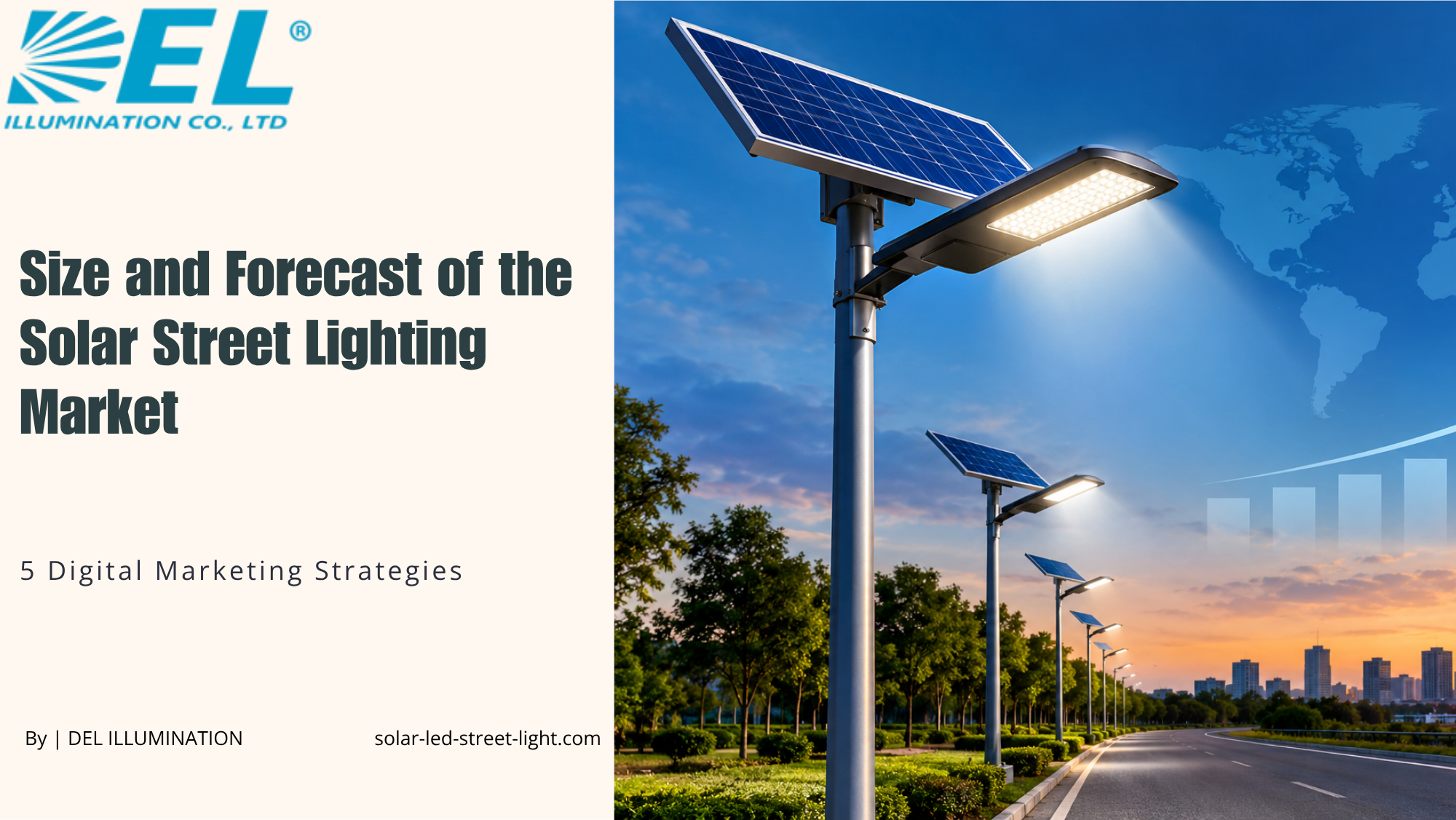
Today, solar street lights have become the lighting sources most used for outdoor lighting. Solar energy is the primary energy source for these lights. Photovoltaic panels, which are always placed on the integrated poles, power the street lights. Since the demand for continuous power and lighting has increased in urban and rural areas, the prospect for the Solar Street Lighting Market has drastically expanded. Some aspects, for instance technological innovations in the street lighting design, have brought about a reduction in the components of street lighting, hence making them an appealing alternative to traditional street lights.
Manufacturers like DEL Illumination, whose All in One solar street lights integrate the panel, battery, and fixture into one unit, sit right at the center of that shift in the Solar Street Lighting Market.
Solar Street Lighting Market Outlook
In several reports, the section of the market outlook is known for mainly encompassing the most important aspects of the market, which incorporate challenges, opportunities, drivers, and restraints being faced by solar lighting companies. Restraints and drivers are assumed to be the essential factors. On the other hand, challenges and opportunities are assumed to be extrinsic factors within the Solar Street Lighting Market.
Since several governments are encouraging their citizens to consider installing solar street lights, the market has been expanding. This factor, together with the environmentally friendly and cost effective nature of various solar street lighting systems, has been driving the market. High maintenance needed for the running of the solar street lights, together with the expensive initial investment needed, have been restraining the market. According to the International Energy Agency, solar is now the fastest growing source of renewable power, which helps explain why the Solar Street Lighting Market continues to grow despite those restraints.
Factors Affecting the Solar Street Lighting Market’s Size and Forecast
The size and the forecast of the Solar Street Lighting Market are generally affected by the following factors:
Awareness
Consumer education is among the top factors facing solar street lights’ penetration into the market. It is important to consider raising the level of awareness of the target market by stating the available options, their benefits, together with the hazards associated with the use of more dangerous sources of energy to light people’s homes. It is believed, in the energy sector, that insufficient entrepreneurial skills, as well as entrepreneurial capacity, are key things that limit the marketing of solar street lighting products.
If the awareness of solar street lighting products has been affected by spoilage, it becomes very difficult for solar street light companies to thrive in the market. Market spoilage is likely to be experienced where there are substandard products and services in the market. Moreover, low quality lighting products, in as much as they are cheap, have been increasing the difficulties of market penetration since consumers do not trust the quality and technology. In other words, if consumers get appropriate awareness, it becomes easier for more people to trust solar street lighting products, hence increasing the size and forecast of the Solar Street Lighting Market.
Affordability or Access to Finance
Affordability affects the penetration of the Solar Street Lighting Market in most parts of the world. Limited financing alternatives can be felt on different distribution value chain levels, from the manufacturers to dealers, distributors, importers, and even users. Because there is no detailed information regarding the solar lighting industry, foreign direct investors have been facing a serious impediment. Also, the risk elements for the investors are always raised by the limited awareness of market trends, together with the return rates as well as political instability related fears.
Enabling Environment
This is assumed to be the prevailing conditions in the areas or countries supporting the growth of the solar energy industry. The enabling environment is all about the roles of the national governments and those of regulatory bodies. The business model viability of a nation can be gauged using national policies. In some parts of the world, like the United States and Europe, some solar energy projects managed to penetrate the market because there are tax breaks, subsidies, and some supportive policies in place. Because of governments cutting back on subsidies, some companies cannot thrive in the Solar Street Lighting Market.
Technical Support Services
In the proximity of the consumers, having available technical assistance is an important factor as far as countering the effects on the Solar Street Lighting Market is concerned. If there is a technician who is proficient in repair, maintenance, and troubleshooting of the solar street lights, the customers’ trust will increase. Because of the novelty of some solar energy products, there is a need for developing local maintenance capacities in areas where solar street lighting products are being sold and marketed. However, low buying power in some areas makes it difficult for some manufacturers to establish service centers.
Regional Trends Shaping the Solar Street Lighting Market
The Solar Street Lighting Market does not move at the same pace everywhere. Asia Pacific leads on volume, driven by large rural electrification and smart city programmes, while the Middle East and Africa are growing quickly as off grid lighting reaches communities the grid never served. Europe and North America lean toward replacement and upgrade demand, where older fixtures are swapped for efficient solar units. Before committing to any deployment, it is worth working through a proper solar lighting project checklist so your specification matches the regional conditions and standards that shape the Solar Street Lighting Market you are selling into.
Solar Street Lighting Market: Conclusion
For the issues affecting the size and forecast of the Solar Street Lighting Market to be solved, there is a need for developing innovative approaches. It is only through this that there will be increased penetration of solar street lighting products. To position your project on the right side of these trends with tested, well documented products, get in touch with the DEL team and the engineers will help you specify a solution that fits your target market.
Frequently Asked Questions
What is driving growth in the Solar Street Lighting Market?
Growth is driven mainly by government support, rising demand for outdoor lighting in both urban and rural areas, and steady improvements in panel and battery technology that lower the cost per fixture. The environmentally friendly nature of solar lighting and falling running costs also pull more buyers toward it every year.
What are the biggest restraints on the market?
The two most cited restraints are the high upfront investment compared with conventional lighting and the maintenance capability needed to keep systems running. Weak consumer awareness and limited access to finance in some regions also slow adoption.
Which regions are growing fastest?
Asia Pacific leads on sheer volume thanks to large electrification and smart city programmes, while the Middle East and Africa are among the fastest growing because solar reaches off grid communities the traditional grid never served. Europe and North America grow more through replacement and upgrade demand.
Why does technical support matter for market penetration?
Because solar lighting is still new to many buyers, local access to repair and maintenance builds the trust needed for wider adoption. Where skilled technicians and service centres exist nearby, customers are far more confident buying, which lifts the size and forecast of the market.
How can a buyer choose reliable products in this market?
Look past the lowest price toward documented specifications, recognised certifications, and a manufacturer with a track record of completed projects. Low quality fixtures are cheap but erode trust, so verified quality is the safer route to a system that lasts.