
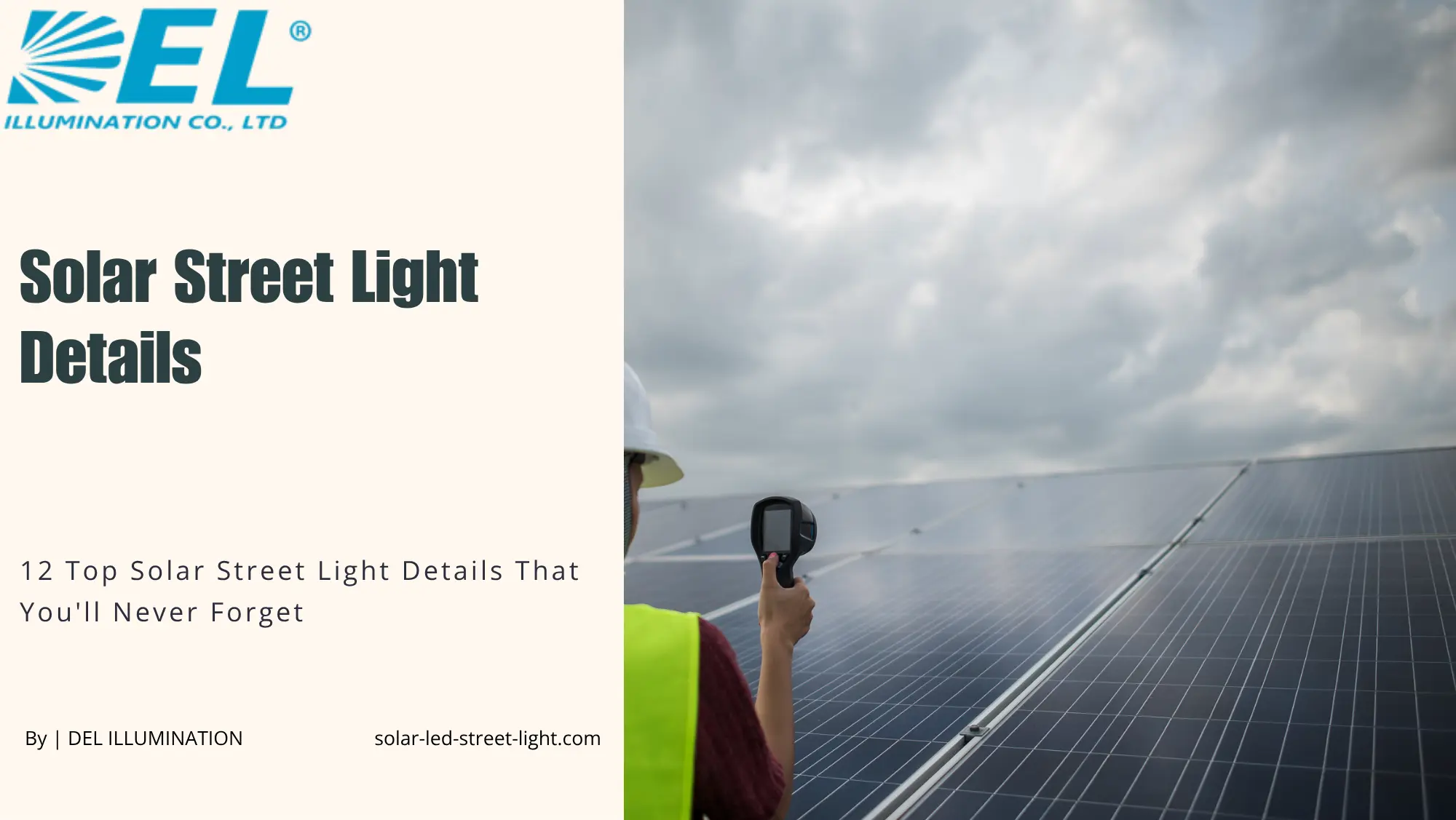
Solar street lighting is an outdoor lighting unit used to illuminate a road or open area. Solar street lights work from sunset to sunrise: the light automatically turns on after nightfall and turns off after dawn. These street lights work in standalone mode. The solar street light ought to be mounted in a shade free place or region where direct daylight is accessible for the duration of the day. For the fundamentals of how this automatic operation works, our guide on the solar street light working principle is a helpful companion read.
1. Solar Street Light Details: Core Components
A street lighting framework comprises an SPV module, battery, luminaire, charge controller unit, interconnecting cables, and pole. Our post on the anatomy of solar LED street light luminaires breaks these parts down further. Here are the essential solar street light details for each component:
SPV Module
The SPV (solar photovoltaic) module is fixed solidly over the pole at the appropriate tilt and inclination in order to capture the maximum daylight throughout the day. The SPV module generates the appropriate current and voltage, which is used to charge the battery inside the battery box. This energy stored in the battery is used to illuminate the lamp housed within the fixture during the evening. To understand these modules better, see our post on what photovoltaic street lights are.
Battery
The energy produced by the SPV module is stored in the battery, which is used to illuminate the fixture throughout the evening. Low maintenance cylindrical lead acid or sealed batteries are commonly used for road lights. The battery is housed in a battery box, which is set on the pole at a reasonable height from the ground for easy support and replacement. Our 10 tips to maintain your solar street light battery help extend its life.
Pole
The SPV module and the fixture are mounted on a steel or aluminum pole, typically at a height of around 4 meters above the ground. Our 9 factors for choosing solar power light poles can guide pole selection.
Illuminator
A CFL lamp or LED lamp is used to provide lighting during evening hours. The charge controller unit (CCU) is connected to the luminaire directly. Our comparison of HPS lights vs LEDs in outdoor solar street lamps explains why LED is the preferred light source.
Interconnecting Cables
The illuminator, SPV module, and battery are all connected to one another via cables.
CCU (Charge Controller Unit)
This unit is the core of the framework; it regulates the loading and discharging of the battery. The CCU protects battery life by preventing the battery from undergoing a deep discharge. During deep discharge situations, the CCU will disconnect the light, and a red LED glows on the illuminator, indicating that the battery is low and requires charging, whereas a green LED on the light signifies that the battery is charging. During overcharge circumstances, the CCU will disconnect the solar module and prevent overcharging of the battery. Our guide to the solar street light controller explains this component in depth.
2. Go for First Rate Solar Street Light Details
This means you should search for the specific particulars that accurately reflect how your solar street lighting framework will perform. A solar street light data sheet is where you’ll find most of these particulars laid out. Some of these fundamental solar street light details that can educate you about the solar street light you’re planning to buy include the following.
Solar Power System
These particulars should specify the type and number of solar modules used in the array. It should also disclose whether they are single or multiple crystalline solar panels, and the total solar array wattage.
Light Level Particulars
The areas that need to be lit should be indicated. The more detail provided, the better. Lighting uniformity ratios can also be referenced. However, determining light levels purely by rough equivalency should be avoided, as it can lead to a few misleading conclusions. A footcandle determination is a more precise and quantifiable measurement of light. Our guide on how to calculate the distance for LED solar area lights helps with accurate light-level planning.
Type of Solar Light Fixture
Notable attributes of the light fixture include lumens per watt delivered, type of lamp, light distribution pattern, and light level distribution. Other details of the fixture may include the installation bracket arm and fixture mounting height.
System Controller
This should include a description of the daily operating schedule. It’s important for ensuring that the solar street lighting framework meets a specific requirement. Sunset to sunrise operation isn’t sufficient information if adaptive lighting frameworks are being set up. Learn more about programmable control in our post on the 9 benefits of solar light remote control technology.
Light Pole
The light pole is equally significant among the key solar street light details. Particulars should specify whether it’s direct burial, anchor base, and whether it’s steel, aluminum, composite, or concrete. It must support the total weight of the solar street lighting framework, including the wind loads predictable in the region. Our post on the 5 advantages of solar light pole systems covers pole considerations in more detail.
Battery
Battery details should also include the total amp hours of the battery and the self sufficient battery storage capacity, which will ensure solid all year performance of the framework. Five nights of autonomy by the battery should be considered at minimum. Our guide on battery powered street lights explains how to calculate this capacity. Other notable specifications relate to the battery box mount, battery box, and other construction materials, including ratings if any.
Solar Street Light Details: Advantages and Disadvantages
Solar street lights offer the following:
Advantages
- Require fewer components for the installation
- Provide freedom of mobility for placement
- Offer high lighting output compared to conventional lights
- Provide a long usable lifespan and low upkeep
- Support contamination free ambiance
- Need less time for installation and fewer components overall
- Typically come with a two year full framework warranty
For a broader buying reference, see our list of the 10 things about the best solar street lights.
Disadvantages
- Initial cost is high compared to conventional lights.
- Dust, snow, or moisture can accumulate on the solar panels and subsequently reduce energy production.
- The rechargeable batteries need to be replaced periodically.
- Solar system components are relatively costly, and thus the risk of theft is higher.
Solar Street Light Details: Conclusion
DEL Illumination Co., Ltd has years of experience creating solar street light systems. Their engineers will provide you with solar street light details such as lighting photometric simulations and formats specific to your application, along with suitable framework setups for your local solar conditions. According to the U.S. Department of Energy, investing in a well-specified solar system delivers strong long-term returns.
You may also want to check out our guide on how to calculate the necessary distance between LED solar area lights.
Harness the Sun. Get Solar Power Today!
FAQs: Solar Street Light Details
1. What are the core components covered in most solar street light details?
The essential components are the SPV (solar photovoltaic) module, battery, luminaire (illuminator), charge controller unit (CCU), interconnecting cables, and pole. Each plays a specific role, from capturing sunlight to storing energy to regulating charge and discharge cycles.
2. Why is the charge controller unit (CCU) considered the core of the framework?
The CCU regulates the loading and discharging of the battery, which directly protects the battery’s lifespan. It prevents deep discharge (which can damage the battery) and overcharging (which can also shorten battery life), while also providing visual indicators, like a red or green LED, of the battery’s charging status.
3. How many nights of battery autonomy should a solar street light have?
At minimum, five nights of autonomy should be considered when reviewing solar street light details for the battery. This ensures the light continues to operate reliably through stretches of overcast weather or reduced sunlight without fully draining.
4. What’s the difference between footcandle determination and rough equivalency when specifying light levels?
Footcandle determination gives a precise, quantifiable measurement of light output at a given surface, while rough equivalency estimates light levels by comparing them loosely to other known fixtures. Rough equivalency can lead to a few misleading conclusions, so footcandle measurements are the more reliable of the two when specifying solar street light details.
5. Why does theft risk factor into solar street light details and disadvantages?
Because the solar panel, battery, and other components represent a meaningful material cost, installations can become a target for theft, particularly in areas without secure mounting or surveillance. This is one of the trade offs worth planning for alongside the higher initial cost compared to conventional grid tied lighting.