
Introduction: The Need of Solar-Powered Outdoor Lighting for Public Spaces
Public spaces work hard. They carry foot traffic after dark, connect people to transit, and keep parks and markets lively in the evening. When lighting underperforms, residents notice—and so do businesses. If you’re evaluating upgrades, solar-powered outdoor lighting for public spaces has moved from “niche” to “serious option” in the last few years. The combination of efficient solar-powered LEDs, better batteries, and smarter controls means cities and private operators can improve safety and ambience while keeping energy and maintenance under control. LEDs already cut energy; pairing them with solar often removes grid energy for those luminaires entirely.
This guide is written for municipal teams, developers, campus operators, special economic zones, and business improvement districts across South America, Africa, and Southeast Asia. We’ll walk through the technology, the economics, the safety standards that matter, and a practical specification checklist you can take to procurement.
Solar Outdoor Lighting for Municipalities: The Energy and Cost Savings
Let’s start with what’s changed. Replacing older lamps with LED is already a big win: the U.S. Department of Energy notes LEDs use at least 75% less energy than incandescent and can last up to 25× longer. While that stat is framed for general lighting, the efficiency advantage carries into outdoor/public lighting, where modern optics and drivers squeeze more usable light out of every watt.
On the systems side, the International Energy Agency reports that lighting’s energy demand has flattened or declined in many places because of LED adoption. That’s before you even apply solar to eliminate grid draw for specific luminaires.
What does solar-powered outdoor lighting for public spaces add to this?
When you deploy commercial solar outdoor lighting (an integrated PV panel + controller + battery + LED luminaire), you’re effectively shifting operating cost from metered energy to asset life and light maintenance. Your display or pathway lights no longer depend on a live grid connection, and you avoid the administrative and construction costs of temporary or permanent feeds in difficult locations.
In areas with volatile tariffs or unreliable power, that’s significant insurance for public-realm operations. (For broader context, IEA’s efficiency analyses show that efficiency and smarter controls deliver material energy and cost reductions across building systems.)
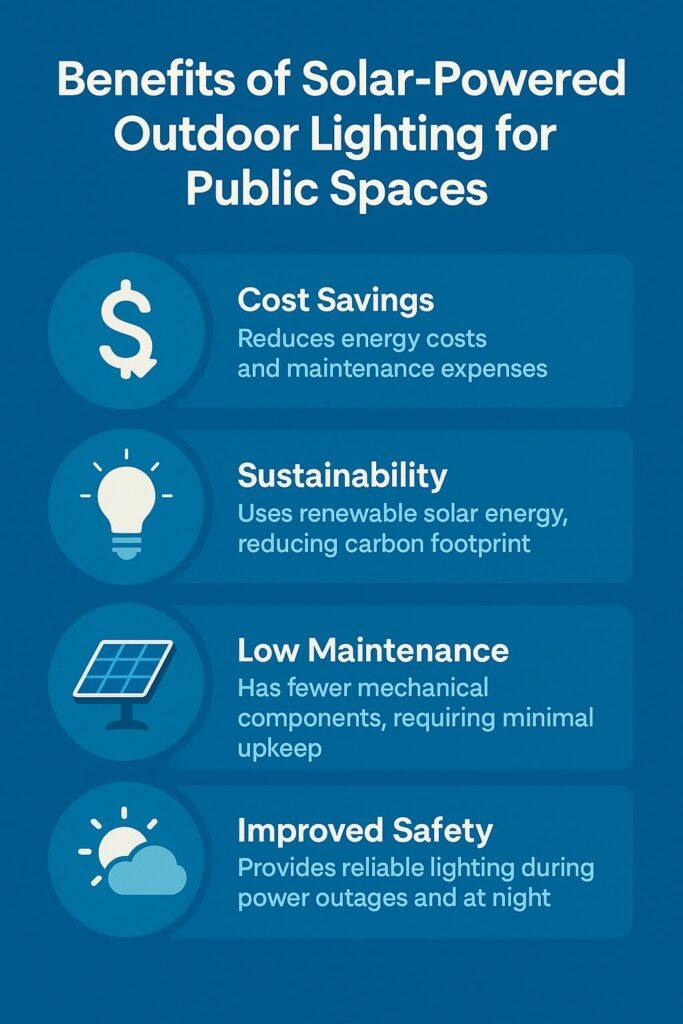
Why Solar-Powered Outdoor Lighting Fits Public Spaces Especially Well
1. Off-grid flexibility
Parks, promenades, waterfront paths, pocket plazas—many of these spaces don’t have spare electrical capacity where you need light. Solar-powered outdoor lighting for public spaces removes the constraint. You can position columns, bollards, or feature lighting for the best pedestrian experience, not just where a spare feed exists. This also reduces road openings and heritage-area disruptions typically associated with new cabling. (Municipal festive-lighting and column-attachment policies underscore how intrusive and paperwork-heavy mains works can be; solar avoids much of that.)
2. Faster programs, fewer permits
Temporary electrical connections, over-street cabling, and night works all create timeline risk. Solar units simplify project phasing because there’s no live cabling through public thoroughfares, which tends to streamline safety reviews and traffic management plans—still inspect and sign off, but the scope is smaller.
3. Budget and sustainability outcomes
Outdoor lighting can be a notable slice of a city’s operational emissions. LED and adaptive control already lower this; running solar outdoor lighting for municipalities pushes grid consumption for those luminaires towards zero during operation. Tie your avoided kWh and associated avoided CO₂ to national grid-intensity factors to meet corporate climate targets. (Public bodies routinely cite street/public lighting as a major lever in their emissions plans.)
Performance of Commercial Solar Outdoor Lighting: Brightness, Runtime, and Weather
The question you’ll hear from stakeholders is simple: Will it be bright and reliable enough? With modern LEDs and good design, yes—if you size and specify the system correctly.
How to size (a simple answer)
- Nightly load (Wh): Sum the wattage of luminaires in a zone and multiply by planned hours (e.g., 6–12 h depending on policy).
- Solar resource: Use Global Solar Atlas (World Bank/ESMAP) to read the worst-month solar resource for your latitude and site. Design for that month.
- Panel wattage: Ensure the array can replenish nightly consumption plus charge the battery for autonomy days in your worst month.
- Battery autonomy: For public spaces, target 2–3 nights without sun so cloudy spells don’t black out the area.
- Controls: Program dusk-to-dawn with time-based dimming (for example, 100% in the early evening, then step down after midnight when footfall drops). International guidance on road/pedestrian lighting now recognizes adaptive lighting—lighting levels that respond to time or conditions.
Environmental durability (IP/IK)
Public equipment takes abuse—from weather, dust, and sometimes people. Specify:
- Ingress protection: IP66 or better for outdoor luminaires and enclosures (dust-tight, protected against strong water jets).
- Impact protection: IK08 or higher for columns/bollards and enclosures in public zones.
These ratings are tied to international luminaire safety frameworks (IEC 60598 series) in regards to solar-powered outdoor lighting for public spaces and frequently referenced by specifiers.
Batteries and heat
Lithium-ion batteries don’t all behave the same in hot climates. Solar lighting for events and public spaces require LiFePO₄ (LFP) chemistries with thermal stability. Independent research and lab work (e.g., NREL and peer-reviewed LFP studies) show how temperature and cycling drive battery degradation, and why thermal management and conservative operating windows extend life.
In hot, humid sites typical of Southeast Asia or equatorial Africa, this is non-negotiable—ask vendors for battery test data and temperature derating.
Soiling and maintenance
Dust and pollution reduce PV output (called soiling losses). For dry seasons in many African and South American cities, plan for routine cleaning and consider hydrophobic coatings where justified. IEA PVPS and NREL publish accessible guidance and maps on soiling impact and mitigation—use them to set realistic maintenance budgets and intervals.
Safety and Compliance for Solar Powered Public Space Lighting Systems
Procurement teams and legal reviewers care about standards. Reference the right ones and you’ll accelerate approvals:
- Luminaires—general safety: IEC 60598-1 (general requirements and tests) and relevant parts of IEC 60598-2 for particular applications. These are the international baselines for luminaire construction and safety.
- Batteries—lithium safety: IEC 62133-2:2017 (+A1:2021) is a widely cited test standard for portable sealed secondary lithium batteries under intended and reasonably foreseeable misuse. For public deployments, insist on evidence of compliance.
- Lighting design for roads and pedestrians: CIE 115 provides the framework for selecting lighting classes (M/C/P) and supports adaptive lighting based on time/traffic. While your installations may be “area/park” rather than carriageways, the methodology informs uniformity and minimum levels for pedestrian comfort and safety.
- Limiting obtrusive light (light pollution, glare, spill): Use the CIE 150 family and ILP GN01 guidance to set limits for light trespass and sky glow—important near residences and dark-sky areas.
When you require these documents in your RFP, vendors who treat public lighting seriously will already have them on file. You’ll also filter out hobbyist “kits” that aren’t fit for solar outdoor lighting for municipalities.
Request a Free Project Proposal
Lighting, Safety, and Perception: Commercial Solar Outdoor Lighting
You’ll likely be asked whether better lighting improves safety. The rigorous answer is: there’s credible evidence of crime reduction with improved street lighting, though effect sizes vary by context, and modern adaptive/dimming strategies don’t necessarily reverse those gains.
- Systematic reviews (spanning decades) find that improved lighting is associated with reductions in total crime, with some reviews citing average reductions around ~20% in treated areas—effects observed day and night, suggesting mechanisms beyond simple visibility (community cohesion, guardianship).
- Studies on dimming and part-night lighting in England/Wales found no overall increase in road collisions or crime where adaptive strategies were applied responsibly, useful for councils adopting later-night dimming for energy savings.
Prioritize uniformity, appropriate lighting classes, and good optics to reduce dark spots and glare. Then add policy-based dimming after peak hours. That approach is consistent with modern guidance and evidence for solar powered public space lighting systems.
Solar-Powered Outdoor Lighting for Public Spaces: Low-Cost Design Patterns
A) Path + plaza core
- Use case: Park loops, waterfront promenades, campus routes.
- Spec: 4–6 m columns with full-cutoff optics; IP66 housings; LiFePO₄ packs sized for 2–3 nights autonomy; dusk-to-dawn with dimming after midnight.
- Why it works: Lower poles + targeted optics improve uniformity and reduce spill to adjacent residences.
B) Market streets and pop-up corridors
- Use case: Night markets, festival streets, temporary corridors during construction.
- Spec: Mixture of standalone solar columns and re-deployable solar towers for perimeters and pop-up nodes; time-limited permits.
- Why it works: Minimal street disruption, fast install, reusable assets across events calendar. (Solar towers are common in events/disaster relief sectors, valued for off-grid reliability.)
C) Hybrid civic center
- Use case: Plazas with a high-power centerpiece (fountains, performance area) plus paths and seating zones.
- Spec: Grid for the “hero” zone; solar for secondary paths, seating, and trees.
- Why it works: Keeps the visual ambition of the main square while offloading most of the area lighting to solar.
Why Choose Solar Lighting for Events and Public Spaces?
Even if your region doesn’t mark Christmas, cities host public holidays, cultural festivals, sports events, and night markets. Solar helps because you can extend operating hours and shape temporary experiences without trenching.
- Temporary installs: Solar bollards and towers define routes and queues, improve stallholder visibility, and can be re-deployed across the year.
- Noise & emissions: Because you’re not running generators for lighting, your events are quieter and cleaner—residents notice.
- Dimming windows: After peak footfall, dim lighting to 50–60% to conserve battery and reduce light nuisance; modern guidance and evidence support adaptive lighting approaches.
Regional Notes for South America, Africa, Southeast Asia
Solar resource: The Global Solar Atlas provides country-level and site-specific solar resource data. In much of these regions, December–April dry seasons offer strong insolation; design for worst-month values to keep winter/rainy-season performance reliable.
Heat and humidity: Prioritize thermal design and LiFePO₄ chemistry, and include shading/air-gap strategies in column enclosures. Ask for battery test records and temperature derating curves.
Dust/soiling: Dry seasons and coastal aerosols can cut PV yield; build panel cleaning into operations, and plan tilt angles to reduce soiling retention. Use IEA PVPS/NREL soiling references to justify budgets.
Financing & programs: Many cities leverage national electrification and public-space improvement funds—World Bank/ESMAP and regional development banks (e.g., AfDB/SEFA) have technical resources and sometimes support instruments that can complement municipal budgets.
Spec and Procurement Checklist (Copy-Paste for Your RFP)
- Optical & electrical
- Photometric files (IES/LDT), uniformity targets, and glare control approach.
- CCT options (e.g., 3000–4000 K for pedestrian comfort); CRI ≥70 for public realms.
- Driver surge protection; programmable time-based dimming; optional motion sensors.
2. Solar & storage
- Panel wattage at STC; worst-month daily energy yield for the site (Global Solar Atlas excerpt).
- Battery chemistry (LiFePO₄ recommended), capacity (Wh), IEC 62133-2 compliance, BMS protections (OV/UV, temp limits).
- Autonomy requirement (≥2–3 nights) and expected cycle life at local temperatures (attach test data).
3. Durability
- IP66 minimum and IK08 impact rating for public areas. Reference IEC 60598 in your compliance matrix.
- Corrosion resistance (coastal treatments), UV-stable cabling and gaskets.
4. Safety & standards
- Luminaires compliant with IEC 60598-1 and relevant -2 parts.
- Batteries compliant with IEC 62133-2:2017 (+A1:2021).
- Design approach aligned to CIE 115 classes for pedestrian areas and paths; include adaptive lighting policy.
- Obtrusive light limits per CIE 150/ILP GN01 (set sky glow/trespass limits, especially near residences).
Check DEL certifications and quality standards.
5. Operations
- Panel cleaning intervals based on local soiling risk (reference IEA PVPS/NREL).
- Remote monitoring (optional): state of charge, fault alerts, runtime logs.
- Anti-tamper hardware; lockable isolators; public-facing components placed out of easy reach.
6. Warranty & support for solar-powered outdoor lighting for public spaces
- 3–5 years on luminaires and batteries; spare-parts availability; in-season response SLAs.
Request a Free Project Proposal
Implementation Roadmap for Commercial Outdoor Solar Lighting
- Survey & design brief: Map desire lines (actual walking routes), conflict points, seating, and activity hubs. Establish lighting classes (pedestrian “P” classes or area lighting requirements) and target uniformity.
- Energy model: For each zone, compute nightly Wh, autonomy, and worst-month solar yield. Add a conservative buffer for soiling if cleaning is infrequent.
- Pilot block: Start with one contiguous block (e.g., a park loop or market street) and run for 60–90 days. Capture resident feedback and fault logs.
- Policy tuning: Adopt dimming windows after peak use (e.g., after 23:00) to extend battery life without sacrificing safety. Evidence suggests well-managed dimming does not automatically increase crime or collisions.
- Scale & standardize: Lock in a standard pole height, optic, and control profile for similar spaces to simplify spares and maintenance.
- Measure & share: Track complaints, light-meter spot checks, and incident reports. Publish results to sustain political support.
Conclusion and Next Step with DEL Illumination Co.
If you need to upgrade a path network, brighten a plaza, or extend the life of a waterfront after dark, solar-powered outdoor lighting for public spaces lets you move faster, spend smarter, and show visible progress on sustainability. The playbook is clear:
- Use LED optics that fit the task.
- Size solar and storage for worst-month resource and 2–3 nights autonomy.
- Demand IEC 60598, IEC 62133-2, IP66/IK08, and CIE 115/CIE 150 alignment in your tender.
- Program adaptive dimming after peak footfall; evidence supports this approach.
- Plan panel cleaning and basic O&M for dusty seasons.
If you want a site-specific plan, our team at Del Illumination Co. can model your zones (load, autonomy, worst-month solar), specify compliant hardware, and deliver a phased rollout that residents will feel on day one.
FAQs: Solar-Powered Outdoor Lighting for Public Spaces
1) How do we choose between solar and grid for a given site?
Run a constraint check first: Is grid capacity or trenching the bottleneck? If yes, solar can avoid months of permitting. Then compare 5-year TCO: grid energy + trenching + permits vs. solar CAPEX + light O&M. Use Global Solar Atlas to set realistic energy yield for your coordinates.
2) What color temperature should we pick for parks and paths?
3000–4000 K is common for pedestrian comfort and recognition. More important is uniformity and glare control—in practice, that means purpose-built pedestrian optics and alignment to CIE 115 classes for the task.
3) Can we dim late at night without increasing risk?
Evidence from England/Wales showed no overall increase in collisions or crime with well-managed part-night/dimming strategies. Combine this with good uniformity and targeted optics.
4) What battery standard should we require for commercial solar outdoor lighting?
Specify lithium batteries tested to IEC 62133-2:2017 (+A1:2021), with BMS protections and enclosure ratings (IP66/IK08) suitable for public areas. Ask vendors to include certificates in the bid.
5) How do we plan maintenance of solar-powered outdoor lighting for public spaces?
Include panel cleaning at intervals informed by local soiling—use IEA PVPS/NREL guidance to estimate losses and schedule cleaning around dry/dusty seasons. Quick visual checks for damage and firmware updates can align with your regular park inspections.