
How Smart Solar Street Lights Reduce City Maintenance Costs (2025 Technical Edition)
Municipalities across Europe are under increasing pressure to modernize infrastructure while keeping operating expenses under control. Street lighting — one of the most visible and maintenance-heavy public assets — consumes considerable budget year after year. Traditional grid-connected lights require routine inspections, reactive repairs, constant energy supply, and frequent component replacements.
Smart solar street lights fundamentally shift this cost structure.
By combining high-efficiency LED modules, LiFePO₄ batteries with long cycle life, MPPT charging controllers, and real-time monitoring, smart solar street lights significantly reduce maintenance workload and stabilize long-term budgets. Municipalities, EPC contractors, and industrial operators increasingly adopt these systems because they deliver predictable maintenance profiles, consistent performance, and measurable ROI for road lighting applications.
This article explains how smart solar street lights work, why they reduce maintenance costs, and how models such as the DN8 (all-in-one) and DS8 (all-in-two) are engineered to meet the performance, reliability, and compliance standards required in European road-lighting projects.
Smart solar street lights systems are now one of the most reliable solutions for municipalities seeking predictable maintenance and long-term savings.
What Makes a Solar Street Light “Smart” in 2025
Smart in solar street lighting is often misinterpreted as simply having IoT capabilities. In practice, smart systems deliver hardware optimization + real-time diagnostics + predictable maintenance — the core elements valued by cities and industrial operators.
1. High-Efficiency LED Modules (200–240 lm/W)
Premium road-lighting systems use LED chips tested under LM-80 standards, ensuring reliability and long lumen maintenance. Efficiency levels of 200–240 lm/W reduce electricity consumption and allow smaller solar panels while maintaining required illumination levels (typically 3000–18,000 lumens depending on wattage).
High efficiency directly lowers maintenance cost because LEDs operate at lower temperatures, extending lumen life and reducing driver stress.
2. Long-Life LiFePO₄ Batteries (3000–4000 Cycles)
LiFePO₄ batteries are now the standard for municipal solar lighting due to their stability, long lifespan, and high cycle rate.
Typical performance:
- 3000–4000 cycles
- 8–10+ year lifespan
- stable in harsh climates (–20°C to +65°C)
- low capacity decay
Smart battery management systems (BMS) prevent over-discharge and overheating, two of the most common failure modes in older systems.
3. MPPT Charging Controllers (20–30% Efficiency Gain)
Compared to PWM controllers, MPPT improves charging efficiency significantly, especially during winter or cloudy periods.
The result:
- faster full-charge times
- improved nighttime autonomy
- reduced battery stress
- higher long-term reliability
4. Real-Time Performance Visibility
Smart controllers capture and transmit key operational data:
- battery voltage
- remaining autonomy
- panel input (W / kWh)
- LED driver current
- temperature
- error codes
- component health trends
This eliminates the need for physical inspections and enables predictive maintenance.
5. Adaptive Dimming Profiles
Smart dimming algorithms reduce LED output during periods of low traffic, extending battery cycles and lowering thermal stress on components.
Common profiles:
- 100% brightness at evening peak
- 60–70% late-night
- 30–40% early morning
This alone can reduce energy demand by 20–40%.
Why DN8 and DS8 Are Engineered for Road Lighting Quality
Unlike generic solar lights designed for parks or pathways, DN8 and DS8 are optimized specifically for road lighting, complying with European performance expectations.
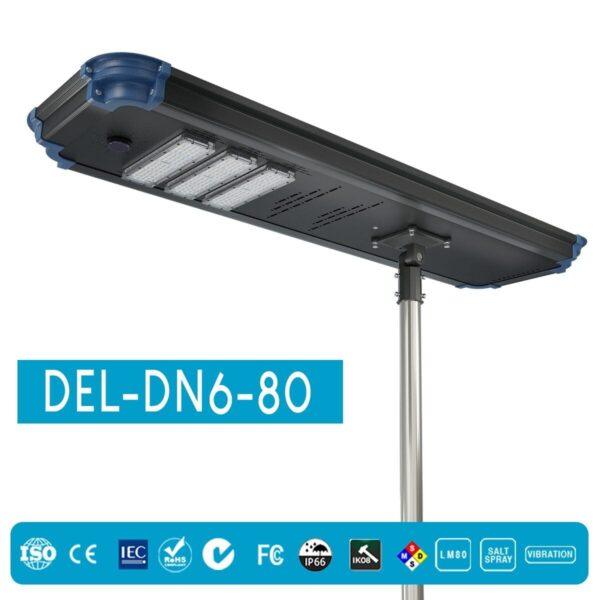
DN8 Series (All-in-One)
- Designed in Germany
- 40W / 60W / 80W LED configurations
- Up to 240 lm/W output
- 2–3 nights autonomy
- Type II / Type III optical distributions
- Recommended for 6–8 m pole heights
DS8 Series (All-in-Two)
- Separate solar panel for improved heat dissipation
- 60W / 100W / 120W LED
- 150–180W solar panel
- 3–4 nights autonomy
- Ideal for 8–10 m poles, highways, industrial roads

Both series use:
- LiFePO₄ Grade A cells
- 10kV surge protection
- IP65/IP66 housings
- IK08 impact resistance
- LM-80 certified LED chips
These specifications directly influence lifespan, maintenance cost, and tender eligibility.
Both the DN8 and DS8 product lines are engineered as high-performance smart solar street lights designed for European road lighting requirements.
Why Traditional Lighting Is Expensive to Maintain
Municipalities typically spend on:
1. Nighttime Inspections and Labor
Technicians must physically inspect poles using bucket trucks.
Average crew cost in Europe:
- €35–€65/hour per technician
- vehicle + fuel + night shift premiums
2. Reactive Repairs
HPS and MH lamps degrade quickly. Failures are often discovered after citizen complaints, requiring emergency intervention.
3. Grid-Related Issues
Surges, cable damage, and outages result in downtime and costly repairs.
4. High Energy Consumption
Conventional systems run at full power all night, regardless of roadway demand.
How Smart Solar Street Lights Reduce Maintenance Costs
1. Predictive Maintenance Through Self-Diagnostics
Smart controllers continuously measure system health.
Cities report 30–40% fewer unplanned interventions after switching to smart solar systems.
2. Fewer On-Site Inspections
From 1,000 poles inspected per month → as few as 120–150.
Reduction in:
- labor cost
- fuel usage
- night operations
- vehicle wear
3. Longer Component Lifespan
Smart dimming + BMS protection reduce stress on:
- batteries → 20–30% longer life
- LED modules → lower thermal load
- drivers → fewer replacements
4. Reduced Downtime
Solar lights operate independently of the grid.
5. No Electricity Bills
Savings: €18,000–€25,000/year per 100 poles (EU average).
Real Project ROI: What Cities Can Expect
Year 1:
20–25% maintenance reduction
Year 3:
35–40% lower workload
Year 10:
100–150% total savings
Buyer Guidance for Municipal Decision-Makers
1. Battery Grade
- LiFePO₄ Grade A only
- 3000–4000 cycles
2. LED Requirements
- ≥200 lm/W
- LM-80 test compliance
- low THD driver
3. Autonomy Requirements
- 2 nights → urban roads
- 3–4 nights → industrial / remote
4. Optical Distribution
- Type II → narrow roads
- Type III → wide roads
- Type V → open areas
5. Structural Protection
- IP65/IP66
- IK08
- 10kV surge
6. Documentation for Tenders
- IES/LDT photometric files
- LM-80 / LM-79 test reports
- CE / ROHS certificates
FAQs
Q1: What is the typical lifespan of DN8/DS8 solar street lights?
A: 8–10 years depending on climate and cycle depth.
Q2: Can these systems work in winter?
A: Yes — thanks to MPPT and LiFePO₄ chemistry.
Q3: What maintenance is required?
A: Cleaning 1–2 times/year + firmware updates.
Q4: Can existing poles be upgraded?
A: Yes — DN8/DS8 support retrofit installations.
Conclusion
Smart solar street lights represent one of the most effective ways for municipalities and industrial operators to reduce maintenance expenses, extend asset lifespan, and stabilize operational budgets. With long-life LiFePO₄ batteries, MPPT charging, high-efficiency LED modules, and predictive diagnostics, systems like the DN8 and DS8 deliver the reliability, compliance, and performance required in European road-lighting projects.
For buyers focused on long-term value, predictable maintenance, and measurable ROI, smart solar street lights are a strategic upgrade that pays for itself — and continues to deliver savings for more than a decade.
For any city or contractor planning upgrades in 2025, smart solar street lights provide the strongest balance between performance, autonomy, and long-term maintenance savings