
Streets can be illuminated in many ways. We can light our streets with the help of traditional grid street lights, solar street lights, smart street lights, fiber optic lighting, and inductive lighting. But if you want to power street light using renewable energy, solar is the most effective and widely used approach.
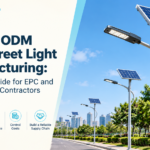
Solar panels and solar LED street lights are the most practical way to power street light using renewable energy today. These lights use sunlight as the source of energy to generate electricity, which directly runs the LED lights. Modern all in one solar street lights combine the panel, battery, controller, and lamp in a single unit, which makes them simple to install on almost any road.
Ways to Power Street Light using Renewable Energy
There are three main ways to power street light using renewable energy:
- Solar street lights: A solar panel charges a battery during the day, and the battery runs the LED lamp at night. This is by far the most common option.
- Wind and solar hybrid street lights: A small wind turbine is added alongside the solar panel, which helps in coastal or windy areas with fewer sun hours. These systems cost more and have moving parts that need maintenance.
- Grid tied lights with renewable supply: Standard street lights are connected to a grid that buys electricity from solar or wind farms. This still needs cabling and grid connection.
For most roads, parks, campuses, and remote areas, solar street lights are the simplest way to power street light using renewable energy, because each pole is fully independent.
How Do Solar Streetlights Work?
Solar streetlights work by converting solar energy into electricity using photovoltaic cells. The electricity is stored in batteries and used to power LED lights at night. A typical system includes a solar panel, battery, LED light, charge controller, and light sensor.
During the day, the panel charges the battery. At dusk, the light sensor tells the controller that it is getting dark, and the controller switches on the LED lamp. Many modern lights also use dimming schedules and motion sensors to save energy through the night. This simple cycle is what allows us to power street light using renewable energy every single night without a grid connection.
Solar Street Light Advantages and Disadvantages
Before you decide to power street light using renewable energy, it helps to understand both the benefits and the limits of solar lighting.
Advantages
- Energy efficiency: They are powered by the sun, a renewable and sustainable energy source.
- Cost savings: They are independent of the grid, which means they do not require a connection to a power source and there are no monthly electricity bills.
- Easy installation: They are easy to install and do not require extensive infrastructure or wiring.
- Low maintenance: Solar street lights require minimal maintenance, as they have no moving parts.
- Safety and security: Solar street lights can improve safety and security in public areas, and they keep working during grid power cuts.
- Durability: Quality systems last many years, with the solar panel and LED lasting much longer than the battery.
Disadvantages
- High initial cost: Solar street lights can be more expensive than traditional ones upfront, especially for larger systems.
- Weather dependent: The performance of solar streetlights depends on weather conditions, particularly the amount of sunlight available.
- Limited battery capacity: If the battery is undersized, the light may not stay on as long as a grid powered street light.
Most of these disadvantages can be solved with correct system sizing. According to the International Energy Agency, the cost of solar PV has fallen sharply over the past decade, which has made it far more affordable to power street light using renewable energy than it was in the past.
How Long Do Solar Streetlights Last?
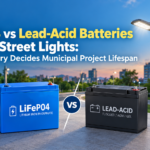
Generally speaking, older solar streetlights with lead acid batteries had a working life of around 5 to 7 years before major parts needed replacing. Each component has its own lifespan. The solar panel is typically the most durable component and can last up to 25 years. LED lights have a lifespan of around 50,000 to 100,000 hours. The battery has the shortest lifespan: older lead acid batteries typically lasted around 3 to 5 years, while modern lithium iron phosphate batteries often last several years longer.
This is why the battery choice matters so much when you plan to power street light using renewable energy on a long term project. Replacing only the battery can extend the life of the whole light.
Tips to Improve the Lifespan of Solar Lights
Once you power street light using renewable energy, a little care keeps the system running at its best:
- Keep it clean: Dirt on the solar panel can block the sunlight, and the panel’s capacity to produce electricity diminishes.
- Location: It is essential to place solar street lights in an open place where sunlight is available abundantly, away from trees and buildings that cast shade.
- Proper setting: Improperly angled panels or badly placed lights lose efficiency. The panel should face the equator and be tilted close to your local latitude.
- Know your requirements: Assess your energy needs before installation, including lighting hours, brightness, and local sun hours, to prevent battery drain.
For larger projects, a solar lighting project checklist helps you collect these details before choosing a system to power street light using renewable energy.
Final Takeaways
Initially, you will have to pay more, but you will save money in the long run. Solar street lights provide optimal brightness for roads, pathways, parks, and parking areas, and they keep working even when the grid fails. For cities, developers, and contractors who want to power street light using renewable energy, solar LED street lighting is now the most practical and proven choice.
DEL Illumination works as a solar street lighting engineering solution expert, sizing the panel, battery, and lamp for each project so the lights perform every night. If you are planning to power street light using renewable energy on your next project, contact our team for a project assessment.
Frequently Asked Questions
1. Are solar LED lights waterproof?
As these lights are made for outdoor use, they are designed to bear harsh environmental conditions such as heavy rain, storms, and dust. Different lights are given different IP codes. Solar streetlights with high ratings such as IP65, IP66, and IP67 are specially designed to bear harsh conditions.
2. How long do solar lights last at night?
It depends on the size and efficiency of the solar panel, the size of the connected battery, and the energy consumption of the LED lights. A well sized system should run from dusk to dawn, often using a dimming profile to stretch stored energy.
3. What is an integrated solar street light?
An integrated solar street light is an all in one solar street light in which all the components are packed in a single unit. The main purpose of integrated solar lights is to make installation quick and easy.
4. Is a solar street light a good choice?
Yes. When we power street light using renewable energy, we are less dependent on the grid. They have changed how public lighting is powered, turning each pole into its own small renewable power station.
5. What is the cheapest way to power street light using renewable energy?
For most sites, solar street lights are the most cost effective option, because they avoid trenching, cabling, and electricity bills. Wind and solar hybrid systems usually cost more and suit only windy locations with limited sun.