
Introduction: How Often Should You Replace Solar Light Batteries?
Owning solar lights – whether small garden lamps or large commercial street lights comes with the question of battery lifespan. How long do those rechargeable batteries for solar lights last, and how often should you replace solar light batteries to keep them shining bright?
Based on industry knowledge and our experience at DEL Solar Street Lights (a Sino-German solar lighting manufacturer), the answer depends on the type of battery and how the lights are used. In this blog post, we’ll explain typical solar light battery lifespans, signs of wear, and best practices so you can plan timely replacements and maintain optimal performance.
Understanding the Most Common Solar Light Battery Lifespan
Battery life in solar lights can range widely, from about 1 year up to 5 or more years, depending on the battery type, quality, and usage conditions. Cheaper garden lights with low-capacity batteries might fail within a year, while high-quality solar lighting systems can run 5+ years before needing a battery swap.
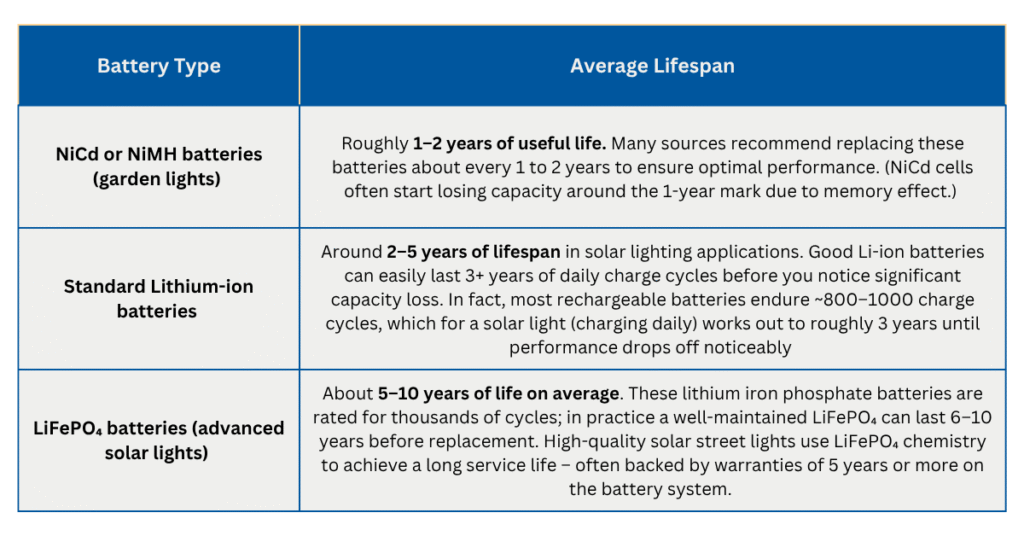
This table shows the breakdown of a typical solar light battery lifespan:
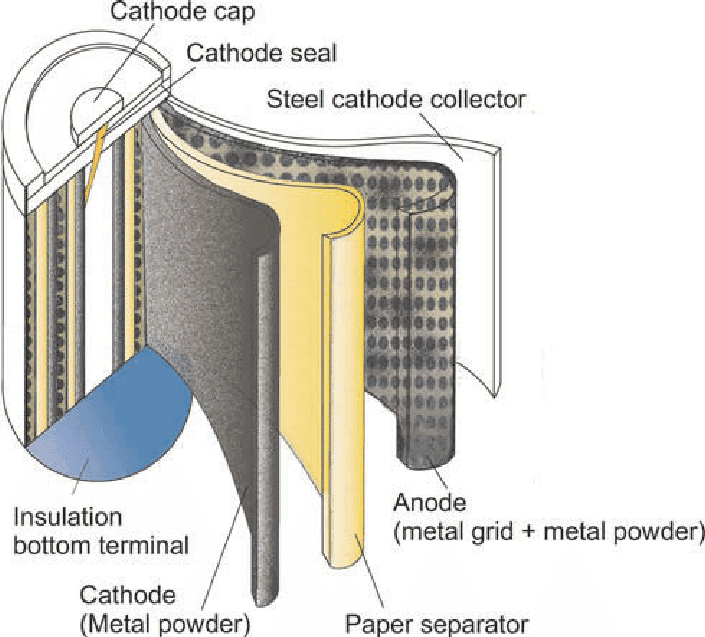
Rechargeable batteries for solar lights typically last a few years before their capacity fades. NiMH AA batteries (like the one shown below) are common in garden lights and generally need replacement every 1-2 years, whereas larger lithium batteries in commercial solar lights can last longer.
What Affects the Solar Light Battery Lifespan?
Environmental factors and usage patterns affect these lifespan estimates.
For example, harsh climates can shorten a battery’s life: extreme heat can degrade batteries faster, and extreme cold can reduce their capacity temporarily (or even permanently if the battery isn’t suited for freezing temperatures). Solar lights in northern climates often see batteries wear out sooner if they are left outside through frigid winters.
Likewise, a light that runs on a nightly basis year-round uses up its charge cycles faster than one used seasonally. Quality matters too – as mentioned, the “1-2 year” guideline for cheap NiCd/NiMH is a general rule, but higher-quality cells or lights can push toward the upper end of 3-5 years before replacement.
Important: Always check the manufacturer’s specs; many solar lights come with an expected battery life or warranty period that hints at when to replace solar light batteries.
4 Signs That Tell You It’s Time for Solar Light Battery Replacement
Rather than waiting for an arbitrary timeline, it’s wise to monitor your solar lights for telltale signs of battery fatigue. Rechargeable batteries for solar lights gradually hold less charge as they age, so your lights will give some warning signs when a replacement is due:
- Diminished Brightness: The light isn’t as bright as it used to be. A dying battery struggles to provide the same power to the LED.
- Shorter Runtime: Your lights used to last most of the night, but now go out after just a few hours of darkness. If a solar light that once glowed until dawn now fades well before midnight, the battery likely can’t hold a full charge.
- Flickering or Inconsistent Lighting: The light may flicker or intermittently turn off and on. This often means the battery’s voltage is dropping too quickly to sustain a steady output.
- Failure to Turn On at All: If the solar light doesn’t come on at dusk even after a sunny day, the battery could be fully depleted or unable to charge. (Do check that the panel is clean and the light’s switch (if any) is on – but if those are fine, the battery is the prime suspect.) In garden lights, a battery that goes completely dead immediately after dusk or only glows dimly for minutes is a strong indicator the cell has worn out.
If you notice one or more of these symptoms and you’ve had the batteries for a while, it’s likely time to replace them. Most solar lights have easy-access battery compartments (usually just a small screw or tab to open) and use standard sizes (like AA or AAA rechargeable cells), making it straightforward for you to swap in fresh batteries.
How Often Should You Replace Solar Light Batteries?
Now we come to the core question: as a rule, how often should you replace solar light batteries? The answer combines the expected lifespan with a bit of proactive maintenance philosophy:
For NiMH/NiCd-Powered Lights (Common Garden Solar Lights)
Plan on replacing the batteries about every 1 to 2 years. Many experts suggest an annual or biennial solar light battery replacement to keep your lights at peak brightness. In fact, for Ni-Cd batteries, which degrade faster, one guide recommends swapping them out every 6 months to 1 year for best results.
NiMH cells are more resilient; replacing them roughly once every 2 years is usually adequate if performance is still good. The key is to monitor performance – if year two rolls around and the lights are noticeably dimmer or shorter-lived, it’s time for new batteries.
On the other hand, if you’re using inexpensive solar stake lights and want maximum output, an annual refresh of the batteries can ensure they always run strong through the long nights.
For Lithium-ion (Li-ion) Solar Lights
These batteries have longer service lives, so replacement every 3 to 5 years is typically sufficient. For instance, a lithium 18650 cell in a solar motion light might be rated for ~1000 cycles, meaning about 3 years of daily use before its capacity is significantly reduced.
If you have a higher-capacity lithium battery or a light that isn’t used nightly, you might get 4 or 5 years before needing a change. It’s still wise to check performance each year and especially by the 3-year mark.
One benefit of Li-ion: they tend to give fairly consistent performance and then degrade rapidly at end-of-life, so you’ll notice when they’re done (as opposed to the gradual fade of NiMH).
For LiFePO₄-Powered Systems (Solar Lights and High-End Installations)
These batteries are long-lived; plan for solar light battery replacement roughly every 5 to 10 years. In commercial solar street lights like those made by DEL Solar Street Lights, LiFePO₄ battery packs are chosen specifically for their durability – often lasting at least 5 years before their capacity falls to around 80% of original. Some can last up to a decade with proper care.
This means maintenance crews or users don’t have to service the batteries annually, offering a low-maintenance experience.
For example, a quality solar street light might guarantee ~2000 charge cycles on its battery, which is ~5.5 years of daily cycling, and many continue working beyond that timeframe.
Keep in mind these intervals are general guidelines. It’s not a strict schedule set in stone – rather, a preventative approach. If you’re very keen on always having maximum illumination, following the low end of these ranges (e.g. every year for NiMH, every 3 years for Li-ion) will ensure the lights never get a chance to dim out.
If you’re more budget-conscious and don’t mind a bit of drop-off, you can use the batteries until the performance decline becomes evident, then replace. Just avoid letting old batteries sit until they leak or corrode, as that can damage your light’s electronics. It’s better to change them out at least once they hit their expected lifespan limit, even if they haven’t completely died.
Maintenance Tips to Extend Solar Light Battery Lifespan
Proper care can stretch the time between a solar light battery replacement. Here are some maintenance tips to get the most out of your solar light batteries and ensure your lights run efficiently:
- Keep Solar Panels Clean: Dirt, dust, or pollen on the panel will block sunlight and reduce charging. Wipe the solar panel periodically (every few weeks or at least a couple of times each season) with a damp cloth to ensure maximum sun exposure. A clean panel means the battery can charge fully each day, which helps it last through the night and avoids the strain of chronic undercharging.
- Optimize Sun Exposure: Install or place your solar lights where they receive ample direct sunlight for most of the day. If they’re in the shade or only get a couple hours of sun, the battery is often undercharged and can wear out faster (due to being constantly drained deeply every night). Aim for 6-8 hours of sun daily on the panel. Also, be mindful of things like overhanging branches or dirt accumulating on the panel over time, and adjust placement or clean as needed.
- Avoid Extreme Temperatures: How often should you replace solar light batteries hinges a lot on your climate and it’s temperature. While you can’t change your climate, you can take some precautions. During winter in cold climates, small garden solar lights may struggle – shorter daylight means less charge, and freezing temperatures can reduce battery efficiency. Consider bringing portable solar lights indoors in harsh winter months or at least switching them off to preserve the batteries.
- Periodic Deep Charge (for NiMH/NiCd): NiMH batteries don’t have a severe memory effect, but if your area has had several gloomy days, it can help to turn the light off for a day or two so the battery can get a full charge from the solar panel. This ensures the cell isn’t always operating in a partially charged state. NiCd batteries actually benefit from occasional full discharge and recharge cycles to maintain capacity – if your lights use NiCd and have an off switch, you can let them run completely down every so often and recharge fully.
- Replace All Batteries Together: If your solar light uses more than one battery (some larger lights or string lights might use two or more cells), replace them as a set. Mixing an old battery with a new one can cause the older cell to drag down the new cell, leading to imbalance. Installing a fresh matching set ensures uniform performance. Likewise, use the same chemistry – don’t mix a NiCd and a NiMH in the same light.
- Use the Correct Solar Light Battery Replacement: Always replace with the same type and voltage that the light was designed for. For instance, if your garden light came with 1.2V NiMH AA batteries of 600 mAh, use the same NiMH chemistry and similar capacity when replacing. Using a much higher capacity battery is not advisable, because the small solar panel might not be able to fully charge it. Similarly, never put a non-rechargeable (alkaline) battery into a solar light – not only will it not recharge, but it can leak or even burst since solar lights continuously try to charge the battery.
- Check for Corrosion or Damage: When replacing batteries, inspect the contacts and compartment. If you see corrosion (a white or green crusty build-up) on the battery terminals, gently clean it off with a bit of vinegar or baking soda solution and a cotton swab, then dry thoroughly. Ensuring good contact will help the new batteries charge efficiently.
- Properly Dispose of Old Batteries: Spent solar light batteries should be recycled or disposed of according to your local e-waste guidelines. NiCd batteries in particular are hazardous waste if thrown in the trash. Most cities have battery recycling drop-offs – use them. This not only is environmentally responsible but also builds trust in solar technology as a green solution.
FAQs: Solar Light Battery Replacement and Care
1: How often should you replace solar light batteries?
As a rule of thumb, every 2 years is a good interval for most garden solar lights using NiMH batteries, or even annually if you notice performance drop-offs. For NiCd batteries, some experts suggest changing them yearly or even twice a year (every 6 months) to maintain brightness. Lithium-ion solar lights can go longer – you might only need to replace those batteries about every 4-5 years (sometimes a bit sooner if used nightly). And if you have commercial solar lights with LiFePO₄, you’ll likely replace the battery pack perhaps once a decade at most.
2: What are the signs that my solar light batteries are going bad?
The main signs are dimmer light output and shorter operating time after dark. If your solar lights used to shine bright for 8+ hours and now barely last a few hours or are very faint, the batteries are weak. Flickering or inconsistent light is another red flag. And of course, if the light doesn’t turn on at all (despite sunny days charging it), the battery could be defunct (verify the bulb and panel are okay, but in most cases the battery is the culprit).
3: Can I use regular alkaline batteries in my solar lights?
No – only use rechargeable batteries for solar lights. Standard alkaline batteries are not designed to be recharged; if you put one in a solar light, it might power the light for a short time but it could leak or even rupture when the solar panel tries to charge it. Using the wrong battery type can damage your light or pose a safety hazard.
4: What is the best replacement battery for my solar lights – NiMH or NiCd?
If your light originally came with NiCd batteries, you can generally upgrade to NiMH of the same size and voltage, which is recommended in most cases. NiMH batteries have roughly twice the capacity of NiCd for the same size and have no significant memory effect, meaning they will provide longer runtimes and maintain performance longer. These days, NiMH are considered the best choice for most garden solar lights due to their combination of cost, capacity, and environmental friendliness (they contain no toxic cadmium).
5: Is it worth replacing the batteries in solar lights, or should I just buy new lights?
In most cases, replacing the battery is absolutely worth it. It’s a cost-effective and eco-friendly solution. New rechargeable batteries are relatively inexpensive, and swapping them can restore your solar lights to near-original performance. This saves you from buying completely new lights (which is costlier) and also reduces waste. Unless the solar light fixture itself is damaged or very low quality, a fresh battery will usually give it a second life.
Conclusion: Solar Light Battery Replacement
You can avoid outages, make your system last longer, and keep your lights working the way they should by knowing how often you should replace solar light batteries. That means changing NiMH or NiCd batteries every 1–2 years, lithium-ion batteries every 3–5 years, and LiFePO₄ batteries, like the ones used in our own DEL solar street lights, every 5–10 years.
But timing isn’t everything. If the lights are dim, the runtimes are short, or they flicker, it’s time to make a change. And if you do simple things to take care of your solar batteries, like keeping the panels clean, avoiding extreme temperatures, and using the right replacements, each battery will last longer.