
Today, many regions have replaced traditional street lights with solar street lighting. As an emerging energy saving product, solar street lights have gained popularity thanks to their simple installation, low energy use, and environmentally friendly operation. But to appreciate how far the technology has come, it helps to look back at the history of solar street lights and the long road of street lighting that led to them.
So what did street lighting look like before solar arrived? The story is a fascinating pursuit of brightness that stretches across six centuries.
The History of Solar Street Lights
1. The origin of street lights
The development of street lights is a history of the pursuit of brightness. Their origin traces back to the 15th century, when the aim was to brighten the dark winter nights in London. The city ordered lighting equipment to be hung outdoors, and this was the earliest form of the street light.
2. The coming of the Bright Age
The Bright Age arrived in France in the 16th century, when Louis XIV issued an ordinance requiring public lighting in the city. Lamps were hoisted over the streets of Paris. They drew little attention at the time, yet public lighting would eventually capture the interest of whole populations.
3. The street light revolution
Early street lights burned candles and oil and gave weak light. Kerosene made them brighter, but the result was still poor until the gas lamp appeared. Gas lamp lighting was not welcomed by everyone at first, yet its advantages could not be ignored, and it quickly spread across European countries.
4. Early street lighting in China
The first street light in China was a kerosene lamp that appeared on the streets of Shanghai. When night fell, crowds gathered to catch a glimpse of it. It was later changed to a gas lamp, which improved the light considerably. In 1879, China lit its first electric light, though electric lighting was hard to apply then. It required a ten horsepower internal combustion generating set and a knife switch on each utility pole, all operated by hand.
5. The emergence of electric light
The history of electric lighting brings to mind Lodygin of Russia and Edison of America. Lodygin invented the incandescent lamp and won the Lomonosov Prize. Years later, Edison refined the bulb, making it brighter and cheaper. As this technology matured, electric lights took over road lighting and replaced the gas lamps for good.
6. High pole street lights
City roads grew more complex over time. Installing street lights on both sides of a wide road could clutter the cityscape, so Beijing was among the first to adopt tall high pole street lights that cover a large area from a single point.
7. The birth of a new light source
As the 21st century began, the world turned its attention to environmental problems, and developing energy saving products became a priority. From this need a new light source was born: solar LED street lights. Their long service life and stable, energy saving performance quickly made them widely used across the lighting industry. Solar power let street lights generate electricity from natural sunlight, and pairing that with LED technology made the whole system far more capable. This is the point at which modern solar street lighting truly began.
The Current Types of Solar Street Lights
Solar street lighting now comes in several forms, each suited to different needs. You can compare current models in our All In Two solar street lights range.
- Stand alone street lights: These have their own solar panel and battery, separate from other infrastructure. They install anywhere with adequate sunlight and run independently.
- Integrated solar street lights: The panel and battery are built into the fixture, making them easy to install with minimal maintenance.
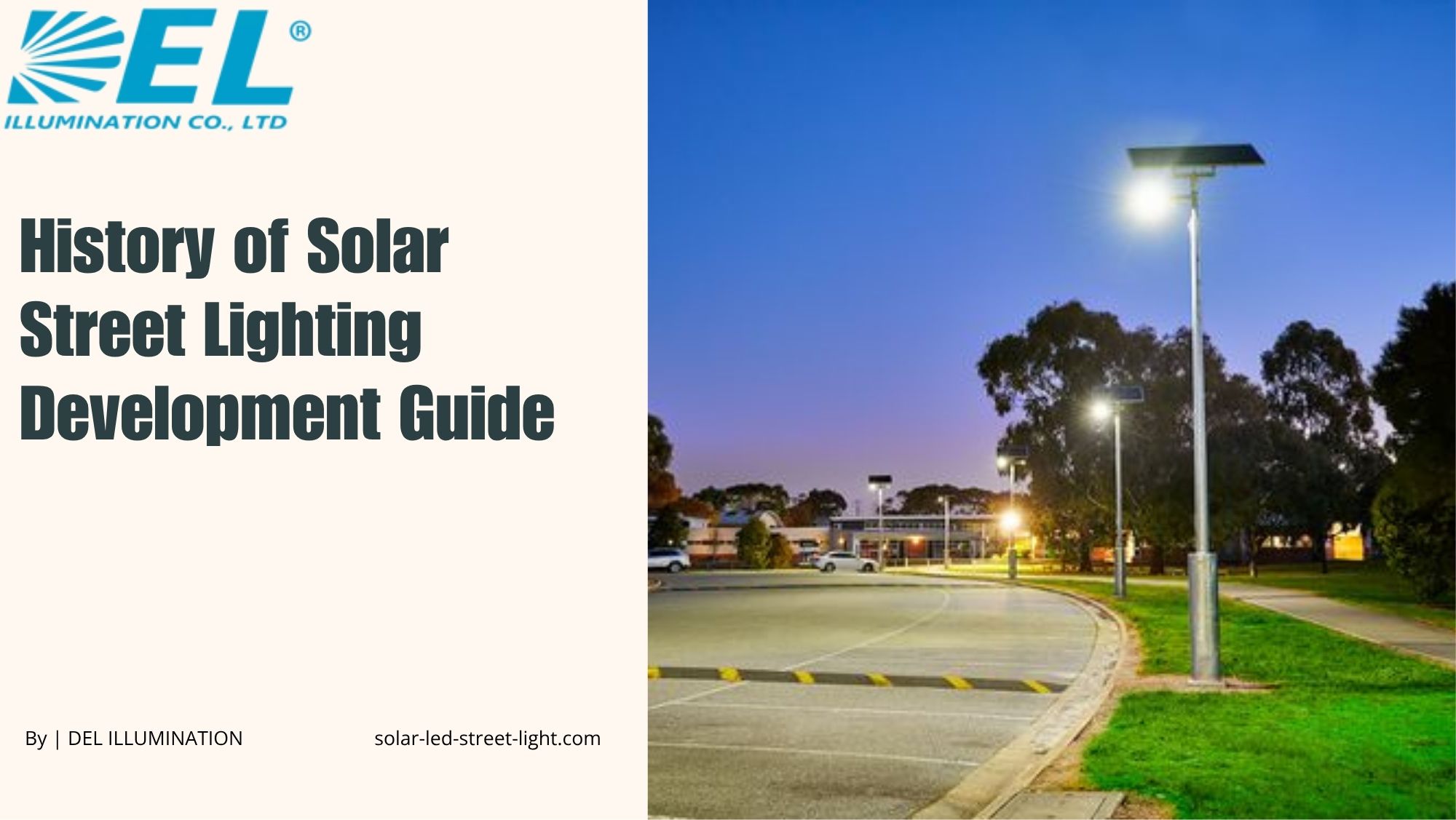
- All in one solar street lights: Panel, battery, and fixture combine into a single compact unit, a popular choice for residential and commercial sites.
- Solar powered LED street lights: These use LED sources that are more efficient, longer lasting, and brighter than older bulbs, suiting areas that need higher illumination.
- Hybrid solar street lights: Designed to run on both solar power and grid electricity, switching between sources as needed for reliability where sunlight is limited.
- Motion sensor solar street lights: These detect movement and brighten when someone is near, saving energy while improving safety in dark areas.
The Future of Solar Street Lighting
Solar street lighting has a promising future as it continues to gain traction worldwide. Manufacturers keep refining the technology to make it more efficient, cost effective, and sustainable, and each new generation improves on the last.
Smart technology is adding even greater control. Modern systems can adjust brightness based on traffic or pedestrian activity, conserving energy and cutting running costs. As sustainability rises up the agenda and the need for clean lighting grows, solar street lighting is set for continued expansion. As performance improves and costs fall, more communities and cities are adopting solar LED street lights as a viable, sustainable answer to their lighting needs.
Conclusion
Trace the history of solar street lights and one theme stands out: a centuries long pursuit of brighter, cleaner, more efficient light. The street lights we use today are brighter, more attractive, and far kinder to the environment than anything that came before, built on the wisdom and effort of generations. The next stage points clearly toward intelligence and sustainability, and solar street lighting sits at the centre of it. To bring modern solar lighting to your own project, contact our team for guidance and a quote. For broader background on solar technology, the International Energy Agency publishes useful global research.
Frequently Asked Questions
When did solar street lighting first appear?
Modern solar LED street lights emerged in the early 21st century, as environmental concerns drove demand for clean, energy saving products. They built on decades of solar panel and LED progress to become a practical replacement for grid lighting.
What did street lights use before electricity?
Early street lights burned candles, oil, and kerosene, then moved to gas lamps, which spread across Europe. Electric incandescent lighting later replaced gas, setting the stage for the LED and solar systems used today.
What is the difference between the main types of solar street lights?
Stand alone units keep the panel and battery separate, integrated and all in one units combine components into the fixture, and hybrid models can also draw on grid power. Motion sensor versions add movement detection to save energy.
Why are solar LED street lights so widely used now?
They combine a long service life with stable, energy saving performance and need no grid connection or electricity bill. LED sources make them brighter and more efficient, which is why they have spread quickly through the lighting industry.
What does the future of solar street lighting look like?
The clear direction is smart, sustainable systems that adjust brightness to real time activity and cut energy use further. As costs fall and performance rises, more cities are expected to adopt solar street lighting at scale.