
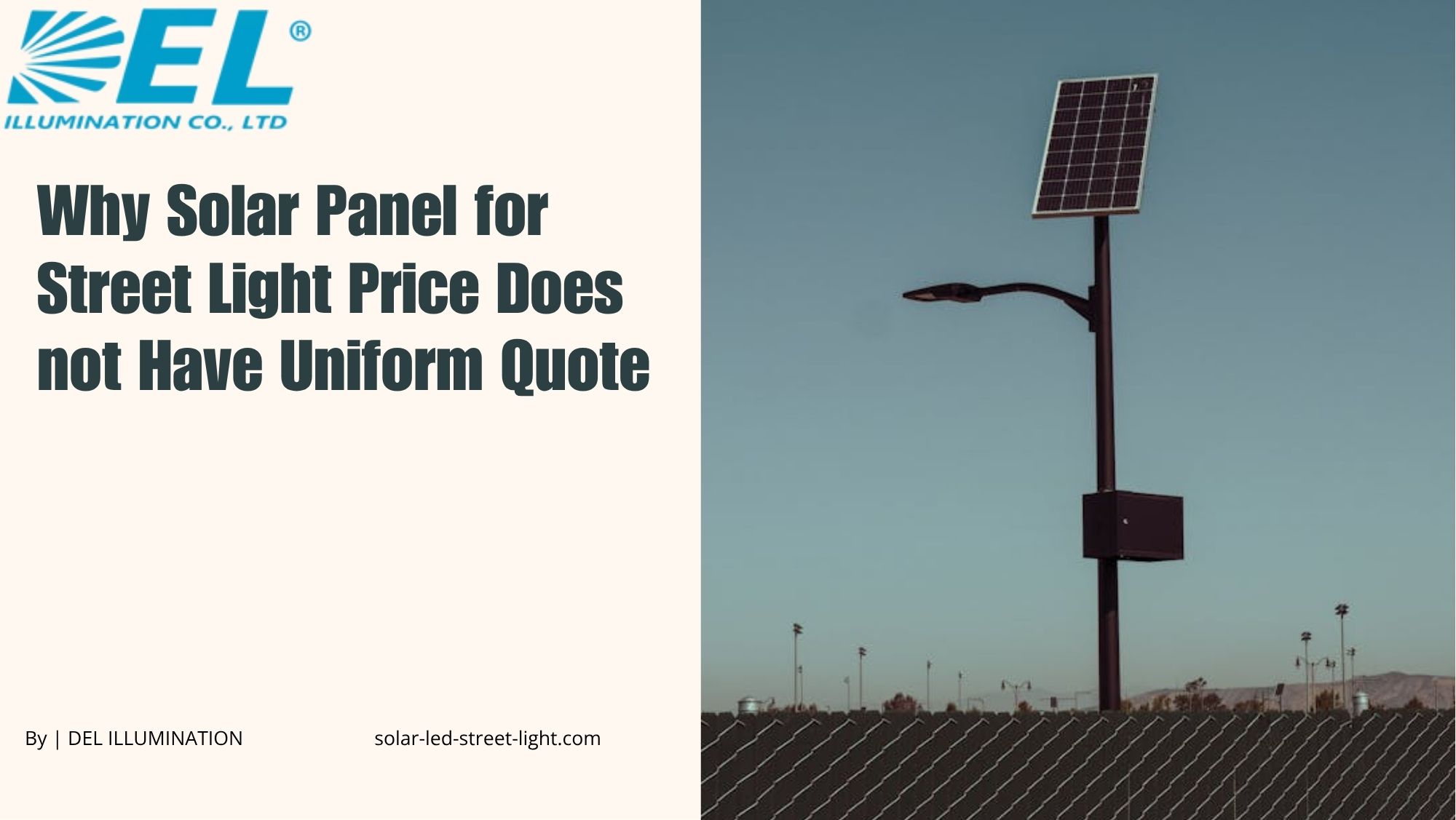
If you have asked several suppliers for a quote, you have probably noticed that the solar panel for street light price can vary widely, even for lights that look almost the same. The cost of solar panels has dropped significantly over the last decade, yet buyers still receive very different numbers for similar projects. So why is there no uniform quote?
The answer is that the panel itself is only part of the story. Module prices keep falling, but the “soft costs” around a project, such as design, site surveys, shipping, installation, and customer support, remain high and vary from one market to another. In this guide, we explain the main reasons the solar panel for street light price is not uniform, and how you can compare quotes fairly. If you are still choosing a product type, integrated all in one solar street lights are a good starting point, since they combine the panel, battery, and lamp in one unit.
What Goes Into Solar Panel for Street Light Price?
The solar panel for street light price depends first on the panel’s size, which is set by the lamp wattage, lighting hours, and local sun hours. As a rough guide:
- Pathway and garden lights: Small panels, often under 60 watts.
- Residential and village roads: Mid size panels, often around 60 to 150 watts.
- Main roads and highways: Larger panels, often 150 watts and above, usually in split designs.
Beyond size, cell type (monocrystalline or polycrystalline), frame quality, glass, and certifications all affect the solar panel for street light price. According to the International Energy Agency, solar PV module costs have fallen sharply over the past decade, which is why hardware is no longer the main reason quotes differ.
Regions Are Changing Their Subsidies
One reason the solar panel for street light price has no uniform quote is that incentives differ by country and region. Some governments offer subsidies or tax benefits for public solar lighting, while others are phasing them out. Where support is reduced, project budgets rise, and suppliers price their offers differently from market to market.
Module prices are also flattening after years of steep decline, so the savings from cheaper panels are smaller than before. Meanwhile, soft costs, which include installation, maintenance, and customer acquisition, remain high in many markets. Countries with one national set of rules and standards tend to have lower soft costs, while markets where every city or state has its own requirements see higher costs for design, approvals, and paperwork. All of this feeds into the solar panel for street light price in each market. Local electricity prices matter too: where grid power is expensive, the savings from solar are larger, and buyers are more willing to invest.
Buyers Have Different Levels of Knowledge
Another factor behind the solar panel for street light price is how much support each buyer needs. Many first time buyers are not familiar with terms like watt peak, lumens, battery capacity, or days of autonomy. They may not know how many sun hours their site receives or how bright the road needs to be.
Because of this, suppliers must spend time on education and trust building, explaining options, running calculations, and preparing lighting layouts. This adds to customer acquisition costs, and those costs are reflected in the final solar panel for street light price. Experienced buyers such as EPC contractors and municipal engineers often receive faster, sharper quotes because they arrive with clear specifications.
As solar lighting becomes more common, word of mouth and visible projects in nearby towns help new buyers understand the technology, which should reduce these costs over time. Today, suppliers can also use satellite imagery, such as Google Earth, to check shading from trees and buildings and estimate energy generation for a site before visiting.
Why a Site Survey Still Matters
Even with online tools, on site checks remain important. A survey confirms soil conditions for foundations, pole spacing, shading, road width, and access for installation crews. These details decide the panel size and pole design, which directly change the solar panel for street light price.
Reducing installation time is one of the best ways to lower soft costs and bring down the total solar panel for street light price. Integrated designs with factory wiring, preliminary project designs completed before crews arrive, and standardized mounting brackets all cut labor time on site. A solar lighting project checklist helps you gather this information before requesting quotes, so suppliers can price your project accurately the first time.
How to Compare Solar Panel for Street Light Price Quotes
To compare quotes fairly, make sure each supplier is pricing the same thing:
- Panel wattage and cell type: A bigger or more efficient panel costs more but charges the battery faster.
- Battery capacity and chemistry: Lithium iron phosphate costs more upfront but lasts much longer.
- Lamp wattage and lumen output: Brighter lamps need bigger panels and batteries.
- Pole and foundation: Check whether poles, bolts, and brackets are included.
- Shipping and installation: Confirm who pays freight, duties, and labor.
- Warranty: Compare warranty terms for each component, not just the whole light.
A lower solar panel for street light price can hide a smaller panel, a weaker battery, or a shorter warranty, which often costs more over the life of the system.
Solar Panel for Street Light Price: Conclusion
Reducing soft costs is one of the hardest challenges in renewable energy. Hardware prices have fallen quickly, but design, approvals, logistics, and installation improve more slowly, and it may take years of steady progress before quotes become more uniform. For solar street lighting to reach its full potential, it must keep becoming cheaper, easier to buy, and more transparent.
Until then, the best way to get a fair solar panel for street light price is to share clear project details and compare quotes on the same basis. DEL Illumination works as a solar street lighting engineering solution expert, sizing each panel, battery, and lamp to the site so you pay only for the performance you need. Contact our team for a project quote.
Frequently Asked Questions
1. Why do solar street light quotes vary so much?
The solar panel for street light price and the full system quote vary because of differences in panel size, battery type, lamp wattage, pole design, shipping, installation, warranty terms, and local regulations. Soft costs such as design and support also differ between suppliers.
2. What size solar panel does a street light need?
It depends on the lamp wattage, lighting hours, and local sun hours. Small pathway lights may need under 60 watts, while main road lights often need 150 watts or more.
3. Is a monocrystalline panel worth the extra cost?
Usually, yes. Monocrystalline panels are more efficient, so they produce more power from a smaller area. This suits compact all in one lights and sites with limited sun.
4. Does the panel make up most of the total cost?
Not usually. The battery, lamp, pole, foundation, shipping, and installation together often cost more than the panel itself, which is why comparing full system quotes is important.
5. How can I get an accurate quote for my project?
Share the road type, pole height and spacing, required brightness, lighting hours, and site location with suppliers. Clear details let them size the system correctly and give a reliable price.