
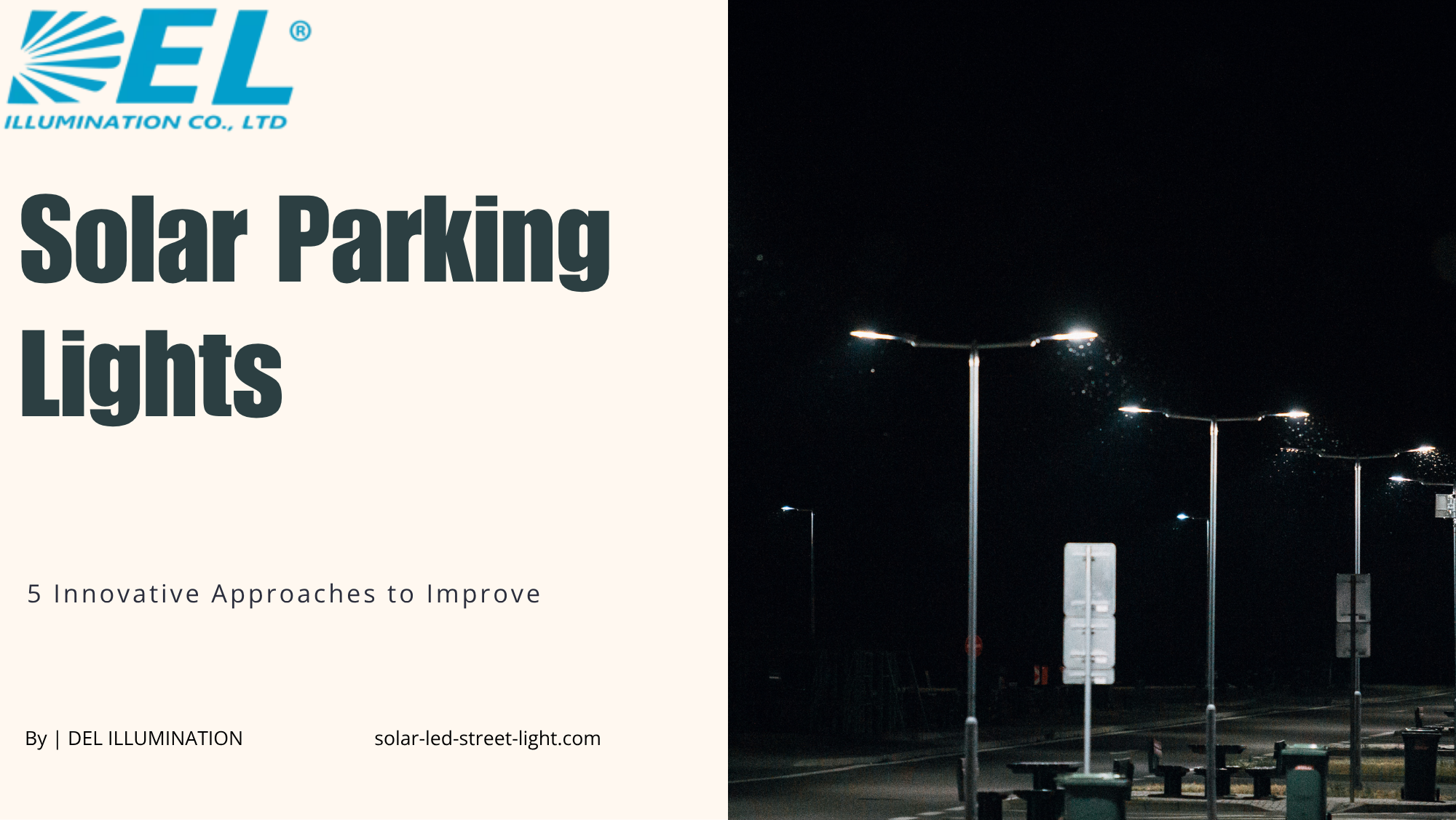
Parking lots are considered in business and recreational facilities that need illumination to boost visibility and security at night. The growing interest and initiatives in the use of environmentally friendly power sources led to the need for lights that ensure sustainability and an overall green presentation. This desire for clean energy lighting led to the development of solar parking lights.
Solar parking lights are a smart and efficient way to provide lighting for parking areas without the need for standard utility power. They have replaced traditional on grid lighting systems, which are now considered expensive in terms of operation and maintenance. If you want to see what a modern integrated design actually looks like, take a look at our All In One Solar Street Lights range before reading on.
With solar parking lights, there is no need to trench electric wire or pay electrical bills every month for the life span of the system. This cost saving aspect is the reason solar parking lights have been widely accepted in residential and commercial properties heading into 2026.
Since the construction of the first solar cell, there have been new and better ways to take advantage of solar technology, and the pace of innovation has only accelerated in recent years. Here you will learn about five innovative approaches to improve your solar parking lights, updated with the latest trends shaping the industry in 2026.
Integrated Design
Looking at the variety of solar parking lights being sold in the marketplace today brings to light one common trend: companies in the solar industry are producing highly integrated solar systems. Engineers have found refined ways of combining the solar panel, controller, battery, and lighting fixture into a single compact component.
You will find these branded as either all in one or fully integrated solar parking lights. The advantage of using fully integrated lights is that installation is easy and less costly. All you need is to fix the integrated lighting source to the grounded pole, and you are good to go. In 2026, integrated solar parking lights have also become more compact and lightweight thanks to improved lithium battery chemistry, meaning fewer structural requirements for the mounting pole itself.
Sensor Technology
Sensor technology has become far more advanced within the lighting industry. This technology is coupled with solar parking lights to help adjust light output depending on changes in activity or ambient conditions.
The industry now provides solar parking lights that can reduce or increase the brightness of illumination when there is little activity or increased activity, respectively. In terms of ambiance, your lamp will automatically turn on at dusk and switch off at dawn. Many 2026 models now combine motion sensors with adaptive dimming algorithms, allowing solar parking lights to run at a low glow baseline and jump to full brightness only when a vehicle or pedestrian is detected, which significantly extends battery runtime during cloudy stretches.
Wireless Control Adjustments
Wireless control comes into play when you wish to adjust your lighting fixture to maximize efficiency in the production of power. In split integration solar parking lights, the lighting system depends on the tilt angle of the solar panel to provide enough power to illuminate an area for the required period.
Wireless control can help in the conversion of solar energy to electric power by letting you change the panel angle without physically climbing the pole to make adjustments. Modern solar parking lights can track the movement of the sun and automatically apply the required corrections.
Bluetooth as a method of wireless control can be used to obtain information from the solar lighting system that determines the lifespan of its components. Using this technology, you can schedule maintenance for your solar parking lights well in advance. Heading into 2026, more manufacturers are shifting toward app based and cloud connected monitoring, allowing facility managers to check the battery health, brightness levels, and fault alerts of every solar parking light across a site from a single dashboard rather than relying on individual Bluetooth connections.
Energy Efficient Bulbs and Lamps
You may be wondering which light source is the most energy efficient for solar parking lights. For years the answer was Compact Fluorescent Lamps, commonly known as CFLs, alongside LED. These lamps became popular because of their efficiency in the utilization of energy, translating to a lifespan of eight to ten years.
Using CFLs and LED in your solar parking lights brought more cost savings compared to traditional incandescent bulbs. CFLs come in a full spectrum of light colors that are ideal for areas where abundant lighting is needed, though they carry the downside of containing mercury, which is harmful when disposed of improperly.
Most people now prefer LED over CFL for solar parking lights because LED produces more lumens per watt, has a longer lifespan, is energy efficient, and does not contain mercury or any harmful chemical. By 2026 the industry has largely phased out CFL use in new installations altogether, with high efficacy LED chips now standard across nearly all commercial solar parking lights, some exceeding 180 lumens per watt.
Whichever type of bulb you choose for your solar parking lights, look for Energy Star or an equivalent efficiency certification. You no longer have to settle for a lamp that gives off most of the harvested solar energy as heat. Energy saving light sources are far more efficient today and provide far greater choice in brightness levels and color temperature.
Solar Paint and Emerging Photovoltaic Materials
Solar paint remains one of the more experimental approaches to maximizing solar energy conversion in your solar parking lights. This energy capturing paint can be applied to the surface of the light system’s structure, such as the pole or the lighting fixture. The paint is made up of billions of light sensitive particles suspended in the mixture that capture solar energy and convert it into electricity.
Installing solar paint on your solar parking lights can help reduce the overall footprint needed to meet the lighting system’s power thresholds, though a qualified technician is still required for proper installation. Looking ahead through 2026, thin film and perovskite based coatings are also entering pilot projects as a next step beyond solar paint, offering the potential for flexible, semi transparent solar surfaces that could one day be integrated directly into parking canopies and shade structures rather than just the pole itself. For teams planning a larger rollout, our Solar Lighting Project Checklist is a useful resource for mapping out these decisions before installation begins.
Solar Parking Lights: Conclusion
These five innovative approaches can help you improve your solar parking lights well into 2026 and beyond. However, do not limit yourself to just these five approaches. You can go deeper into the science of solar lighting and discover more innovative methods that have not yet been widely commercialized.
If you want more technical innovation approaches to improve your solar parking lights, look deeper into the design and production of the solar panel and battery, since these two components are what actually produce and store the power for your parking lights.
These innovative approaches will help you reduce the cost of maintenance and enable your solar parking lights to serve you for a much longer time. Most of these upgrades come at a price, but they are worth the investment given the long term value they provide.
If you have any requirement for solar LED street lighting or solar parking lights, feel free to contact DEL ILLUMINATION. You can also learn about the basics of a solar street light circuit diagram, or explore our full Blogs page for more guides on getting the most out of your solar parking lights.
Frequently Asked Questions
1. What are solar parking lights and how do they work?
Solar parking lights use an onboard solar panel to charge a battery during the day, which then powers an LED lamp at night without any connection to the utility grid.
2. Are solar parking lights a good investment in 2026?
Yes, solar parking lights continue to offer strong long term value, since improvements in battery chemistry and LED efficiency have made 2026 models more reliable and longer lasting than earlier generations.
3. How long do solar parking lights typically last?
With proper maintenance, a well built solar parking light system can last 8 to 10 years or more, especially when equipped with lithium batteries and Energy Star rated LED components.
4. Do solar parking lights work well in cloudy or low sunlight regions?
Yes, modern solar parking lights are designed with adaptive dimming and efficient battery storage that allow them to maintain reliable lighting even after several consecutive cloudy days.
5. What is the biggest upgrade in solar parking lights for 2026?
The shift toward app based and cloud connected monitoring is one of the biggest upgrades, allowing facility managers to track the performance of every solar parking light on a site remotely instead of checking each pole individually.