
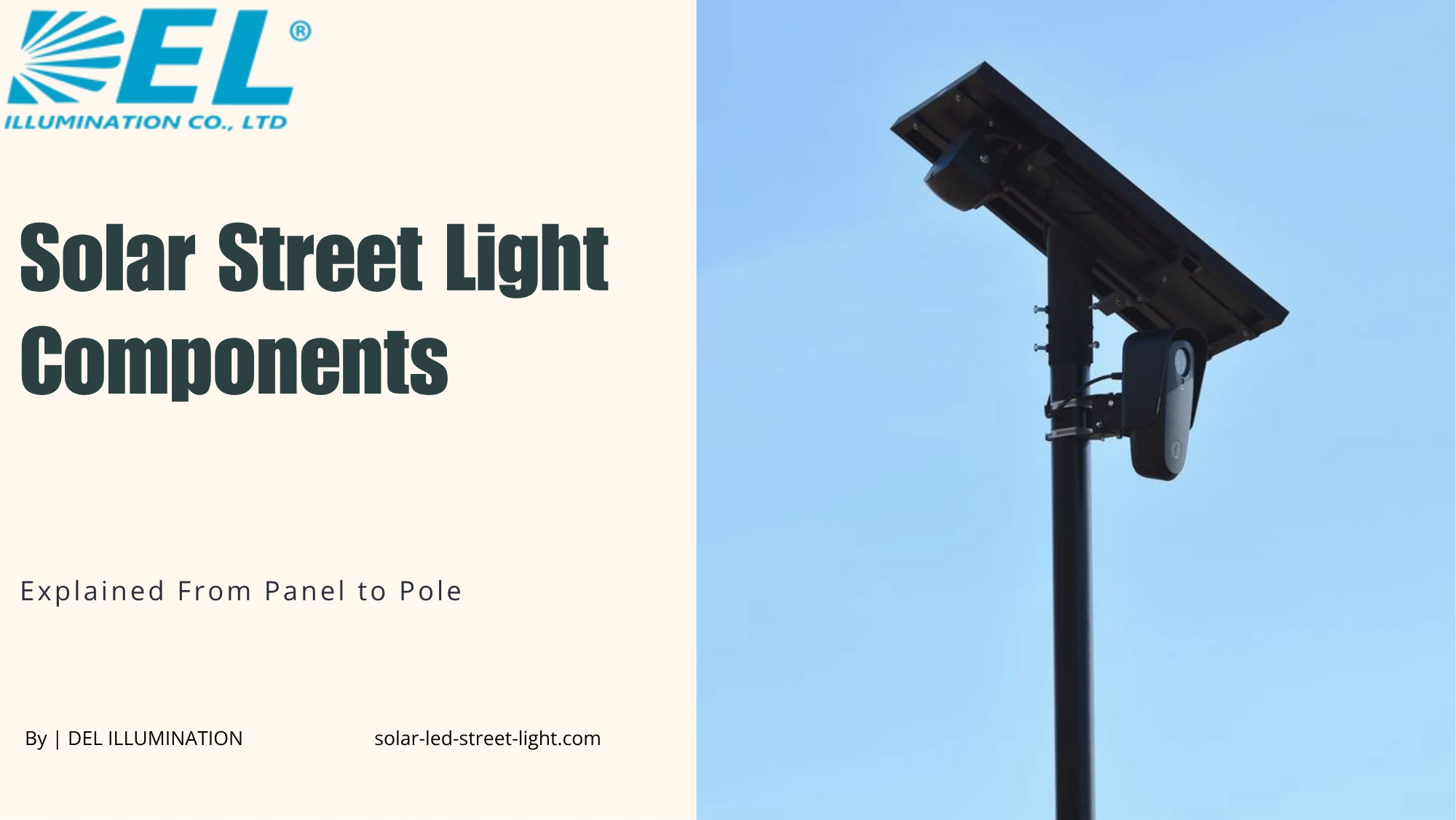
A solar street light looks like a single product, but it is really five engineered systems working in concert and a failure in any one of these solar street light components puts the whole unit in the dark. Procurement teams routinely approve fixtures on a headline wattage figure, only to discover two years later that a self declared IP65 housing has let water reach a lead acid battery rated for just 300–500 cycles. The light goes out, and a truck has to drive to a remote pole to fix a fault that better component selection would have prevented entirely.
For city planners, EPC (engineering, procurement, and construction) contractors, and facility managers, understanding solar street light components is the difference between a system that runs for a decade at near zero operational cost and one that drains budgets through repeated replacements. This guide walks through each major component the solar panel, battery, charge controller, LED luminaire, and pole explaining what each does, the specifications that matter, and how German engineered parts compare to generic alternatives. The goal is simple: to let you read a datasheet and know exactly what you are buying.
The Solar Panel: Where Energy Begins
The solar panel, technically a photovoltaic (PV) module, converts daylight into direct current electricity to charge the battery. Among the solar street light components, it sets the ceiling on how much energy the whole system can capture, so its efficiency directly determines whether the light survives a string of cloudy nights.
The decisive specification is conversion efficiency the percentage of sunlight turned into usable power. German engineered systems use monocrystalline silicon panels at 21–23% efficiency, while generic units often fit polycrystalline panels at 15–17%. That gap matters in two ways: higher efficiency means more charge from the same panel area, and it means a smaller, lighter panel can meet the same energy target, easing the structural load on the pole.
- Monocrystalline (premium): 21–23% efficiency, higher power density, better low light performance
- Polycrystalline (generic): 15–17% efficiency, cheaper but larger for equal output
- Operating range: quality modules perform across roughly −40°C to 85°C
- Soiling factor: dust accumulation can sharply cut harvest, so accessible cleaning matters
For procurement, the practical test is to look past the wattage printed on the module and ask for the efficiency rating and the irradiance conditions under which it was measured. A panel sized for Arizona sun will underperform in a cloudy northern climate, so the panel to LED ratio must be calculated against local solar data rather than copied from a catalogue. Getting the panel right is the foundation on which every other of the solar street light components depends.
The Battery: The Heart of Overnight Performance
If the panel is where energy begins, the battery is where the system lives or dies. It stores the day’s harvest and releases it through the night, cycling every single day which is exactly why battery chemistry is the most consequential of all solar street light components.
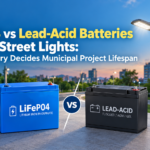
German engineered systems use LiFePO4 (lithium iron phosphate) batteries, which deliver 2,000–3,000 charge cycles and an 8–12 year calendar life, holding stable performance across roughly −20°C to 60°C with minimal capacity loss. Generic units frequently rely on lead acid batteries, which manage only 300–500 cycles and 2–4 years of service, degrading rapidly above 40°C and losing capacity in the cold. Because a street light cycles nightly, that difference translates directly into how many times a crew must return to replace a failed pack.
- LiFePO4 (premium): 2,000–3,000 cycles, 8–12 years, wide temperature tolerance, maintenance free
- Lead acid (generic): 300–500 cycles, 2–4 years, heat sensitive, heavier
- Charge efficiency: LiFePO4 exceeds 90%, capturing more of the panel’s output
- Safety: LiFePO4 offers high thermal stability, important in sealed enclosures
The cost logic is decisive over a project lifetime. A lead acid unit is cheaper on day one but typically forces two or three replacements across ten years, each carrying full mobilization cost on remote sites. A correctly sized LiFePO4 pack often outlasts the entire deployment, which is why it has become the industry standard for serious municipal and commercial projects. For backup autonomy, climate dependent sizing of 3–7 days ensures the light keeps running through extended overcast periods rather than failing on the sixth dark night.
The Charge Controller and LED Luminaire: Intelligence and Output
Two of the most important solar street light components turn stored energy into reliable light: the charge controller and the LED luminaire. The charge controller is the system’s brain, regulating how power flows between panel, battery, and lamp while protecting against overcharge, deep discharge, and short circuits.
The critical choice is between MPPT (Maximum Power Point Tracking) and PWM (Pulse Width Modulation) controllers. MPPT continuously finds the panel’s optimal operating point and converts surplus voltage into extra charging current, harvesting roughly 25–30% more energy than PWM a margin that can reach up to 98% charging efficiency versus around 70–80% for PWM, and which proves decisive in cold or low light conditions. German engineered systems specify MPPT as standard; many generic units fit cheaper PWM to cut cost.
The LED luminaire produces the actual light, and its efficacy lumens per watt (lm/W) governs how much illumination each watt delivers. Quality engineering matters here:
- LED efficacy (premium): 160–180 lm/W, more light per watt drawn
- LED efficacy (generic): 100–120 lm/W, larger battery needed for equal output
- Rated LED life (premium): 50,000 hours, versus 20,000–30,000 hours in practice for generic
- Thermal management: die cast aluminium housing keeps LED junction temperature at or below 85°C in 50°C ambient heat, versus over 100°C in thin or plastic housings
That thermal point is easy to overlook but critical: heat is the primary killer of LED output, so a fixture that runs cool holds its rated life and brightness far longer than one that bakes inside a flimsy housing.
The Pole and Housing: Structural Integrity for the Long Haul
The pole is the most visible yet most underestimated of the solar street light components. It carries the panel, luminaire, and sometimes the battery, and it must withstand wind, corrosion, and decades of weather without bending or rusting through. Material selection should follow the installation environment rather than the lowest quote.
Two materials dominate. Hot dip galvanized steel, dipped in molten zinc at around 449°C, forms a sacrificial zinc layer that corrodes before the steel and delivers excellent strength for tall poles and high wind zones. Aluminium alloy is lighter, naturally forms a self healing protective oxide layer, and resists salt corrosion better, making it the preferred choice for coastal and Middle East sites.
- Hot dip galvanized steel: maximum strength, ideal for high wind and arterial roads; needs intact coating
- Aluminium alloy (e.g. 6063): lightweight, coastal friendly, easier remote installation
- Coastal upgrade: electrophoretic coating extends aluminium corrosion resistance to over five years
- High altitude/high wind: steel wall thickness increased from 3mm to 4mm to resist bending
The economics reward quality: cheap untreated steel poles can rust within two years, while properly hot dip galvanized poles last around eight years or more, making the small upfront premium a clear long term saving. Crucially, wind load capacity must be matched to the site’s maximum recorded wind speed, and foundation depth typically a substantial concrete pedestal sized to the pole’s effective projected area. A pole that topples in a storm takes every other component down with it, so structural specification is not where to economise. To see how the pole height ties back into the rest of the solar street light components, match mounting height to road width and wattage.
Conclusion
Three takeaways should guide any evaluation of solar street light components. First, a solar street light is only as reliable as its weakest part, so each component panel efficiency, battery chemistry, controller type, LED efficacy, and pole material must be specified deliberately rather than inferred from a single wattage number. Second, German engineered choices (21–23% monocrystalline panels, LiFePO4 batteries, MPPT controllers, 160–180 lm/W LEDs, and properly treated poles) consistently outperform generic alternatives where it counts: lifespan, harsh weather resilience, and total cost. Third, the right specification always reflects the site climate, wind, and corrosion exposure should drive battery sizing, pole material, and coatings.
Read the datasheet, match each component to your environment, and you avoid the costly failures that plague under engineered systems. For a component by component specification and a transparent 10 year total cost comparison tailored to your project, visit solar led street light.com for expert consultation or a customised quote.
FAQ
1. Which solar street light component fails most often? The battery is the most common point of failure because it cycles every night and is sensitive to heat. Lead acid units typically fail within 2–4 years, while LiFePO4 batteries last 8–12 years. Choosing the right chemistry and sizing autonomy correctly prevents most field failures.
2. Can I mix components from different manufacturers? It is possible but risky, because solar street light components must be matched the controller’s charge settings must suit the battery chemistry, and the panel must be sized to the LED load and local sunlight. Mismatched parts often cause premature failure or poor performance. A properly engineered, integrated system avoids these compatibility gaps.
3. How do I verify a component’s claimed specifications? Request the actual datasheet and third party test reports rather than relying on marketing figures, especially for IP ratings, battery cycle life, and LED efficacy at operating temperature. Accredited laboratory verification is the standard for bankable projects. Self declared figures should be treated with caution.
4. Is an all in one or split type configuration better for components? All in one units integrate the panel, battery, controller, and LED into one housing for fast installation, while split type systems mount components separately, which can aid heat dissipation and panel angling. The best choice depends on site access, climate, and maintenance preferences. Both can use identical high quality components.
5. Why does the charge controller matter so much if it produces no light? The controller protects the battery and maximises energy harvest, directly affecting both lifespan and nightly runtime. An MPPT controller extracts substantially more energy than PWM, particularly in poor weather. A weak charge controller can shorten battery life and leave the light dark before dawn.
6. What pole material should I choose for a coastal project? Aluminium alloy is generally preferred for coastal sites because it naturally resists salt corrosion, ideally with an electrophoretic coating for extended protection. Galvanized steel can rust in highly corrosive salt laden air over time. Match the material and coating to your site’s specific exposure.
7. How does component quality affect the total cost of ownership? Premium solar street light components cost more upfront but eliminate the replacement cycles that drive generic systems to 2–3× higher cost over ten years. After payback, a well engineered system runs at near zero operational cost. The cheapest invoice rarely produces the cheapest decade.
8. Do solar street lights need much maintenance? With quality components, maintenance is minimal mainly periodic panel cleaning to remove dust that reduces harvest. LiFePO4 batteries are maintenance free, and sealed quality housings keep moisture out. Poor components, by contrast, demand frequent battery swaps and corrosion repairs.
References
- International Electrotechnical Commission. (2025). IEC 61215 & 61730: Photovoltaic module design qualification and safety. https://www.iec.ch
- International Electrotechnical Commission. (2025). IEC 62619: Safety requirements for secondary lithium cells and batteries for industrial applications. https://www.iec.ch
- European Committee for Standardization. (2024). EN 40: Lighting columns specification. https://www.cen.eu
- International Energy Agency. (2025). Access to electricity stagnates, leaving globally 730 million in the dark. https://www.iea.org/commentaries/access-to-electricity-stagnates-leaving-globally-730-million-in-the-dark
- Fortune Business Insights. (2025). Solar Street Lighting Market Size, Share & Industry Report 2032. https://www.fortunebusinessinsights.com/industry-reports/solar-street-lighting-market-100585
- International Electrotechnical Commission. (2025). IEC 60598: Luminaires — General requirements and tests. https://www.iec.ch
- U.S. Department of Energy. (2024). Solar Photovoltaic Technology Basics. https://www.energy.gov/eere/solar/solar-photovoltaic-technology-basics
- American Galvanizers Association. (2024). Hot-Dip Galvanizing for Corrosion Protection. https://galvanizeit.org
Disclaimer
This article is for informational purposes only and does not constitute professional engineering, installation, or procurement advice. Performance specifications and costs may vary based on project requirements, location, and local regulations. Always consult qualified solar energy professionals and legal advisors before making procurement decisions.
For expert consultation on solar LED street lighting solutions, visit solar led street light.com or contact our team for a customised quote.